Category
page 1Desi culture

kite
right|thumb|Various kites being flown

biryani
Biryani is a mixed rice dish originating in South Asia, traditionally made with rice, meat (chicken, goat, beef) or seafood (prawns or fish), vegetables, and spices. It was present in Mughal-era India, though the precise date and place of origin are debated. It is thought to derive from a Persian rice dish, either pilau or birinj biryan. The dish makes use of slow-cooking as in Persian pilau, combined with Persian-style yoghurt-marinated meat and a spicy Indian style of cooking; it was likely developed in the Mughal court kitchens. It is also possible that biryani was brought to South India be

hookah
thumb|A Rajput man smoking through a hookah, [[Rajasthan, India.]]

pakora
Pakora () is a fritter originating from the Indian subcontinent. They are sold by street vendors and served in restaurants across South Asia. They often consist of vegetables such as potatoes and onions, which are coated in seasoned gram flour batter and deep-fried.

bindi
upright|thumb|Hindu woman in Kullu, Himachal Pradesh wearing a stick-on bindi

tandoori chicken
Indian subcontinent chicken dish
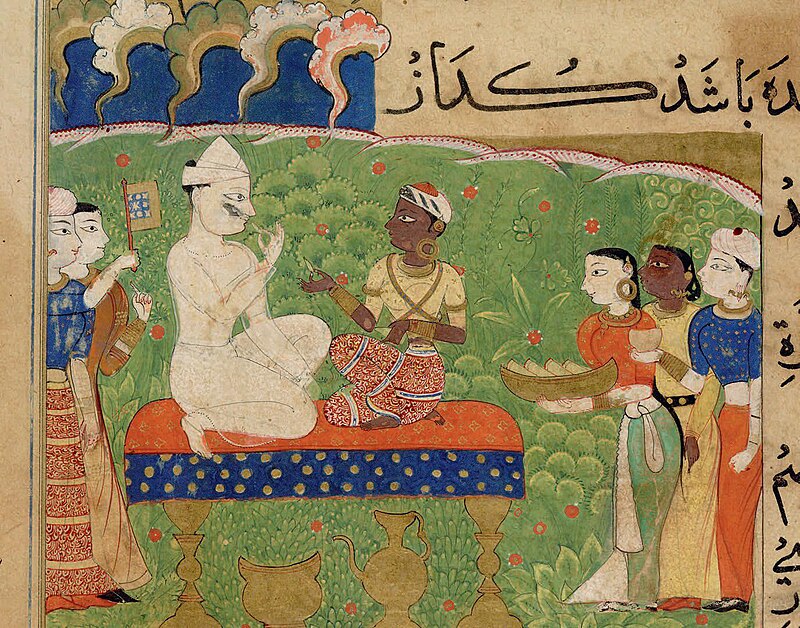
Paan
Hindi word for betel used for a stimulating and psychoactive preparation combined with areca nut and/or cured tobacco

Beedi
right|thumb|Packs of beedies.
thumb|Beedi making process, rare handicrafts in Akkaraipattu, Sri Lanka. Bidi leaf (Bauhinia racemosa) and shredded tobacco are prepared and finalized with thread binding.
A beedi (also spelled bidi or biri) is a thin cigarette or mini-cigar filled with tobacco flake and commonly wrapped in a tendu (Diospyros melanoxylon) or Piliostigma racemosum leaf tied with a string or adhesive at one end. It originates from the Indian subcontinent. The name is derived from the Marwari word beeda—a mixture of betel nuts, herbs, and spices wrapped in a leaf. It is a traditional

bhang
thumb|Photo of bhang drinkers, from the Indian Hemp Drugs Commission report, 1893
thumb|Bhang
thumb|right|Process of making bhang in a village in Punjab, India

desi
Desi ( or or ; Hindustani: देसी , , ), also Deshi (Bengali: দেশী), is a loose term used to describe the peoples, cultures, and products of the Indian subcontinent and their diaspora, derived from Sanskrit (), meaning 'land' or 'country'. Desi traces its origin to the people from the South Asian republics of India, Pakistan, and Bangladesh, and may also sometimes be extended to include peoples, cultures and products of Bhutan, Maldives, Nepal, Afghanistan, and Sri Lanka.
banana leaf
leaf of the banana plant
bhangra
several types of dance originating from the Punjab region

chillum
thumb|right|An Italian-made chillum
thumb|Traditional earthen chillum displayed for sale at Chawk Bazaar Jorhat, [[Assam]]

mushaira
thumb|Depiction of Ghalib at a Mushaira
Mushaira () is a traditional Urdu poetry gathering in which poets publicly recite their work, often engaging in forms of improvisation and competitive performance. Mushairas, also known as mehfil or mushairi, have been a defining institution of Urdu literary culture in North India, Pakistan, and the Deccan, particularly among Hyderabadi Muslims. It is often regarded as a forum for free self-expression.

manjaa
thumb|Traditional Indian charpai. At the near end, the lacing for re-tensioning the bias weave.
thumb|One of many charpai patterns
Charpai (also, kaithu kattil, rope cot, charpaya, charpoy, khat, khatla, manja, or manji) is a traditional woven bed used across South Asia. The name charpai is a compound of char "four" and pay "footed". Regional variations are found in Afghanistan and Pakistan, North and Central India, Bihar and Myanmar.

Kachori
Kachori, kachodi, katchuri, kachuri or kachauri () is a deep-fried, spicy, stuffed pastry or bread originating from the Marwar region of Rajasthan, India. It is made of maida filled with a baked mixture of moong dal or onions (usually, depending on the variation), besan, coriander, red chili powder, salt, and other Indian spices and deep-fried in vegetable oil until crispy golden brown. It is served potato curry and sometimes with hot with sweet and spicy tamarind chutney or occasionally with mint and green chilli chutney.

Gutka
right|thumb|upright=1.1|Gutka street vendor in Himachal Pradesh, India
Bikaneri Bhujia
Indian snack
list of Indian spices
variety of spices grown across the Indian subcontinent
Sarpanch
A sarpanch, gram pradhan, mukhiya or president is a decision-maker, elected by the village-level constitutional body of local self-government called the gram sabha (village government) in India. The sarpanch, together with other elected panchayat members (referred to as ward panch or ward member), constitute gram panchayats and zilla panchayats. The sarpanch is the focal point of contact between government officers and the village community and retains power for five years. The term used to refer to the sarpanch can vary across different states of India. There are many commonly used terms for

Bread pakora
Indian fried snack
%20yang%20dijual%20di%20dataran%20puncak%20Jabal%20Rahmah%2C%20Mekah.jpg)
Attar
thumb|Attar being sold at the top of Mount Arafat|Jabale Rahmah, [[Mecca.]]
Akhni
Akhni () is a mixed rice dish with its origins among the Bengali Muslims of Chittagong and Sylhet, in eastern Bangladesh. It is often considered to be a particular variation of biryani or polao. The dish is especially popular in restaurants throughout Bangladesh, as well as among the diaspora across the world. The dish is a staple in Chittagong, where it is said to be consumed every week by the average Chittagonian person. During Ramadan, the Islamic month of fasting, the dish is popularly eaten at Iftar meals across Sylhet too.

ghevar
Ghevar or ghewar is a disc-shaped Rajasthani sweet with a honeycomb-like texture, made from ghee, maida, and sugar syrup. It is traditionally associated with the month of Shraavana and the festivals of Teej and Raksha Bandhan. It is a part of Rajasthani tradition and is gifted to newly married daughter on Sinjara, the day preceding Gangaur and Teej. It is also one of the Chhapan Bhog (56 dishes) served to the Lord Krishna. Besides Rajasthan, it is also famous in the adjoining states of Haryana, Delhi, Gujarat, Uttar Pradesh, and Madhya Pradesh.
Desi daru
liquor made in rural parts of the Indian subcontinent
Mirchi Bada
dish specially made in jodhpur with filling of potatoes and a chilli
mehfil
thumb|400x400px|A Mehil-e-Mushaira at Hyderabad, in the presence of the courtiers
Mehfil or mahfil (Urdu: محفل), alternatively known as Bazm (Urdu: بزم) is a formal venue where indoor recreational activities such as poetic symposiums (mushaira), singing, music, and dance are entertained in parts of the Indian subcontinent. It is part of Ganga-Jamuni tehzeeb culture.
Sardarji joke
class of joke about Sikhs
Besan barfi
Indian dessert