Category
page 1Developmental biology

old age
consists of ages nearing or surpassing the life expectancy of human beings
embryo
An embryo ( ) is the initial stage of development for a multicellular organism. In organisms that reproduce sexually, embryonic development is the part of the life cycle that begins just after fertilization of the female egg cell by the male sperm cell. The resulting fusion of these two cells produces a single-celled zygote that undergoes many cell divisions that produce cells known as blastomeres. The blastomeres are arranged as a solid ball that when reaching a certain size, called a morula, takes in fluid to create a cavity called a blastocoel. The structure is then termed a blastula, or a
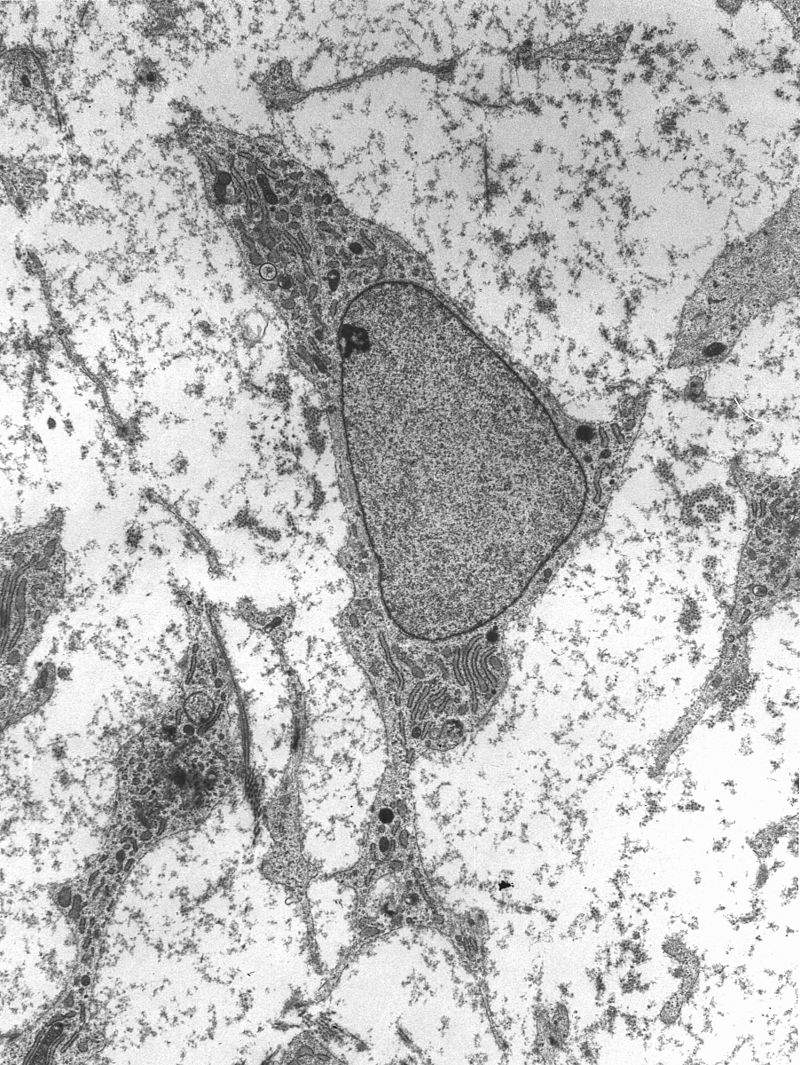
stem cell
undifferentiated biological cells that can differentiate into specialized cells

zygote
A zygote (; , ) is a eukaryotic cell formed by a fertilization event between two gametes.

sexual reproduction
reproduction process that creates a new organism by combining the genetic material of two organisms

monster
thumb|A polemical allegory represented as a five-headed monster, 1618
A monster is a type of imaginary or fictional creature found in literature, folklore, mythology, horror, fantasy, fiction and religion. They are very often depicted as dangerous and aggressive, with a strange or grotesque appearance that causes terror and fear, often in humans. Monsters usually resemble bizarre, deformed, otherworldly and/or mutated animals or entirely unique creatures of varying sizes, but may also take a human form, such as mutants, ghosts, spirits, vampires or zombies, among other things. They may or may

multicellular organism
organism that consists of more than one cell

developmental biology
discipline that explores the processes by which individual organisms grow and develop (ontogeny)

ontogeny
thumb|300px|The initial stages of human embryogenesis
thumb|300px|Parts of a human embryo

regeneration
biological process of renewal, restoration, and growth that makes genomes, cells, organisms, and ecosystems resilient to natural fluctuations

cell differentiation
process in which relatively unspecialized cells acquire specialized features

oogenesis
Oogenesis () or ovogenesis is the differentiation of the ovum (egg cell) into a cell competent to further develop when fertilized. It is developed from the primary oocyte by maturation. Oogenesis is initiated during embryonic development.

mesoderm
The mesoderm is the middle layer of the three germ layers that develops during gastrulation in the very early development of the embryo of most animals. The outer layer is the ectoderm, and the inner layer is the endoderm.
embryogenesis
process by which the embryo is formed and develops

teratology
Teratology is the study of abnormalities of physiological development in organisms during their life span.
It is a sub-discipline in medical genetics which focuses on the classification of congenital abnormalities in dysmorphology caused by teratogens and also in pharmacology and toxicology.

endoderm
Endoderm is the innermost of the three primary germ layers in the very early embryo. The other two layers are the ectoderm (outside layer) and mesoderm (middle layer). Cells migrating inward along the archenteron form the inner layer of the gastrula, which develops into the endoderm.

menarche
Menarche ( ; ) is the first menstrual cycle, or first menstrual bleeding, in female humans. From both social and medical perspectives, it is often considered the central event of female puberty, as it signals the possibility of fertility. Girls experience menarche at different ages, but the most common age is 12. Having menarche occur between the ages of 9–14 in the West is considered normal.
.svg)
gametogenesis
Gametogenesis is a biological process by which diploid or haploid precursor cells undergo cell division and differentiation to form mature haploid gametes. Depending on the biological life cycle of the organism, gametogenesis occurs by meiotic division of diploid gametocytes into various gametes, or by mitosis. For example, plants produce gametes through mitosis in gametophytes. The gametophytes grow from haploid spores after sporic meiosis. The existence of a multicellular, haploid phase in the life cycle between meiosis and gametogenesis is also referred to as alternation of generations.

germ layer
primary layer of cells in embryonic development

morphogenesis
Morphogenesis (from the Greek morphê shape and genesis creation, literally "the generation of form") is the biological process that causes a cell, tissue, or organism to develop its shape. It is one of three fundamental aspects of developmental biology, along with the control of tissue growth and the patterning of cellular differentiation.

neoteny
Neoteny (), also called juvenilization, is the delaying or slowing of the physiological, or somatic, development of an organism, typically an animal. Neoteny in modern humans is more significant than in other primates. In progenesis or paedogenesis, sexual development is accelerated.
somatic cell
any biological cell forming the body of a multicellular organism other than a gamete, germ cell, gametocyte or undifferentiated stem cell

diapause
In animal dormancy, diapause is the delay in development in response to regular and recurring periods of adverse environmental conditions. It is a physiological state with very specific initiating and inhibiting conditions. The mechanism is a means of surviving predictable, unfavorable environmental conditions, such as temperature extremes, drought, or reduced food availability. Diapause is observed in all the life stages of arthropods, especially insects.
cleavage
division of cells in the early embryo
blastomer
In biology, a blastomere is a type of cell produced by cell division (cleavage) of the zygote after fertilization; blastomeres are an essential part of blastula formation, and blastocyst formation in mammals.
evolutionary developmental biology
field of biology
symmetry in biology
geometric symmetry in living beings
body cavity
internal space within a multicellular organism

organogenesis
Organogenesis is the phase of embryonic development that starts at the end of gastrulation and continues until birth. During organogenesis, the three germ layers formed from gastrulation (the ectoderm, endoderm, and mesoderm) form the tissues and internal organs of the organism. thumb|590x590px|The endoderm of [[vertebrates produces tissue within the lungs, thyroid, and pancreas. The mesoderm aids in the production of cardiac muscle, skeletal muscle, smooth muscle, tissues within the kidneys, and red blood cells. The ectoderm produces tissues within the epidermis and aids in the formation of n

pangenesis
thumb|upright=2|Charles Darwin's pangenesis theory postulated that every part of the body emits tiny particles called gemmules which migrate to the [[gonads and are transferred to offspring. Gemmules were thought to develop into their associated body parts as offspring matures. The theory implied that changes to the body during an organism's life would be inherited, as proposed in Lamarckism.]]
3D ultrasound
rendering technique in medical imaging
epigenesis
process by which an organism develops through a sequence of steps in which cells differentiate and organs form

paleobiology
thumb|right|Brachiopods and [[bryozoans in an Ordovician limestone, southern Minnesota]]
Paleobiology (or palaeobiology) is an interdisciplinary field that combines the methods and findings found in both the earth sciences and the life sciences. An investigator in this field is known as a paleobiologist.
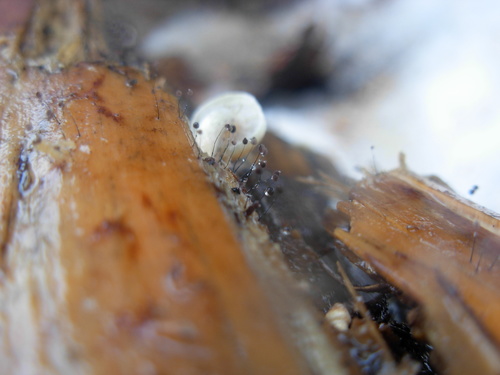
Dictyostelium discoideum
species of slime mould
inner cell mass
mass of cells within the embryo
metamerism
phenomenon of having a linear series of body segments fundamentally similar in structure

heterochrony
thumb|upright=1.3|Giraffes acquired their long necks through heterochrony, extending the development period of the seven neck [[vertebrae's growth in the embryo to add length to the bones, not by adding more bones.]]

deformity
thumb|Chinese people|Chinese circus performer with [[craniosynostosis, 1927]]
thumb|220px|A deformed sucker (cephalopod anatomy)|sucker cluster on an arm of an [[octopus]]
progenitor cell
biological cell that can differentiate into a specific cell type

tissue development
Histogenesis is the formation of different tissues from undifferentiated cells. These cells are constituents of three primary germ layers, the endoderm, mesoderm, and ectoderm. The science of the microscopic structures of the tissues formed within histogenesis is termed histology.
juvenile
individual organism that has not yet reached its adult form, sexual maturity, size
Homeotic gene
genes regulating the development of anatomical structures in various organisms
cell potency
ability of cell differentiation
segmentation
regionalization process that divides an organism or part of an organism into a series of semi-repetitive parts, or segments, often arranged along a longitudinal axis
spermarche
Spermarche, also known as semenarche, is the time at which a male experiences his first ejaculation. It is considered to be the male counterpart of menarche in females. Depending on upbringing, cultural differences, and prior sexual knowledge, males may have different reactions to spermarche, ranging from fear to excitement. Spermarche is one of the first events in the life of a male leading to sexual maturity. It occurs at the time when the secondary sex characteristics are just beginning to develop. Researchers have had difficulty determining the onset of spermarche because it is reliant on

germline
thumb|Cormlets of Watsonia meriana, an example of [[apomixis]]
thumb|Clathria tuberosa, an example of a sponge that can grow indefinitely from somatic tissue and reconstitute itself from totipotent separated somatic cells
In biology and genetics, the germline is the population of a multicellular organism's cells that develop into germ cells. In other words, they are the cells that form gametes (eggs and sperm), which can come together to form a zygote. They differentiate in the gonads from primordial germ cells into gametogonia, which develop into gametocytes, which develop into the final game
Diploblasty
Diploblasty is a condition of the early embryo in which there are two primary germ layers: the ectoderm and endoderm.

germ plasm
thumb|Germplasm bank of the Instituto Nacional de Tecnología Agropecuaria.
Germplasm refers to genetic resources such as seeds, tissues, and DNA sequences that are maintained for the purpose of animal and plant breeding, conservation efforts, agriculture, and other research uses. These resources may take the form of seed collections stored in seed banks, trees growing in nurseries, animal breeding lines maintained in animal breeding programs or gene banks. Germplasm collections can range from collections of wild species to elite, domesticated breeding lines that have undergone extensive human
embryonic diapause
reproductive strategy
Transcription factor, MADS-box, protein family
The MADS box is a conserved sequence motif. The genes which contain this motif are called the MADS-box gene family. The MADS box encodes the DNA-binding MADS domain. The MADS domain binds to DNA sequences of high similarity to the motif CC[A/T]6GG termed the CArG-box. MADS-domain proteins are generally transcription factors. The length of the MADS-box reported by various researchers varies somewhat, but typical lengths are in the range of 168 to 180 base pairs, i.e. the encoded MADS domain has a length of 56 to 60 amino acids. There is evidence that the MADS domain evolved from a sequence stre
Acceleration
human development process
critical period
maturational stage in the lifespan of an organism during which the nervous system is especially sensitive to certain environmental stimuli
pluripotency
ability of certain substances to produce several distinct biological responses
transdifferentiation
Transdifferentiation, also known as lineage reprogramming, is the process in which one mature somatic cell is transformed into another mature somatic cell without undergoing an intermediate pluripotent or progenitor cell stage. It is a type of metaplasia, which includes all cell fate switches, including the interconversion of stem cells. Current uses of transdifferentiation include disease modeling and drug discovery and in the future may include gene therapy and regenerative medicine. The term 'transdifferentiation' was originally coined by Selman and Kafatos in 1974 to describe a change in c

ectogenesis
Ectogenesis (from the Greek ἐκτός, "outside", and genesis) is the growth of an organism in an artificial environment, outside the body in which it would normally be found, such as the growth of an embryo or fetus outside the mother's body, or the growth of bacteria outside the body of a host. The term was coined by British scientist J. B. S. Haldane in 1924.
Precociality and altriciality
classification of birds based on the condition of the young after hatching
canalisation
concept in genetics

Gonadarche
Gonadarche () refers to the earliest gonadal (reproductive gland) changes of puberty. In response to pituitary gonadotropins, the ovaries in females and the testes in males begin to grow and increase the production of the sex steroids, especially estradiol and testosterone. The ovary and testis have receptors, follicle cells and leydig cells, respectively, where gonadotropins bind to stimulate the maturation of the gonads and secretion of estrogen and testosterone. Certain disorders can result in changes to timing or nature of these processes.

theca
thumb|right|Strawberry anther with parallel thecae
In biology, a theca (: thecae) is a sheath or a covering.
invagination
thumb|358x358px|A sheet of cells undergoing invagination
Invagination is the process of a surface folding in on itself to form a cavity, pouch or tube. In developmental biology, invagination of epithelial sheets occurs in many contexts during embryonic development. Invagination is critical for making the primitive gut during gastrulation in many organisms, forming the neural tube in vertebrates, and in the morphogenesis of countless organs and sensory structures. Models of invagination that have been most thoroughly studied include the ventral furrow in Drosophila melanogaster, neural tube for