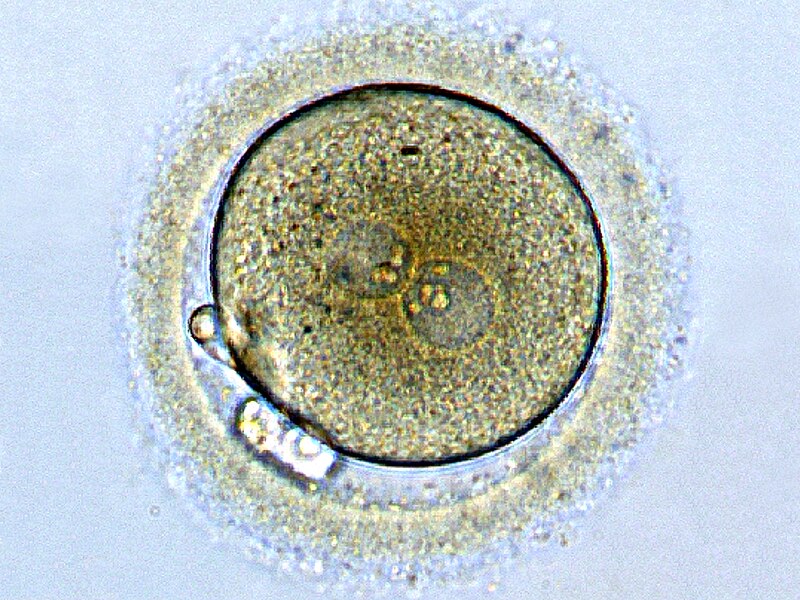
File:Zygote1.jpg · Wikimedia Commons · See Wikimedia Commons
zygote
Sign in to saveA zygote (; , ) is a eukaryotic cell formed by a fertilization event between two gametes.
A zygote is a cell that forms when two sex cells (called gametes) combine during fertilization. It's the starting point for developing a new organism, containing genetic material from both parent cells.
AI-generated from the Wikipedia summary — may contain errors.
Key facts
- Embryology.Name
- Zygote
- Embryology.Image
- Zygote1.jpg
- Embryology.Caption
- Zygote formation: egg cell after fertilization with a sperm. The male and female pronuclei are converging, but the genetic material is not yet united.
- Embryology.Days
- 0
- Embryology.Precursor
- Gametes
- Embryology.GivesRiseTo
- Blastomeres
via Wikipedia infobox
Research
20,199 papers- Plant zygote development: recent insights and applications to clonal seeds.ReviewCurrent opinion in plant biology · 2021Khanday I, Sundaresan VDOI: 10.1016/j.pbi.2020.101993
- OBOX regulates mouse zygotic genome activation and early development.Nature · 2023Ji S, Chen F, Stein P et al.DOI: 10.1038/s41586-023-06428-3
- Chromatin accessibility landscape of mouse early embryos revealed by single-cell NanoATAC-seq2.Science (New York, N.Y.) · 2025Li M, Jiang Z, Xu X et al.DOI: 10.1126/science.adp4319
- Zygote cryobanking applied to CRISPR/Cas9 microinjection in mice.PloS one · 2024Schlapp G, Meikle MN, Pórfido JL et al.DOI: 10.1371/journal.pone.0306617
- Function of atypical mammalian oocyte/zygote nucleoli and its implications for reproductive biology and medicine.ReviewThe International journal of developmental biology · 2019Fulka JJ, Benc M, Loi P et al.DOI: 10.1387/ijdb.180329jf
- Capturing totipotency in human cells through spliceosomal repression.Cell · 2024Li S, Yang M, Shen H et al.DOI: 10.1016/j.cell.2024.05.010
- How can zygotes segregate entire parental genomes into distinct blastomeres? The zygote metaphase revisited.ReviewBioEssays : news and reviews in molecular, cellular and developmental biology · 2017Destouni A, Vermeesch JRDOI: 10.1002/bies.201600226
- Allelic reprogramming of the histone modification H3K4me3 in early mammalian development.Nature · 2016Zhang B, Zheng H, Huang B et al.DOI: 10.1038/nature19361
via PubMed
Wikidata facts
Show 5 more facts
- Commons category
- Zygotes
- fabrication method
- fertilization
- has effect
- cleavage
- manifestation of
- union
- location of creation
- fallopian tube
Sources (7)
via Wikidata · CC0
~4 min read
Encyclopedic overview
8 sectionsContents
- History
- In multicellular organisms
- Humans
- Fungi
- Plants
- In single-celled organisms
- See also
- References
A zygote (; , ) is a eukaryotic cell formed by a fertilization event between two gametes.
The zygote's genome is a combination of the DNA in each gamete, and contains all of the genetic information of a new individual organism.
Excerpted from Wikipedia’s “zygote” article, available under the CC BY-SA 4.0 licence.
Gallery (5)
Available in 83 languages
- Español
- Français
- Deutsch
- 中文
- 日本語
- Русский
- Português
- Italiano
- العربية
- हिन्दी
- Afrikaans
- Albanian
- Albanian
- Aragonese
- Armenian
- Azerbaijani
- Bahasa Indonesia
- Bangla
Show 64 more
- Basque
- be_x_old
- Belarusian
- Bosnian
- Bulgarian
- Catalan
- Croatian
- Czech
- Danish
- Esperanto
- Estonian
- Filipino
- Finnish
- Galician
- Georgian
- Greek
- Haitian Creole
- Hebrew
- Hungarian
- Icelandic
- Ido
- Irish
- Kazakh
- Kurdish
- Kyrgyz
- Latin
- Latvian
- Lingua Franca Nova
- Lithuanian
- Macedonian
- Madurese
- Malay
- Malayalam
- Minangkabau
- Nederlands
- Norwegian
- Norwegian Nynorsk
- Occitan
- Oromo
- Polski
- Romanian
- Serbian
- Serbian (Latin)
- simple
- Sindhi
- Slovak
- Slovenian
- Sundanese
- Svenska
- Tajik
- Tamil
- Telugu
- Tiếng Việt
- Türkçe
- Ukrainian
- Urdu
- Uzbek
- Welsh
- Wu Chinese
- zh_min_nan
- zh_yue
- فارسی
- ไทย
- 한국어
via Wikidata sitelinks · CC0