Category
page 1Dinophyceae
%20(Ifremer%2000689-80077).jpg)
Noctiluca scintillans
Noctiluca is a genus of dinoflagellates in the family Noctilucaceae. Its only species is Noctiluca scintillans, a marine species that can exist in a green or red form, depending on the pigmentation in its vacuoles. It can be found worldwide, but its geographical distribution varies depending on whether it is green or red. This unicellular microorganism is known for its ability to bioluminesce, giving the water a bright blue glow seen at night. However, blooms of this species can be responsible for environmental hazards, such as toxic red tides. They may also be an indicator of anthropogenic eu
Dinophyceae
Dinophyceae is a class of dinoflagellates.

Symbiodinium
Symbiodinium is a genus of dinoflagellates that encompasses the largest and most prevalent group of endosymbiotic dinoflagellates known and have photosymbiotic relationships with many species. These unicellular microalgae commonly reside in the endoderm of tropical cnidarians such as corals, sea anemones, and jellyfish, where the products of their photosynthetic processing are exchanged in the host for inorganic molecules. They are also harbored by various species of demosponges, flatworms, mollusks such as the giant clams, foraminifera (soritids), and some ciliates. Generally, these dinoflage
Noctilucales
The Noctilucales are an order of marine dinoflagellates. They differ from most others in that the mature cell is diploid and its nucleus does not show a dinokaryotic organization. They show gametic meiosis.

Pfiesteria
Pfiesteria is a genus of heterotrophic dinoflagellates that has been associated with harmful algal blooms and fish kills. Pfiesteria complex organisms (PCOs) were claimed to be responsible for large fish kills in the 1980s and 1990s on the coast of North Carolina and in tributaries of the Chesapeake Bay. In reaction to the toxic outbreaks, six states along the US east coast have initiated a monitoring program to allow for rapid response in the case of new outbreaks and to better understand the factors involved in Pfiesteria toxicity and outbreaks. New molecular detection methods have revealed
Peridinium
Peridinium is a genus of motile, marine and freshwater dinoflagellates. Their morphology is considered typical of the armoured dinoflagellates, and their form is commonly used in diagrams of a dinoflagellate's structure. Peridinium can range from 30 to 70 μm in diameter, and has very thick thecal plates.
Prorocentrales
The Prorocentrales are a small order of dinoflagellates. They are distinguished by having their two flagella inserted apically, rather than ventrally as in other groups. One flagellum extends forward and the other circles its base, and there are no flagellar grooves. This arrangement is called desmokont, in contrast to the dinokont arrangement found in other groups. Accordingly, the Prorocentrales may be called desmoflagellates, and in some classifications were treated as a separate class Desmophyceae.
Suessiales
Suessiales is an order of dinoflagellates.

Peridiniales
Peridiniales is an order of dinoflagellates.
Blastodiniales
Blastodiniales is an order of dinoflagellates belonging to the class Dinophyceae.
Oodinium
<!--
2025-04-18: This article has no copyright issues: The article that supposedly had its copyright infringed is based on some version of this article! It clearly says: "Copyright: Wikipedia" after its last paragraph. It also has an image copyrighted by the artist, but that images is not present in this article. Tags removed.
Peridiniaceae
Peridiniaceae is a family of dinoflagellates belonging to the order Peridiniales.
Symbiodiniaceae
Symbiodiniaceae is a family of marine dinoflagellates notable for their symbiotic associations with reef-building corals, sea anemones, jellyfish, marine sponges, giant clams, acoel flatworms, and other marine invertebrates. Symbiotic Symbiodiniaceae are sometimes colloquially referred to as Zooxanthellae, though the latter term can be interpreted to include other families of symbiotic algae as well. While many Symbiodiniaceae species are endosymbionts, others are free living in the water column or sediment.

Ornithocercus
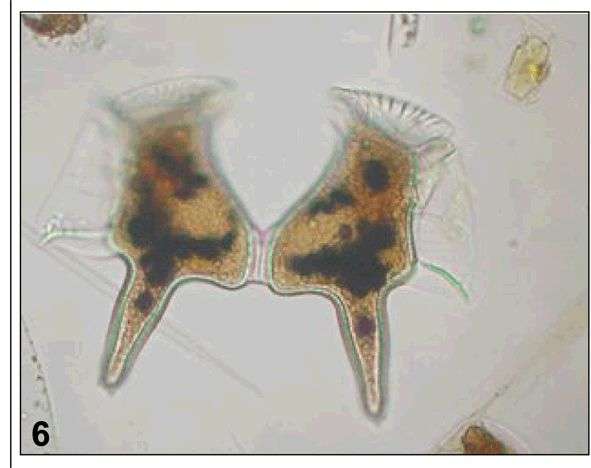
Ornithocercus is a genus of planktonic dinoflagellate that is known for its complex morphology that features considerable lists growing from its thecal plates, giving an attractive appearance. Discovered in 1883, this genus has a small number of species currently categorized but is widespread in tropical and sub-tropical oceans. The genus is marked by exosymbiotic bacteria gardens under its lists, the inter-organismal dynamics of which are a current field of research. As they reside only in warm water, the genus has been used as a proxy for climate change and has potential to be an indicator s

Dinophysis
Dinophysis is a genus of dinoflagellates common in tropical, temperate, coastal and oceanic waters. It was first described in 1839 by Christian Gottfried Ehrenberg.

Glenodinium
Glenodinium is a genus of dinoflagellates with unknown classification.
Heterocapsa
Heterocapsa is a genus of dinoflagellates belonging to the family Heterocapsaceae. It is an unicellular photosynthetic dinoflagellate with thecal plates arranged as Po, cp, 5', 3a, 7'', 6c, 5s, 5, 2' and extracellular, three-dimensional triradiate body scales. The genus is often found in worldwide algal blooms, causing harmful algal blooms (HABs) that devastate the environment or agriculture. Its mixotroph properties grants an advantage to its cosmopolitan distribution, being able to switch to phagotrophy, when light penetration is low.