Category
page 1Domain Name System
top-level domain
domain at the highest level of the DNS hierarchy
Domain Name Server
system to identify resources on a network

domain name
identification string that defines a realm of administrative autonomy, authority or control within the Internet

country code top-level domain
internet top-level domain generally used or reserved for a country

ICANN
thumb|right|ICANN headquarters in the Playa Vista, Los Angeles|Playa Vista neighborhood of Los Angeles.

Stop Online Piracy Act
unpassed United States bill

Verisign
Verisign, Inc. is an American company based in Reston, Virginia, that operates a diverse array of network infrastructure, including two of the Internet's thirteen root nameservers, the authoritative registry for the , , and generic top-level domains and the country-code top-level domains, and the back-end systems for the and sponsored top-level domains.

cybersquatting
Cybersquatting (also known as domain squatting) is the practice of registering, trafficking in, or using an Internet domain name, with a bad faith intent to profit from the goodwill of a trademark belonging to someone else. The term is derived from "squatting", which is the act of occupying an abandoned or unoccupied space or building that the squatter does not own, rent, or otherwise have permission to use.
Domain Name System Security Extensions
suite of IETF specifications for securing certain kinds of information provided by DNS

subdomain
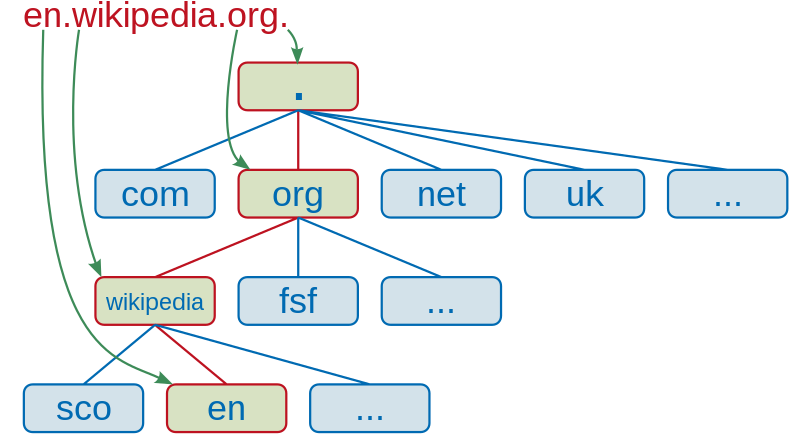
In the Domain Name System (DNS) hierarchy, a subdomain is a domain that is a part of another (main) domain. For example, if a domain offered an online store as part of their website example.com, it might use the subdomain shop.example.com.
directory service
service that maps the names of network resources to their respective network addresses
root name server
name server for the root zone of the Domain Name System of the Internet
Fully qualified domain name
domain name that specifies its exact location in the tree hierarchy of the Domain Name System
domain name registrar
organization or commercial entity that manages the reservation of Internet domain names
hosts file
computer configuration file to map hostnames to IP addresses
Anycast
Anycast is a network addressing and routing methodology in which a single IP address is shared by devices (generally servers) in multiple locations. Routers direct packets addressed to this destination to the location nearest the sender, using their normal decision-making algorithms, typically the lowest number of BGP network hops. Anycast routing is widely used by content delivery networks such as web and name servers, to bring their content closer to end users.
example.com
The domain names example.com, example.net, example.org, and example.edu are second-level domain names in the Domain Name System of the Internet. They are reserved by the Internet Assigned Numbers Authority (IANA) at the direction of the Internet (IETF) as special-use domain names for documentation purposes. The domain names are used widely in books, tutorials, sample network configurations, and generally as examples for the use of domain names. The Internet Corporation for Assigned Names and Numbers (ICANN) operates websites for these domains with content that reflects their purpose.
name server
system for converting computers’ names to their numeric addresses
DNS hijacking
malicious situation created or unwanted manner provided data from a Domain Name Server (DNS)
second-level domain
domain that is directly below a top-level domain
reverse DNS lookup
finding a domain name associated to an IP address
domain hack
a domain that implements an appealing name using elements of the domain name system, such as top-level domain abbreviations
zero-configuration networking
technologies for automatic network connection configuration
DNS over HTTPS
protocol to run DNS queries over HTTPS
dynamic DNS
update method for DNS name servers
domain name registry
database of domain names and associated registrant information
October 2016 Dyn cyberattack
large cyberattack that affected Europe and North America in 2016
Uniform Domain-Name Dispute-Resolution Policy
process for the resolution of disputes regarding the registration of internet domain names
DNS over TLS
protocol to encrypt DNS queries using TLS
DNS spoofing
cyberattack in which corrupt DNS data is introduced into the DNS resolver's cache, causing the name server to return an incorrect result record, e.g. an IP address, diverting traffic to the attacker
Namecoin
Namecoin (Abbreviation: NMC; sign: \mathbb{N}) is a cryptocurrency originally forked from bitcoin software. It uses proof-of-work algorithm. Like bitcoin, it is limited to 21 million coins.
DNS root zone
top level zone in the domain name system
dig
network administration command-line tool
.local
The domain name .local is a special-use domain name reserved by the Internet Engineering Task Force (IETF) so that it may not be installed as a top-level domain in the Domain Name System (DNS) of the Internet. As such it is similar to the other special domain names, such as .localhost. However, .local has since been designated for use in link-local networking, in applications of multicast DNS (mDNS) and zero-configuration networking (zeroconf) so that DNS service may be established without local installations of conventional DNS infrastructure on local area networks.
list of DNS record types
Wikimedia list article
DNS zone
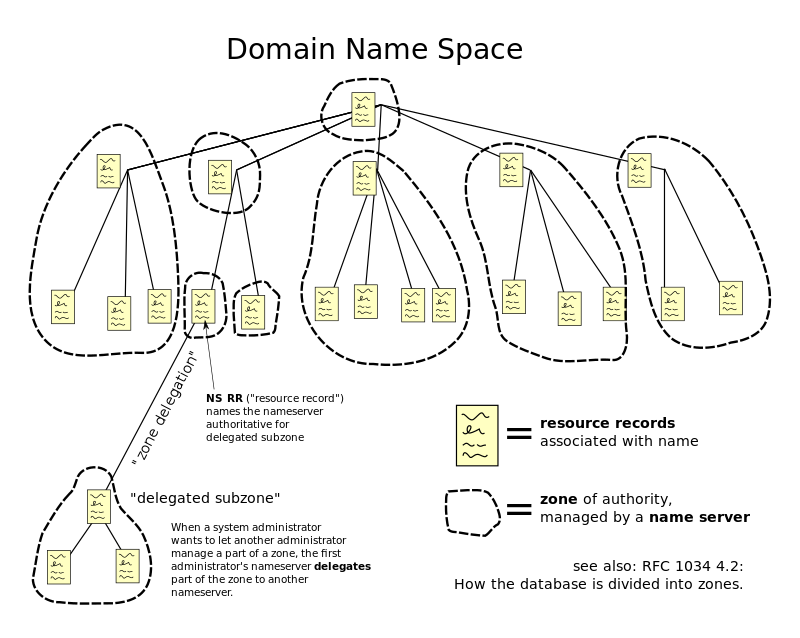
administrable unit of the Domain Name System

Extensible Provisioning Protocol
computer network protocol
Web Proxy Autodiscovery Protocol
Computer protocol
domain parking
reservation of a domain to prevent cybersquatting or for future use
domain name speculation
internet financial sheme
EURid
EURid is the domain name registry that operates the .eu top-level domain and its variants in other scripts – .ею (.eu in Cyrillic) as of 1 June 2016, .ευ (in Greek) – by appointment of the European Commission, with is headquarters in Diegem (Belgium).

DNSCrypt
upright=1.25|thumb|DNSCrypt logo
Round-robin DNS
load balancing technique in the Internet's Domain Name System (DNS)
Name Service Switch
operating system mechanism
DNS zone transfer
type of DNS transaction
DNS Certification Authority Authorization (CAA)
an Internet security policy mechanism
OpenNIC
OpenNIC (also referred to as the OpenNIC Project) is a user-owned and -controlled top-level Network Information Center that offers a non-national alternative to traditional top-level domain (TLD) registries such as ICANN. As of January 2017, OpenNIC recognizes and peers all existing ICANN TLDs, for compatibility reasons. However, OpenNIC has not yet evaluated and does not hold a formal position on future ICANN TLDs.
Fast flux
DNS technique for evading origin server fingerprinting
DNS-based Authentication of Named Entities
Internet security protocol
DNS sinkhole
DNS server that points a domain to bogus internet addresses
Sedo
Sedo (an acronym for Search Engine for Domain Offers and stylised sedo) is a domain name and website marketplace and domain parking provider based in Cambridge, Massachusetts and Cologne, Germany. The company is a subsidiary of United Internet.
public recursive name server
type of name server that is available to the public, that partly gains its answers from others and may modify the reply it then gives
DNS blocking
a restriction on accessing an online resource, enforced through use of Domain Name Server request blocking or filtering

Link-Local Multicast Name Resolution
computer network protocol based on the Domain Name System (DNS) packet format
zone file
text file that describes a DNS zone
emoji domain
internationalized domain name containing Punycoded emoji
Public Suffix List
catalog of Internet domain names under which Internet users can directly register names; maintained by the Mozilla Foundation; used by Firefox
IP address management
methodology implemented in computer software for planning and managing assignment and use of IP addresses and closely related resources of a computer network
domain hijacking
change in the registration of a domain name without permission of the original registrant
Extension mechanism for DNS
specification for Domain Name System