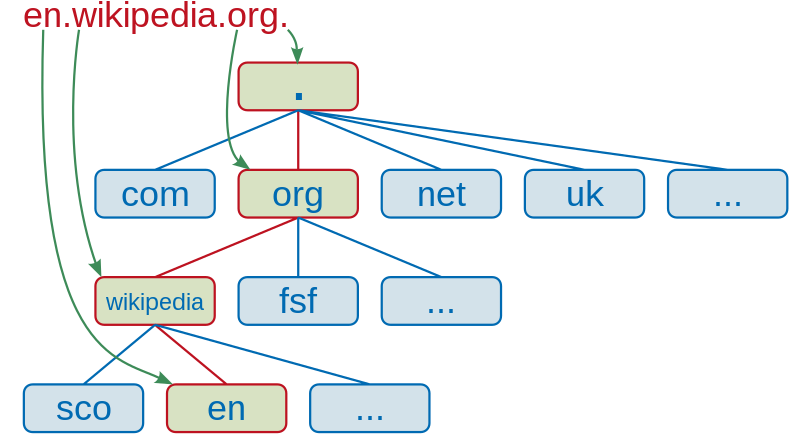
File:DNS_schema.svg · Wikimedia Commons · See Wikimedia Commons
A top-level domain is the final part of a website address that sits at the highest level of the internet's naming system, like the ".com" or ".org" at the end of a web address. It matters because it's the broadest category that organizes all websites and helps route your internet traffic to the correct destination.
AI-generated from the Wikipedia summary — may contain errors.
Wikidata facts
- Instance of
- identifier
- Subclass of
- domain name
- Part of
- Domain Name Server
- Followed by
- second-level domain
- Image
- Aantal treffers GIS op internet zonder extra info.PNG
Show 7 more facts
- different from
- country code top-level domain
- next lower rank
- second-level domain
- Commons category
- Top-level domains
- topic's main category
- Category:Top-level domains
- topic has template
- Template:Generic top-level domains
- dummy value
- .invalid
Sources (2)
via Wikidata · CC0
~17 min read
Encyclopedic overview
A top-level domain (TLD) is one of the domains at the highest level in the hierarchical Domain Name System of the Internet after the root domain. The top-level domain names are installed in the root zone of the name space. For all domains in lower levels, it is the last part of the domain name, that is, the last non-empty label of a fully qualified domain name. For example, in the domain name www.example.com, the top-level domain is .com. Responsibility for management of most top-level domains is delegated to specific organizations by the ICANN, an Internet multi-stakeholder community, which operates the Internet Assigned Numbers Authority (IANA), and is in charge of maintaining the DNS root zone.
History
Excerpted from Wikipedia’s “top-level domain” article, available under the CC BY-SA 4.0 licence.
Available in 106 languages
- Español
- Français
- Deutsch
- 中文
- 日本語
- Русский
- Português
- Italiano
- العربية
- हिन्दी
- Albanian
- Albanian
- Aragonese
- Armenian
- Asturian
- Avaric
- Azerbaijani
- Bahasa Indonesia
Show 87 more
- Bangla
- Basque
- Bavarian
- be_x_old
- Belarusian
- blk
- Bosnian
- Bulgarian
- Burmese
- Catalan
- Central Kurdish
- Chuvash
- Croatian
- Czech
- Egyptian Arabic
- eml
- Esperanto
- Estonian
- Finnish
- fiu_vro
- Galician
- Georgian
- Greek
- Hebrew
- Hungarian
- Icelandic
- Ido
- Interlingua
- Javanese
- Kalmyk
- Karachay-Balkar
- Kazakh
- Khmer
- Kurdish
- Kyrgyz
- Latin
- Latvian
- Limburgish
- Lithuanian
- Lombard
- Low German
- Luxembourgish
- Macedonian
- Malay
- Minangkabau
- Moroccan Arabic
- Nederlands
- Nepali
- Northern Frisian
- Norwegian
- Norwegian Nynorsk
- nrm
- Occitan
- Old English
- Polski
- Romanian
- Saterland Frisian
- Scots
- Serbian
- Serbian (Latin)
- Sicilian
- simple
- Slovak
- Slovenian
- Sranan Tongo
- Sundanese
- Svenska
- Tamil
- Tatar
- Tiếng Việt
- Türkçe
- Ukrainian
- Urdu
- Venetian
- Welsh
- Western Frisian
- Wu Chinese
- Yakut
- Yiddish
- Yoruba
- Zaza
- zh_classical
- zh_min_nan
- zh_yue
- فارسی
- ไทย
- 한국어
via Wikidata sitelinks · CC0