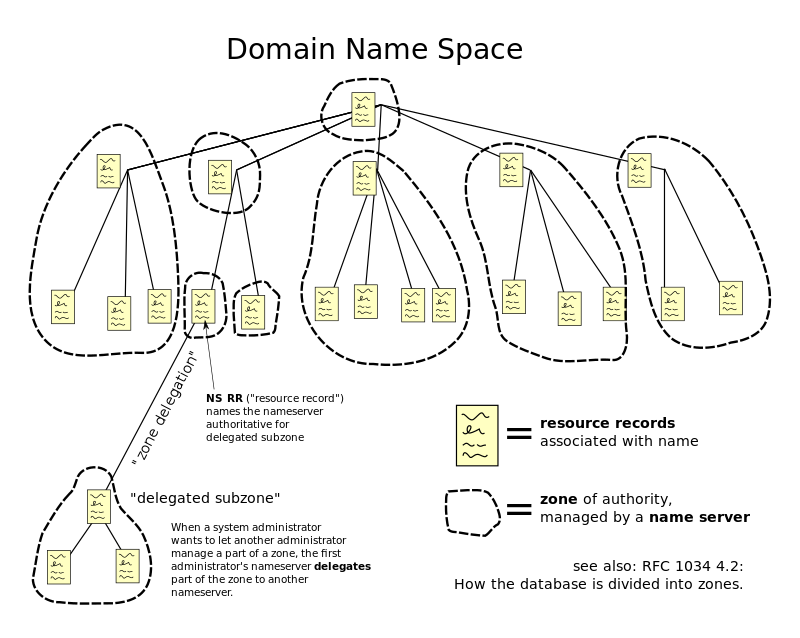
File:Domain_name_space.svg · Wikimedia Commons · See Wikimedia Commons
A Domain Name Server is a system that translates human-friendly website names (like "example.com") into the numerical addresses computers use to find each other on the internet. This matters because it lets you visit websites by typing easy-to-remember names instead of having to memorize long strings of numbers.
AI-generated from the Wikipedia summary — may contain errors.
Wikidata facts
- Instance of
- computer network protocol
- Part of
- World Wide Web
Show 8 more facts
- Commons category
- Domain name system
- port
- 53
- media type
- text/dns
- topic's main category
- Category:Domain Name System
- Stack Exchange tag
- stackoverflow.com/tags/dns
- OSI Model layer location
- application layer
- different from
- DNS
- P13411
- fable
via Wikidata · CC0
~40 min read
Encyclopedic overview
The Domain Name System (DNS) is a hierarchical and distributed name service that provides a naming system for computers, services, and other resources on the Internet or other Internet Protocol (IP) networks. It associates various information with domain names (identification strings) assigned to each of the associated entities. Most prominently, it translates readily memorized domain names to the numerical IP addresses needed for locating and identifying computer services and devices with the underlying network protocols. The Domain Name System has been an essential component of the functionality of the Internet since 1985.
The Domain Name System delegates the responsibility of assigning domain names and mapping those names to Internet resources by designating authoritative name servers for each domain. Network administrators may delegate authority over subdomains of their allocated name space to other name servers. This mechanism provides distributed and fault-tolerant service and was designed to avoid a single large central database. In addition, the DNS specifies the technical functionality of the database service that is at its core. It defines the DNS protocol, a detailed specification of the data structures and data communication exchanges used in the DNS, as part of the Internet protocol suite.
Excerpted from Wikipedia’s “Domain Name Server” article, available under the CC BY-SA 4.0 licence.
Gallery (3)
Available in 81 languages
- Español
- Français
- Deutsch
- 中文
- 日本語
- Русский
- Português
- Italiano
- العربية
- हिन्दी
- Afrikaans
- Albanian
- Armenian
- Asturian
- Azerbaijani
- Bahasa Indonesia
- Bangla
- Basque
Show 62 more
- Bavarian
- be_x_old
- Belarusian
- Bosnian
- Bulgarian
- Catalan
- Central Kurdish
- Croatian
- Czech
- Danish
- eml
- Esperanto
- Estonian
- Finnish
- Galician
- Greek
- Gujarati
- Hebrew
- Hungarian
- Icelandic
- Ido
- Kazakh
- Kyrgyz
- Latgalian
- Latvian
- Limburgish
- Lithuanian
- Lombard
- Macedonian
- Malay
- Malayalam
- Mari
- Mongolian
- Moroccan Arabic
- Nederlands
- Norwegian
- Norwegian Nynorsk
- Occitan
- Polski
- Romanian
- Serbian
- Serbian (Latin)
- simple
- Slovak
- Slovenian
- Svenska
- Tamil
- Telugu
- Tiếng Việt
- Türkçe
- Ukrainian
- Urdu
- Venetian
- Wu Chinese
- Yakut
- Yiddish
- Yoruba
- zh_min_nan
- zh_yue
- فارسی
- ไทย
- 한국어
via Wikidata sitelinks · CC0