Category
page 1Early musical instruments

comb
thumb|A typical plastic comb

harpsichord
thumb|right|300px|This harpsichord is the work of two celebrated makers: originally constructed by Andreas Ruckers in Antwerp (1646), it was later remodeled and expanded by Pascal Taskin in Paris (1780).

Jew's harp
lamellophone instrument

lyre
The lyre () (from Greek λύρα and Latin lyra) is a stringed musical instrument that is classified by Hornbostel–Sachs as a member of the lute family of instruments. In organology, a lyre is considered a yoke lute, since it is a lute in which the strings are attached to a yoke that lies in the same plane as the sound table, and consists of two arms and a crossbar.

cymbal
thumb|Characteristic rock hi-hat pattern.
The cymbals (/ˈsɪm.bəl/ ) are common percussion instruments. Often used in pairs, cymbals consist of thin, normally round plates of various copper alloys. The majority of cymbals are of indefinite pitch, although small disc-shaped cymbals based on ancient designs (such as crotales) sound a definite note. Cymbals are used in many ensembles ranging from the orchestra and percussion ensembles to jazz bands, rock bands, and marching bands. Drum kits usually incorporate at least a crash, a ride, or a crash/ride cymbal and a pair of hi-hat cymbals. A player

oud
The oud ( ; , ) is a Middle Eastern short-neck lute-type, pear-shaped, fretless stringed instrument (a chordophone in the Hornbostel–Sachs classification of instruments), usually with 11 strings grouped in six courses, but some models have five or seven courses, with 10 or 13 strings respectively.

recorder
woodwind musical instrument
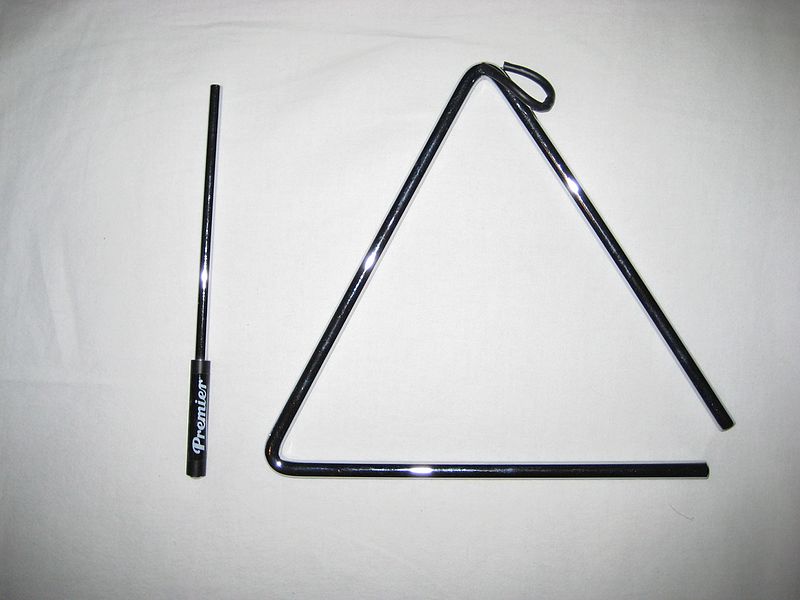
triangle
idiophone type of musical instrument in the percussion family

clavichord
The clavichord is a stringed rectangular keyboard instrument that was used largely in the Late Middle Ages, through the Renaissance, Baroque and Classical eras.
Historically, it was mostly used as a practice instrument and as an aid to composition, not being loud enough for larger performances. The clavichord produces sound by striking brass or iron strings with small metal blades called tangents. Vibrations are transmitted through the bridge(s) to the soundboard.
ocarina
The ocarina (otherwise known as a potato flute) is a wind musical instrument; it is a type of vessel flute. Variations exist, but a typical ocarina is an enclosed space with four to twelve finger holes and a mouthpiece that projects from the body. It is traditionally made from clay or ceramic, but other materials are also used, such as plastic, wood, glass, metal, or bone. The Italian Ocarina was invented in 1853 by 17-year-old Giuseppe Donati, who also gave it the name ocarina. Donati handmade each ocarina from clay, with anything from 7 to 10 finger-holes and a spout for a mouthpiece.

hurdy-gurdy
thumb|Video of a hurdy-gurdy being played

pan flute
simple woodwind musical instrument, formed by tying various lengths of pipe together, now typically made from bamboo

zurna
thumb|260px|Musician playing the zurna.
qanun
Middle-Eastern stringed instrument
serpent
musical instrument

shawm
thumb|Shepherd playing the shawm (1646), by Jan Baptist Wolfaerts|Jan Baptist Wolffort (Dutch [[Rijksmuseum)]]

guqin

spinet
right|thumb|upright=1.5|Spinet built in 1765 by Johann Heinrich Silbermann. Bach House (Eisenach)|Bachhaus, [[Eisenach, Germany. Click for a more detailed view, revealing the use of bookmatched veneering.]]
A spinet is a smaller type of harpsichord or other keyboard instrument, such as a piano or organ.

cornett
The cornett (, ) is a lip-reed wind instrument that dates from the Medieval, Renaissance and Baroque periods, popular from 1500 to 1650. Although smaller and larger sizes were made in both straight and curved forms, surviving cornetts are mostly curved, built in the treble size from in length, usually described as in G. The note sounded with all finger-holes covered is A, which can be lowered a further whole tone to G by slackening the embouchure. The name cornett comes from the Italian cornetto, meaning "small horn".
virginal
thumb|start=56|Virginal from 1668 at St Cecilia's Hall, Edinburgh
The virginals is a keyboard instrument of the harpsichord family. It was popular in Europe during the late Renaissance and early Baroque periods.

Naqareh
The naqareh, naqqāra, nagara or nagada is a Middle Eastern drum with a rounded back and a hide head, usually played in pairs. It is thus a membranophone of the kettle drum variety.

vihuela
The vihuela () is a 15th-century fretted plucked Spanish string instrument, shaped like a guitar (figure-of-eight form offering strength and portability) but tuned like a lute. It was used in 15th- and 16th-century Spain as the equivalent of the lute in Italy and has a large resultant repertory. There were usually five or six doubled strings.

fortepiano
thumb|right|250px|Fortepiano by Paul McNulty (piano maker)|Paul McNulty after Walter & Sohn, 1805
rebec
The rebec (sometimes rebecha, rebeckha, and other spellings, pronounced or ) is a bowed stringed instrument of the Middle Ages and the early Renaissance. In its most common form, it has a narrow boat-shaped body and one to five strings.
cittern
The cittern or cithren (Fr. cistre, It. cetra, Ger. Cister, Sp. cistro, cedra, cítola) is a stringed instrument dating from the Renaissance. Modern scholars debate its exact history, but it is generally accepted that it is descended from the medieval citole (or cytole). Its flat-back design was simpler and cheaper to construct than the lute. It was also easier to play, smaller, less delicate and more portable. Played by people of all social classes, the cittern was a popular instrument of casual music-making much like the guitar is today.
vielle
The is a European bowed stringed instrument used in the medieval period, similar to a modern violin but with a somewhat longer and deeper body, three to five gut strings, and a leaf-shaped pegbox with frontal tuning pegs, sometimes with a figure-8 shaped body. Whatever external form they had, the box-soundchest consisted of back and belly joined by ribs, which experience has shown to be the construction for bowed instruments. The most common shape given to the earliest vielles in France was an oval, which with its modifications remained in favour until the Italian lira da braccio asserted itse

lur
thumb|180px|right|A Bronze Age lur found in Brudevælte Mose, northeast of Lynge in Zealand (Denmark)|Zealand, [[Denmark]]
thumb|180px|right|class=notpageimage |A modern lur from Norway, made of wood wrapped in birch bark
A lur, also lure or lurr, is a long natural horn without finger holes that is played with a brass-type embouchure. Lurs can be straight or curved in various shapes. The purpose of the curves was to make long instruments easier to carry (e.g. for marching, like the modern sousaphone) and to avoid directing the loud noise at nearby people.
chalumeau
The chalumeau (; ; plural chalumeaux) is a single-reed woodwind instrument of the late baroque and early classical eras. The chalumeau is a folk instrument that is the predecessor to the modern-day clarinet. It has a cylindrical bore with eight tone holes (seven in front and one in back for the thumb) and a broad mouthpiece with a single heteroglot reed (i.e. separate, not a continuous part of the instrument's body) made of cane. Similar to the clarinet, the chalumeau overblows a twelfth.

crotales
thumb|327px|Closeup

buccina
thumb|Buccina
thumb|Ludovisi Battle sarcophagus: Detail roman wearing mail, and above him a , a junior officer who communicated signals with the military horn or buccina
A buccina () or bucina (; ), anglicized buccin or bucine, is a brass instrument that was used in the ancient Roman army, similar to the cornu. An aeneator who blew a buccina was called a "buccinator" or "bucinator" ().

ravanahatha
thumb|right|Indian Ravanhatha at the Casa Museo Del Timple, Lanzarote, Spain.
A ravanahatha (variant names: ravanhatta, rawanhattha, ravanastron, ravana hasta veena) is an ancient bowed, stringed instrument, used in India, Sri Lanka, and surrounding areas. It has been suggested as an ancestor of the violin.
olifant
type of horn instrument made from ivory
pipe
simple wooden flute, French tabor pipe

dulcian
thumb|upright|Dulcian, 1700, Museu de la Música de Barcelona
thumb|Dulcians in Theatrum Instrumentorum (Michael Praetorius, 1620)
The dulcian is a Renaissance woodwind instrument, with a double reed and a folded conical bore. Equivalent terms include , , , , , , and .

crwth
See Rotte for the psaltery, or Rotte for the plucked lyre.

crumhorn
thumb|300px|Modern crumhorns with keys, alto crumhorn in F, bass crumhorn in F
thumb|300px|Double-reed of an alto crumhorn in F
The crumhorn is a double reed instrument of the woodwind family, most commonly used during the Renaissance period. In modern times, particularly since the 1960s, there has been a revival of interest in early music, and crumhorns are being played again. It was also spelled krummhorn, krumhorn, krum horn, and cremorne.
portative organ
type of pipe organ

tintinnabulum
thumb|Tintinnabulum in the Basilica of the Holy Blood
dulcimer
The term dulcimer refers to two families of musical string instruments.
fife
musical instrument

Kinnor
Kinnor ( kīnnōr) is an ancient Israelite musical instrument in the yoke lutes family, the first one to be mentioned in the Hebrew Bible.
positive organ
small pipe organ

archlute
The archlute (, , ) is a European plucked string instrument developed around 1600 as a compromise between the very large theorbo, the size and re-entrant tuning of which made for difficulties in the performance of solo music, and the Renaissance tenor lute, which lacked the bass range of the theorbo. Essentially a tenor lute with the theorbo's neck-extension, the archlute lacks the power in the tenor and the bass that the theorbo's large body and typically greater string length provide.
tromba marina
musical instrument

sackbut
thumb|Left to right: replica alto, tenor and bass sackbuts, in Museu de la Música de Barcelona.
thumb|Four sackbuts: two tenors, left & middle; alto, top; bass, right.
A sackbut is an early form of the trombone used during the Renaissance and Baroque eras. A sackbut has the characteristic telescopic slide of a trombone, used to vary the length of the tube to change pitch, but is distinct from later trombones by its smaller, more cylindrically-proportioned bore, and its less-flared bell. Unlike the earlier slide trumpet from which it evolved, the sackbut possesses a U-shaped slide with two pa
regal
small portable organ

lijerica
The lijerica () is a musical instrument from the Croatian region of Dalmatia and Croat parts of eastern Herzegovina. It is a pear-shaped, three-stringed instrument which is played with a bow. It is played to accompany the traditional linđo dance from the region. The lijerica's name comes from the lyra (Greek: λύρα), the bowed instrument of the Byzantine Empire which it probably evolved from.

Lautenwerck
thumb|Lautenwerck
thumb|Lautenwerck
The lautenwerck (also spelled lautenwerk), alternatively called lute-harpsichord (lute-clavier) or keyboard lute, is a European keyboard instrument of the Baroque period. It is similar to a harpsichord, but with gut (sometimes nylon) rather than metal strings (except for the 4-foot register on some instruments), producing a mellow tone.

gittern
The gittern was a relatively small gut-strung, round-backed instrument that first appeared in literature and pictorial representation during the 13th century in Western Europe (Iberian Peninsula, Italy, France, England). It is usually depicted played with a quill plectrum, as can be seen clearly beginning in manuscript illuminations from the thirteenth century. It was also called the ' in Spain, or in France, the in Italy and ' in Germany. A popular instrument with court musicians, minstrels, and amateurs, the gittern is considered an ancestor of the modern guitar and other instruments like th
hammered dulcimer
string instrument played with hammers
Byzantine lyra
string instrument

pommer
thumb|Pommers with reeds
Pommer or bombard (French hautbois; Italian bombardo, bombardone) describes the alto, tenor, bass, and contrabass members of the shawm or Schalmey family. They are similar in function to the modern cor anglais, tenoroon, bassoon, and contrabassoon, although the bassoon family's direct ancestor was the dulcian/curtal family.
lira da braccio
musical instrument

launeddas
The launeddas (also called Sardinian triple clarinet) are a traditional Sardinian woodwind instrument made of three pipes, each of which has an idioglot single reed. They are a polyphonic instrument, with one of the pipes functioning as a drone and the other two playing the melody in thirds and sixths.

citole
The citole was a string musical instrument, closely associated with the medieval fiddles (viol, vielle, gigue) and commonly used from 1200–1350. It was known by other names in various languages: cedra, cetera, cetola, cetula, cistola, citola, citula, citera, chytara, cistole, cithar, cuitole, cythera, cythol, cytiole, cytolys, gytolle, sitole, sytholle, sytole, and zitol.

mandora
File:Mandora MET DP168838.jpg|Mandora (1726)
File:Lute 2, MfM.Uni-Leipzig.jpg|6~9 courses lute (Calchedon, Calichon) (1735)
File:Gallichon, Muzeum Instrumentów Muzycznych w Pradze.jpg|Gallichon
The mandora or gallichon is a type of 18th- and early 19th-century lute, with six to nine courses of strings. The terms were interchangeable, with mandora more commonly used from the mid-18th century onwards.

rackett
thumb|right|300px|Racketts, from Michael Praetorius' [[Syntagma Musicum Theatrum Instrumentorum seu Sciagraphia (1619)]]
.jpg)
svirel
thumb|Different svirel exhibited at the museum of culture and music in Russia
Svirel () is a Slavic woodwind instrument of the end-blown flute type traditionally used in Russia, Belarus, and Ukraine. It is a parallel-bore flute. The six-hole versions are similar to the tin whistle; the ten-hole versions are fully chromatic.
angélique
plucked string instrument of the lute family of the baroque era
Psalterium (instrument)
struck string instrument; zither