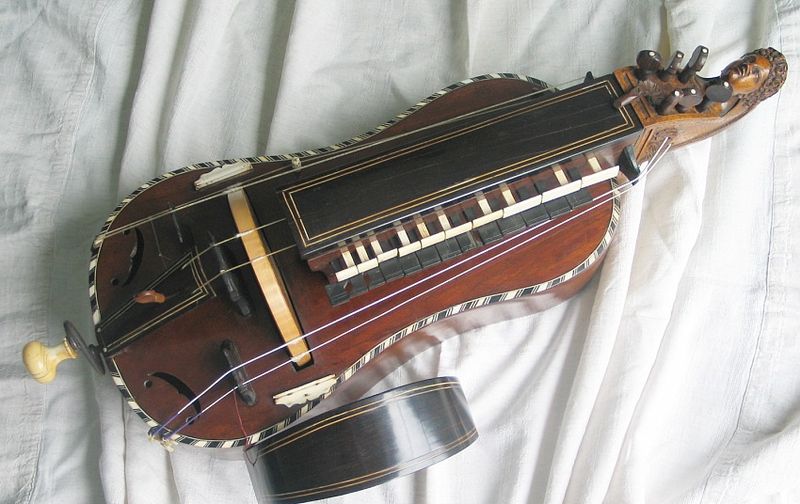
File:Louvet_Drehleier.JPG · Wikimedia Commons · See Wikimedia Commons
hurdy-gurdy
Sign in to saveAlso known as hurdy gurdy, wheel fiddle, wheel vielle, organistrum, vieille, vielle à roue
thumb|Video of a hurdy-gurdy being played
Key facts
- Instrument.names
- Wheel fiddle, wheel vielle, vielle à roue, zanfona, draailier, ghironda
- Instrument.range
- 250px
- Instrument.image
- Louvet Drehleier.JPG
- Instrument.classification
- String instrument (bowed)
- Instrument.hornbostel_sachs
- 321.322-72
- Instrument.hornbostel_sachs_desc
- Composite chordophone sounded by rosined wheel
- Instrument.related
- Drejelire Nyckelharpa Bowed clavier Vielle organisée/Lira organizzata Viola organista
via Wikipedia infobox
Wikidata facts
- Subclass of
- bowed string instrument
- Country of origin
- France
- Image
- Chiesa di San Maurizio - Museo della Musica in Venice - Ghironda 1850 .jpg
Show 6 more facts
- Commons category
- Hurdy-gurdies
- name in kana
- ハーディー・ガーディー
- Hornbostel-Sachs classification
- 321.321-72
- different from
- vielle
- described at URL
- mondes.occitanica.eu/oc/explorar/arts/los-instruments/sonsaina
- indigenous to
- Pau
Sources (6)
via Wikidata · CC0
~28 min read
Encyclopedic overview
15 sectionsContents
- History
- Terminology
- Nomenclature
- Design
- Shape
- Strings
- Buzzing bridge
- Notable hurdy gurdy players
- Regional types
- Electric and electronic versions
- Musicians
- See also
- References
- Further reading
- External links
thumb|Video of a hurdy-gurdy being played
The hurdy-gurdy is a string instrument that produces sound by means of a hand-cranked rosined wheel which rubs against the strings. The wheel functions much like a violin (or nyckelharpa) bow, and single notes played on the instrument sound similar to those of a violin. Melodies are played on a keyboard that presses tangents—small wedges, typically made of wood or metal—against one or more of the strings to change their pitch. Like most other acoustic stringed instruments, it has a sound board and hollow cavity to make the vibration of the strings audible.
Excerpted from Wikipedia’s “hurdy-gurdy” article, available under the CC BY-SA 4.0 licence.