Category
page 1Economic ideologies

communism

capitalism
Capitalism is an economic system based on the private ownership of the means of production and its use for the purpose of obtaining profit. This socioeconomic system has developed historically in several stages, and is defined by a number of constituent elements: private property, profit motive, capital accumulation, competitive markets, commodification, wage labor, and an emphasis on innovation and economic growth. Capitalist economies may experience business cycles of economic expansion followed by recessions.
socialism
Socialism is an economic and political philosophy encompassing diverse economic and social systems characterised by social ownership of the means of production, as opposed to private ownership. It describes the economic, political, and social theories and movements associated with the implementation of such systems. Social ownership can take various forms, including public, community, collective, cooperative, or employee. As one of the main ideologies on the political spectrum, socialism is the standard left-wing ideology in most countries. Types of socialism vary based on the role of markets

Fascism
thumb|upright=1.05|Benito Mussolini, dictator of Italy (left), and [[Adolf Hitler, dictator of Germany (right), were notable fascist leaders.]]

anarchism
Anarchism is a political philosophy and movement that seeks to abolish all institutions that perpetuate authority, coercion, or hierarchy, primarily targeting the state and capitalism. Anarchism advocates for the replacement of the state with stateless societies and voluntary free associations. A historically left-wing movement, anarchism is sometimes described as the libertarian wing of the socialist movement (libertarian socialism).

social democracy
political ideology

libertarianism
Libertarianism (from ; or from ) is a political philosophy that holds freedom, personal sovereignty, and liberty as primary values. Many libertarians believe that the concept of freedom is in accord with the non-aggression principle, according to which each individual has the right to live as they choose, as long as they do not violate the rights of others by initiating force or fraud against them.

market economy
type of economic system

protectionism
upright=1.3|thumb|Pro-free trade poster from the British Liberal Party (UK)|Liberal Party; the "free trade shop" is depicted as having more customers and lower prices, while the "protection shop" has higher prices, a smaller and lower-quality selection of goods, and no customers
upright=1.3|thumb|Anti-free trade postcard from 1910

free market
form of market-based economy

consumerism
thumb|An electronics store displaying CRT TVs in a shopping mall in [[Jakarta, Indonesia (2002)]]

Juche
Juche, officially the '''Juche idea''', is a name of the official ideology of North Korea and its ruling Workers Party of Korea. It is also described as the philosophical principle of Kimilsungism-Kimjongilism.

planned economy
type of economic system
democratic socialism
political ideology
mixed economy
economic system combining public and private production

anarcho-capitalism
thumb|alt=A two-colored flag, split diagonally, with yellow at the top and black at the bottom|The black and gold flag, a symbol of anarchism (black) and capitalism (gold) which, according to Murray Rothbard, was first flown in 1963 in [[Colorado and is also used by the Swedish Anarkokapitalistisk Front.|261x261px]]
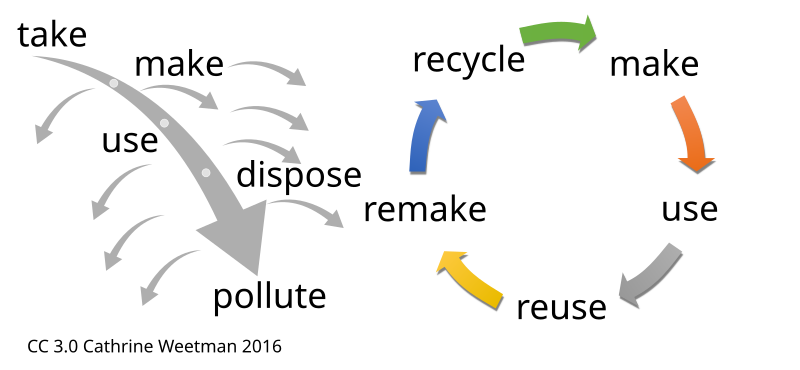
circular economy
regenerative system in which resource input and waste, emissions, and energy leakage, are minimised
.jpg)
anarcho-syndicalism
thumb|upright=1.1|Members of the Anarchism in Spain|Spanish anarcho-syndicalist trade union CNT marching in [[Madrid with their red and black flags, 2010]]

anarcho-communism
political philosophy and school of thought

corporatism
thumb|upright=1.1|Emblems used by medieval German guilds and [[corporations, displaying various symbols related to their professions]]

economic liberalism
political and economic ideology

anti-capitalism
thumb|right|The "Pyramid of Capitalist System" cartoon made by the [[Industrial Workers of the World (1911) is an example of a socialist critique of capitalism and of social stratification.]]

revolutionary syndicalism
thumb|Demonstration by the Argentine syndicalist union FORA in 1915
social market economy
socio-economic model
.svg)
Georgism
thumb|right|Georgist campaign button from the 1890s. The cat on the badge refers to the slogan "Do you see the cat?" from a story by Congressman James G. Maguire. He compared understanding the Single Tax to being able to make out a cat in a picture of a landscape.

libertarian socialism
Anti-authoritarian political philosophy

austerity
In economic policy, austerity is a set of political-economic policies that aim to reduce government budget deficits through spending cuts, tax increases, or a combination of both. There are three primary types of austerity measures: higher taxes to fund spending, raising taxes while cutting spending, and lower taxes and lower government spending. Austerity measures are often used by governments that find it difficult to borrow or meet their existing obligations to pay back loans. The measures are meant to reduce the budget deficit by bringing government revenues closer to expenditures. Propone
%20(51052073462).jpg)
eco-socialism
thumb|300px|Socialist Alternative (Australia)|Socialist Alternative banner at the Global Climate Strike 2021 in [[Melbourne, Australia]]
gross national happiness
philosophy that guides the government of Bhutan
market socialism
economic system aiming to create socialism through supply and demand
autonomism
left-wing political and social movement and theory

distributism
thumb|upright=1.0|Self-portrait of G. K. Chesterton based on the distributist slogan "[[Three acres and a cow"]]
.jpg)
Songun
Songun () is the "military-first" ideology and policy of North Korea, prioritizing the Korean People's Army in the affairs of state and allocation of resources. "Military-first" as a principle guides political and economic life in North Korea, with "military-first politics" dominating the political system; "a line of military-first economic construction" acting as an economic system; and "military-first ideology" serving as the guiding ideology.
economic nationalism
ideology favoring policies that emphasize domestic control of the economy, labor, and capital formation
participatory economics
type of economic system
Islamic economic jurisprudence
handling of economics based on Islamic jurisprudence

corporatocracy
thumb|Protester holding Adbusters' Corporate American flag at the [[Second inauguration of George W. Bush in Washington, D.C.]]
Corporatocracy or corpocracy is an economic, political and judicial system controlled or influenced by business corporations or corporate interests.
.jpg)
Abenomics
thumb|Prime Minister Abe discussing his economic policies in a speech in London, June 2013
state socialism
classification of socialist political or economic ideology

economism
Economism is a direct reduction of any political or cultural phenomena or activities to economics.
revolutionary socialism
political ideology

integralism
thumb|The Labarum of [[Constantine the Great, the first Roman emperor to embrace Christianity]]
Third Position
set of nationalist political ideologies
trickle-down economics
economic theory
national syndicalism
adaptation of syndicalism to suit the social agenda of integral nationalism
socialization
citizen-based control of means of production, allowing for a collectivization of wealth

Folkhemmet
Folkhemmet (, ) is a political concept that played an important role in the history of the Swedish Social Democratic Party and the Swedish welfare state. It is also sometimes used to refer to the long period between 1932 and 1976 when the Social Democrats were in power (except for a brief period in 1936 when Axel Pehrsson-Bramstorp from the Farmers' League was prime minister) and the concept was put into practice, but also works as a poetic name for the Swedish welfare state. Sometimes referred to as "the Swedish Middle Way", folkhemmet was viewed as midway between capitalism and socialism. Th
pink tide
21st century success of left-leaning Latin American leaders
dirigisme
Dirigisme (), or dirigism (), refers to an economic system in which the state takes an active and directive role in shaping and guiding the economy, rather than limiting itself to a purely regulatory or hands-off approach within a market economy. As an economic doctrine, dirigisme stands in contrast to laissez-faire, highlighting the constructive role of market intervention in addressing inefficiencies and market failures. Dirigiste policies typically include indicative planning, state-guided investment, and the strategic use of market instruments such as taxes and subsidies to encourage econo
economic planning
economic planning by a centralized authority
self-ownership
Self-ownership, also known as sovereignty of the individual or individual sovereignty, is the concept of property in one's own person, expressed as the moral or natural right of a person to have bodily integrity and be the exclusive controller of one's own body and life. Self-ownership is a central idea in several political philosophies that emphasize individualism, such as libertarianism, liberalism, and anarchism.
late capitalism
term used by critics of capitalism to describe the current version of the political and economic formation
Orthodox Marxism
body of Marxist thought that emerged following the death of Karl Marx which became the official philosophy of the socialist movement
genuine progress indicator
metric that has been suggested to replace, or supplement, gross domestic product
.jpg)
Workerism
Operaismo (Italian for "workerism") was a heterodox Marxist political and theoretical tendency that emerged in Italy in the early 1960s. Its foundational insight, a "Copernican revolution" in Marxist thought, was to invert the traditional relationship between capital and labour, positing that the struggles of the working class were the primary driving force of capitalist development. Capital, in this view, does not develop along its own internal laws but is forced to restructure and innovate in response to working-class antagonism.
post-materialism
In sociology, postmaterialism is the transformation of individual values from materalist, physical, and economic to new individual values of autonomy and self-expression. The term was popularized by the political scientist Ronald Inglehart in his 1977 book The Silent Revolution, in which he discovered that the formative affluence experienced by the post-war generations was leading some of them to take their material security for granted and instead place greater importance on non-material goals such as self-expression, autonomy, freedom of speech, gender equality, and environmentalism. Ingleha
market fundamentalism
strong belief in the ability of unregulated laissez-faire or free market policies to solve most economic and social problems
socialist-oriented market economy
current economic system in Vietnam
eco-capitalism
Eco-capitalism, also known as environmental capitalism or (sometimes) green capitalism, is the view that capital exists in nature as "natural capital" (ecosystems that have ecological yield) on which all wealth depends. Therefore, governments should use market-based policy-instruments (such as a carbon tax) to resolve environmental problems.
happiness economics
quantitative and theoretical study of happiness, positive and negative affect, well-being, quality of life, life satisfaction and related concepts, typically combining economics with other fields such as psychology, health and sociology