File:Linia_kontraŭ_Cirkulero.svg · Wikimedia Commons · See Wikimedia Commons
circular economy
Sign in to saveregenerative system in which resource input and waste, emissions, and energy leakage, are minimised
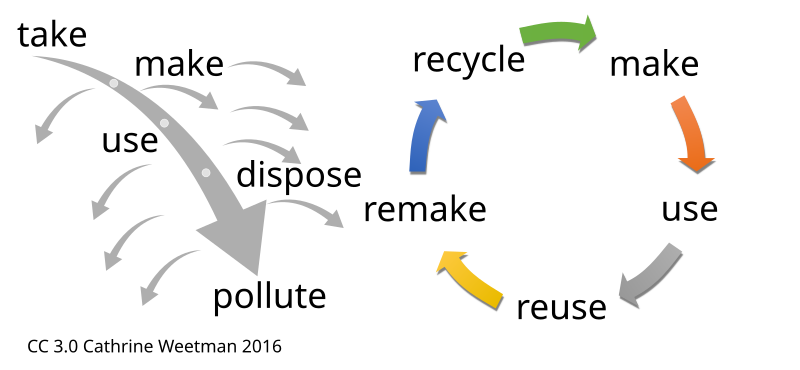
A circular economy is a system designed to minimize waste and resource use by keeping materials in use as long as possible rather than following a traditional "take-make-dispose" model. It matters because reducing the resources we extract, the waste we create, and the energy we consume helps address environmental challenges and can make our economic systems more sustainable.
AI-generated from the Wikipedia summary — may contain errors.
Wikidata facts
- Subclass of
- economic activity
- Image
- Economi Llinol vs Cylchol cy.svg
Show 5 more facts
- Commons category
- Circular economy
- inspired by
- cradle-to-cradle design
- different from
- recycling
- has characteristic
- regeneration
- relates to sustainable development goal, target or indicator
- Sustainable Development Goal 11
via Wikidata · CC0
~40 min read
Encyclopedic overview
Contrast between the wasteful "take, make, dispose" approach of a linear economy, and that of a circular economy
Circular economy (CE), also referred to as circularity, is a model of resource production and consumption that involves sharing, leasing, reusing, repairing, refurbishing, and recycling materials and products, to extend product life cycle for as long as possible. The concept aims to tackle global challenges such as climate change, biodiversity loss, waste, and pollution by emphasizing the design-based implementation of the three base principles of the model. The main three principles required for the transformation to a circular economy are:
Excerpted from Wikipedia’s “circular economy” article, available under the CC BY-SA 4.0 licence.