Category
page 1Edible algae

seaweed
thumb|upright|Ascophyllum nodosum exposed to the sun in [[Nova Scotia, Canada|alt=Photo of seaweed with small swollen areas at the end of each frond]]
thumb|Dead man's fingers (Codium fragile) off the [[Massachusetts coast in the United States|alt=Photo of detached seaweed frond lying on sand]]
right|thumb|The top of a kelp forest in [[Otago, New Zealand|alt=Photo of seaweed with the tip floating at the surface]]
Seaweed, or macroalgae, refers to thousands of species of macroscopic, multicellular, marine algae. The term includes some types of Rhodophyta (red), Phaeophyta (brown) and Chlorophyt

Chlorella
Chlorella is a genus of about thirteen species of single-celled or colonial green algae of the division Chlorophyta. The cells are spherical in shape, about 2 to 10 μm in diameter, and are without flagella. Their chloroplasts contain the green photosynthetic pigments chlorophyll-a and -b. In ideal conditions cells of Chlorella multiply rapidly, requiring only carbon dioxide, water, sunlight, and a small amount of minerals to reproduce.

spirulina
Dry biomass of cyanobacteria belonging to genus Limnospira, used as dietary supplement and food

wakame
Wakame (Undaria pinnatifida) is a species of kelp native to cold, temperate coasts of the northwest Pacific Ocean. As an edible seaweed, it has a subtly sweet, but distinctive and strong flavour and satiny texture. It is most often served in soups and salads.

Ulva
genus of algae

Fucus vesiculosus
species of Phaeophyceae

Chondrus crispus
species of edible alga

Sargassum
Sargassum is a genus of brown macroalgae (seaweed) in the order Fucales of the class Phaeophyceae. This brown macroalgae comes from the Sargasso Sea, which was named because it hosts large amounts of Sargassum. Sargassum can extend for kilometers across the ocean surface, forming golden brown drifting mats that move with the currents and wind; in recent years, Sargassum has been known for arriving in large quantities throughout the Caribbean region. More recently, scientists have found using satellite data that a new hotspot has been forming from western Africa and extends into the Caribbean S

Palmaria palmata
species of edible alga

Laminaria digitata
species of alga

Porphyra
Porphyra is a genus of coldwater seaweeds that grow in cold, shallow seawater. More specifically, it belongs to red algae phylum of laver species (from which comes laverbread), comprising approximately 70 species. It grows in the intertidal zone, typically between the upper intertidal zone and the splash zone in cold waters of temperate oceans. In East Asia, it is used to produce the sea vegetable products nori (in Japan) and gim (in Korea). There are considered to be 60–70 species of Porphyra worldwide and seven around Britain and Ireland, where it has been traditionally used to produce edibl

Saccharina latissima
species of Phaeophyceae, type of kelp

Gracilaria
Gracilaria, also known as Irish moss or ogonori, is a genus of red algae in the family Gracilariaceae. It is notable for its economic importance as an agarophyte meaning that it is used to make agar, as well as its use as a food for humans and various species of shellfish. Various species in the genus are cultivated among Asia, South America, Africa and Oceania. They produce over 90% of the world's agar.
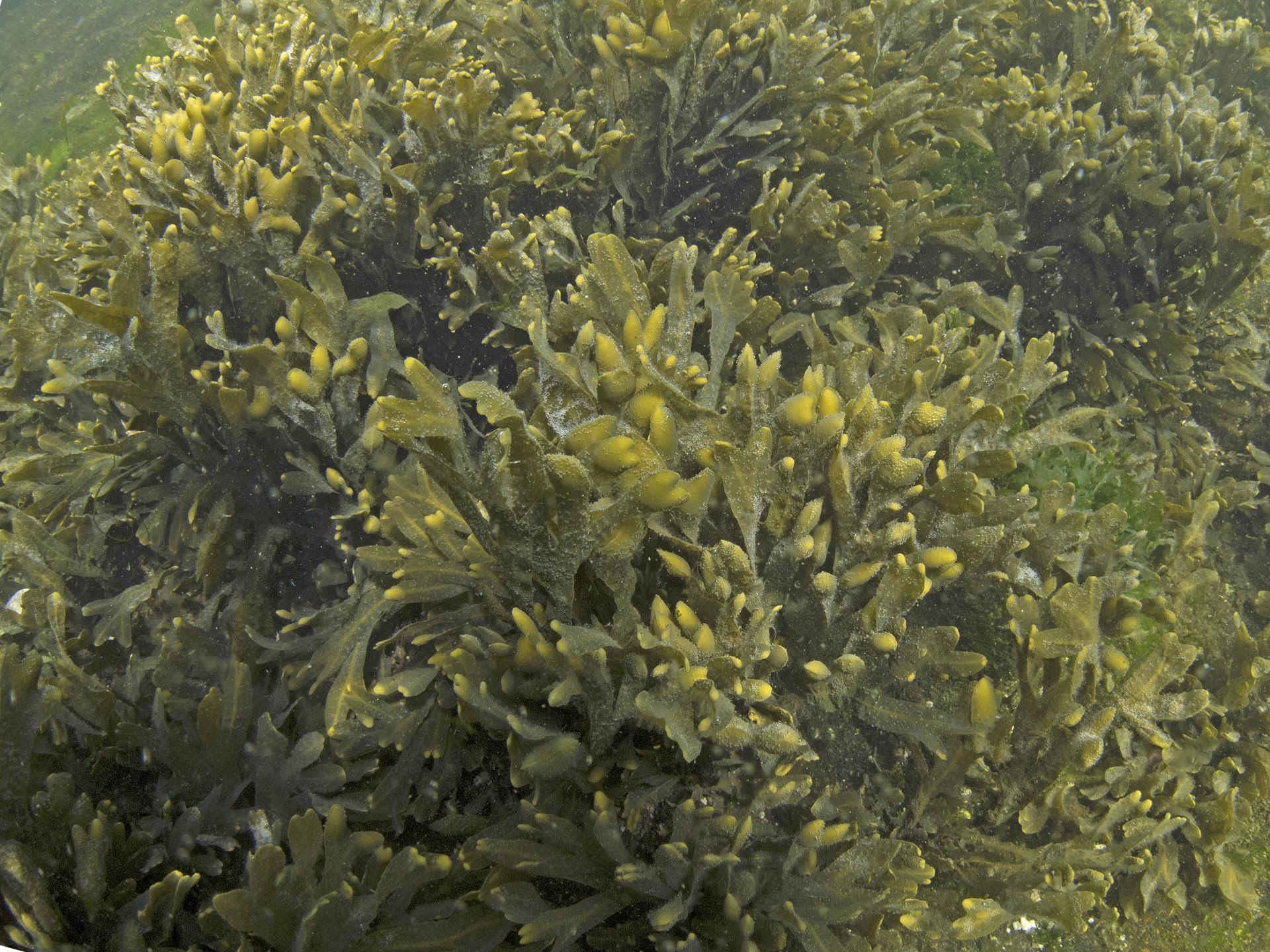
Fucus spiralis
species of Phaeophyceae
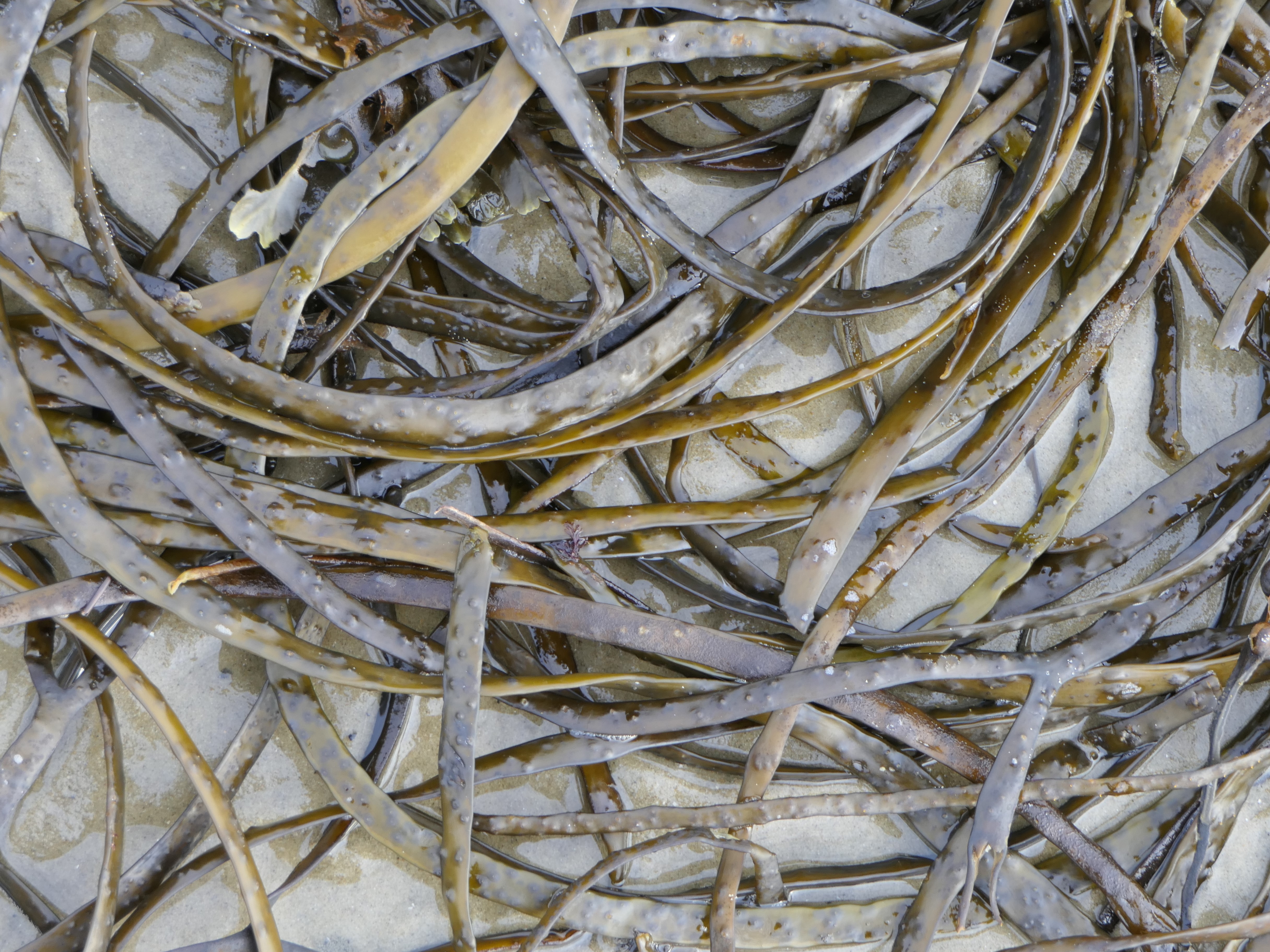
Himanthalia elongata
species of Phaeophyceae
.jpg)
Pyropia
Pyropia is a genus of red algae in the family Bangiaceae. It is found around the world in intertidal zones and shallow water. The genus has folding frond-like blades which are either red, brown or green. Some Pyropia species are used to create nori, and are thus important subjects for aquaculture.

Gelidiaceae
The Gelidiaceae is a small family of red algae containing eight genera. Many species of this algae are used to make agar.
thumb|left|Drying Gelidium amansii to make [[agar ]]

Nereocystis
Nereocystis (Greek, 'mermaid's bladder huki kelp') is a monotypic genus of subtidal kelp containing the species Nereocystis luetkeana. Some English names include edible kelp, bull kelp, bullwhip kelp, ribbon kelp, bladder wrack, and variations of these names. Due to the English name, bull kelp can be confused with southern bull kelps, which are found in the Southern Hemisphere. Nereocystis luetkeana forms thick beds on subtidal rocks, and is an important part of kelp forests.

Eucheuma
Eucheuma, commonly known as sea moss or gusô (), is a rhodophyte seaweed that may vary in color (purple, brown, and green). Eucheuma species are used in the production of carrageenan, an ingredient for cosmetics, food processing, and industrial manufacturing, as well as a food source for people in the Philippines, Caribbean and parts of Indonesia and Malaysia. Eucheuma cottonii – which grows in the Caribbean and cultivated in the Philippines – is the particular species known as gusô. Other species include Betaphycus gelatinae, Eucheuma denticulatum, and several species of the genus Kappaphycus

Chlorella vulgaris
species of alga
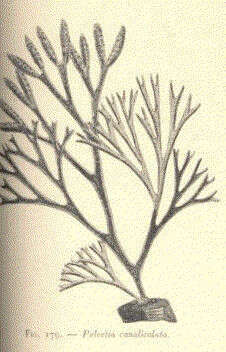
Pelvetia
Pelvetia canaliculata, the channelled wrack, is a very common brown alga (Phaeophyceae) found on the rocks of the upper shores of Europe. It is the only species remaining in the monotypic genus Pelvetia. In 1999, the other members of this genus were reclassified as Silvetia due to differences of oogonium structure and of nucleic acid sequences of the rDNA.

Postelsia palmaeformis
Postelsia palmaeformis, also known as the sea palm (not to be confused with the southern sea palm) or palm seaweed, is a species of kelp and classified within brown algae in the SAR supergroup of eukaryotes. It is the only known species in the genus Postelsia. The sea palm is found along the western coast of North America, on rocky shores with constant waves.

Gracilariaceae
The Gracilariaceae is a small family of red algae, containing several genera of agarophytes.
It has a cosmopolitan distribution, in which 24 species are found in China, six in Great Britain and Ireland, and some in Australia and Chile.

Mastocarpus stellatus
species of alga

Asparagopsis taxiformis
species of alga

Gelidiellaceae
The Gelidiellaceae is a small family of red algae containing 5 genera of agarophytes.
Mozuku
thumb|
Mozuku is a collective term for various types of Japanese brown algae from the family Chordariaceae, which are used as food. These include ito-mozuku (Nemacystus decipiens), Okinawa mozuku (Cladosiphon okamuranus), ishi-mozuku (Sphaerotrichia divaricata) and futo mozuku (Tinocladia crassa). Occasionally the aquatic flowering plant Hydrilla verticillata is referred to as mozuku.
Pterocladiaceae
The Pterocladiaceae is a small family of red algae containing 2 genera of agarophytes.

Callophyllis
Callophyllis is a red algae genus in the family Kallymeniaceae. Several species are exploited as edible seaweeds under the common name carola, most commonly Callophyllis variegata.

Furcellaria
Furcellaria is a genus of red algae. It is a monotypic genus, the only species being Furcellaria lumbricalis, which has commercial importance as a raw material for carrageenan production. It is mainly harvested from the waters of Denmark and Canada.

Caloglossa
Caloglossa is a genus of algae in the Delesseriaceae.