Category
page 1Electromagnetism

plasma
state of matter consisting of ionized gas

electromagnetism
thumb|300x300px|Electromagnetic interactions are responsible for the glowing filaments in this plasma globe.

photon
A photon () is an elementary particle that is a quantum of the electromagnetic field, including electromagnetic radiation such as light and radio waves, and the force carrier for the electromagnetic force. Photons are massless particles that can only move at one speed, the speed of light measured in a vacuum. The photon belongs to the class of boson particles.
electric field
spatial distribution of vectors representing the force applied to a charged test particle
Maxwell's equations
set of partial differential equations that describe how electric and magnetic fields are generated and altered by each other and by charges and currents

Coulomb's law
a physical law that states the electric force between two point charges is proportional to the product of the charges and inversely proportional to the square of the distance between them.
electromagnetic field
physical field produced by electrically charged objects

Gauss's law
foundational law of electromagnetism

Lorentz force
force exerted on a charge in electromagnetic field
classical electromagnetism
branch of theoretical physics that studies consequences of the electromagnetic forces between electric charges and currents

electromagnet
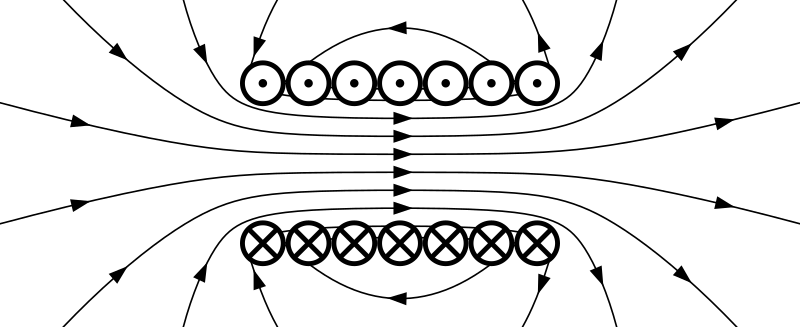
thumb|A simple electromagnet consisting of a coil of wire wrapped around an iron core. A core of ferromagnetic material like iron serves to increase the magnetic field created. The strength of the magnetic field generated is proportional to the amount of current through the winding.
electromotive force
scalar physical quantity homogeneous to a voltage, expressing the modulus of the force exerted on a charge in an electric field
Biot-Savart law
important law of classical magnetism
Ampère's circuital law
relates the integrated magnetic field around a closed loop to the electric current passing through the loop

right-hand rule
common mnemonic for understanding orientation of axes in three-dimensional space

cathode ray
stream of electrons observed in vacuum tubes
skin effect
tendency of alternating current to have the greatest current density near the surface of a conductor
fine-structure constant
physical constant quantifying the strength of the electromagnetic interaction between elementary charged particles

dipole
thumb|Field lines of a point dipole of any type, electric, magnetic, acoustic, etc.
charge conservation
conservation law
permittivity of vacuum
physical constant defining the capability of an electric field to permeate a vacuum
Stokes' theorem
theorem in vector calculus

metamaterial
thumb|upright=1.2|Negative-index metamaterial array configuration, which was constructed of copper [[split-ring resonators and wires mounted on interlocking sheets of fiberglass circuit board. The total array consists of 3×20×20 unit cells with overall dimensions of .]]
Poisson's equation
partial differential equation of elliptic type with broad utility in mechanical engineering and theoretical physics
displacement current
electromagnetism
Fleming's left-hand rule for motors
Used to determine direction of the coil
magnetic circuit
closed loop path containing a magnetic flux
Larmor precession
Physical phenomenon
charge
generalization of electric charge (EM) adding color charge (QCD), mass-energy (gravitation), etc.; sometimes considered same as its charge quantum number

quadrupole
A quadrupole or quadrapole is one of a sequence of configurations of things like electric charge or current, magnetic fields, or gravitational mass that can exist in ideal form, but it is usually just part of a multipole expansion of a more complex structure reflecting various orders of complexity.
Electromagnetic wave equation
partial differential equation used in physics
electromagnetic tensor
mathematical object that describes the electromagnetic field in spacetime
impedance of vacuum
physical constant relating the magnitudes of the electric and magnetic fields of electromagnetic radiation travelling through free space
Clausius–Mossotti relation
expression for the dielectric constant of a material in terms of the atomic polarizability of the material’s constituent atoms/molecules
electromagnetic four-potential
relativistic vector field
surface plasmon resonance
physical phenomenon of electron resonance
field strength
physical quantity
relativistic quantum mechanics
quantum mechanics taking into account particles near or at the speed of light
Larmor formula
formula used to calculate the total power radiated by a non relativistic point charge as it accelerates
Maxwell stress tensor
symmetric second-order tensor
four-current
In special and general relativity, the four-current (technically the four-current density) is the four-dimensional analogue of the current density, with the dimension of electric charge per time per area. Also known as vector current, it is used in the context of four-dimensional spacetime, rather than separating time from three-dimensional space. It is a four-vector and is Lorentz covariant.
magnetic hysteresis
application of an external magnetic field to a ferromagnet
evanescent wave
oscillating electric and/or magnetic field that does not propagate as an electromagnetic wave but whose energy is spatially concentrated in the vicinity of the source
Method of image charges
calculation technique for classical electrostatics
proximity effect
magnetically induced current distortions resulting in increased effective resistance of a conductor
circulation
path integral of the fluid velocity around a closed curve
Lorenz gauge condition
incomplete, Lorentz-invariant gauge condition setting the four-divergence of the electromagnetic four-potential to zero
Jefimenko's equations
solution for electric field and magnetic field due to a distribution of moving electric charges and electric current in space
finite-difference time-domain method
numerical methods for solving partial differential equations
electron optics
electron trajectories in electromagnetic fields
electromagnetic unit

propagation coefficient
complex measure of the attenuation (real part) and phase angle (imaginary part) along the path travelled by a plane wave

covariant formulation of classical electromagnetism
ways of writing the laws of classical electromagnetism in a form that is manifestly invariant under Lorentz transformations, in the formalism of special relativity using rectilinear inertial coordinate systems
electromagnetic clutch
type of clutch

Dielectric heating
heating using radio waves
dielectric loss
measure of a dielectric material's inherent dissipation of electromagnetic energy
Wheeler–Feynman absorber theory
interpretation of electrodynamics
moving magnet and conductor problem
physics thought experiment
Radio atmospheric
broadband electromagnetic impulse
Ewald summation
Computation method named after Paul Peter Ewald