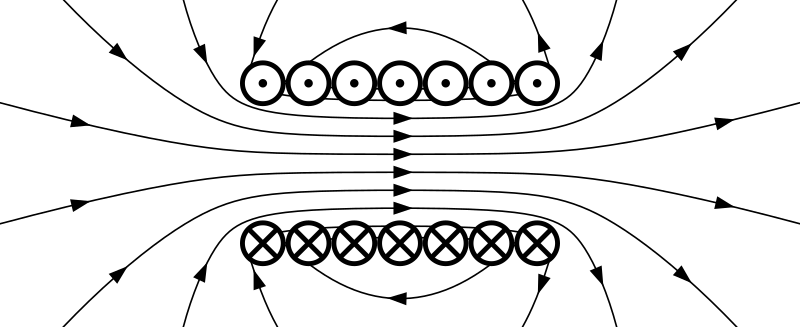
File:VFPt_Solenoid_correct2.svg · Wikimedia Commons · See Wikimedia Commons
electromagnetic field
Sign in to saveAlso known as EM field, EMF, electromagnetic fields
physical field produced by electrically charged objects
An electromagnetic field is a physical field created by electrically charged objects that surrounds them in space. It matters because it's the fundamental force responsible for how charged particles interact with each other and with light, making it essential to understanding everything from electricity and magnetism to how atoms hold together.
AI-generated from the Wikipedia summary — may contain errors.
Research
37,867 papers- Veterinary applications of pulsed electromagnetic field therapy.ReviewResearch in veterinary science · 2018Gaynor JS, Hagberg S, Gurfein BTDOI: 10.1016/j.rvsc.2018.05.005
- Electromagnetic field and cardiovascular diseases: A state-of-the-art review of diagnostic, therapeutic, and predictive values.ReviewFASEB journal : official publication of the Federation of American Societies for Experimental Biology · 2023Wang Y, Zhao ZG, Chai Z et al.DOI: 10.1096/fj.202300201RR
- Electromagnetic field and brain development.ReviewJournal of chemical neuroanatomy · 2016Kaplan S, Deniz OG, Önger ME et al.DOI: 10.1016/j.jchemneu.2015.11.005
- Electromagnetic field therapy in cardiovascular diseases: A review of patents, clinically effective devices, and mechanism of therapeutic effects.ReviewTrends in cardiovascular medicine · 2023Soltani D, Samimi S, Vasheghani-Farahani A et al.DOI: 10.1016/j.tcm.2021.10.006
- The use of the electromagnetic field in microbial process bioengineering.ReviewAdvances in applied microbiology · 2022Jabłońska J, Dubrowska K, Gliźniewicz M et al.DOI: 10.1016/bs.aambs.2022.08.002
- Electromagnetic field exposure as a plausible approach to enhance the proliferation and differentiation of mesenchymal stem cells in clinically relevant scenarios.ReviewJournal of Zhejiang University. Science. B · 2022Hamid HA, Sarmadi VH, Prasad V et al.DOI: 10.1631/jzus.B2100443
- The Impact of the Low Frequency of the Electromagnetic Field on Human.ReviewAdvances in experimental medicine and biology · 2020Diab KADOI: 10.1007/5584_2019_420
- Pulsed Electromagnetic Fields (PEMF)-Physiological Response and Its Potential in Trauma Treatment.ReviewInternational journal of molecular sciences · 2023Flatscher J, Pavez Loriè E, Mittermayr R et al.DOI: 10.3390/ijms241411239
via PubMed
Wikidata facts
- Subclass of
- field
- Has part
- magnetic field
- Image
- Onde electromagnetique.svg
Show 3 more facts
- Commons category
- Electromagnetic field
- on focus list of Wikimedia project
- Wikipedia:Vital articles/Level/4
- manifestation of
- electromagnetic interaction
via Wikidata · CC0
~15 min read
Encyclopedic overview
An electromagnetic field (also EM field) is a physical field, varying in space and time, that represents the electric and magnetic influences generated by and acting upon electric charges. The field at any point in space and time can be regarded as a combination of an electric field and a magnetic field. Because of the interrelationship between the fields, a disturbance in the electric field can create a disturbance in the magnetic field which in turn affects the electric field, leading to an oscillation that propagates through space, known as an electromagnetic wave.
Mathematically, the electromagnetic field is a pair of vector fields consisting of one vector for the electric field and one for the magnetic field at each point in space. The vectors may change over time and space in accordance with Maxwell's equations. The vectors are subject to the rules of special relativity; different observers may determine different vectors.
Excerpted from Wikipedia’s “electromagnetic field” article, available under the CC BY-SA 4.0 licence.
Gallery (4)
Available in 77 languages
- Español
- Français
- Deutsch
- 中文
- 日本語
- Русский
- Português
- Italiano
- العربية
- हिन्दी
- Albanian
- Armenian
- Asturian
- azb
- Azerbaijani
- Bahasa Indonesia
- Bangla
- Basque
Show 58 more
- be_x_old
- Belarusian
- Bosnian
- Bulgarian
- Catalan
- Central Kurdish
- Chuvash
- Croatian
- Czech
- Danish
- Esperanto
- Estonian
- Finnish
- Galician
- Georgian
- Greek
- Hebrew
- Hungarian
- Icelandic
- Ido
- Kazakh
- Kyrgyz
- Latvian
- Limburgish
- Lithuanian
- Macedonian
- Malagasy
- Malay
- Malayalam
- Mongolian
- Neapolitan
- Nederlands
- Norwegian
- Norwegian Nynorsk
- Occitan
- Pashto
- Polski
- Punjabi
- Romanian
- Serbian
- Serbian (Latin)
- Slovak
- Slovenian
- Svenska
- Tamil
- Tiếng Việt
- Toki Pona
- Türkçe
- Ukrainian
- Urdu
- Uzbek
- Wolof
- Wu Chinese
- Zaza
- zh_min_nan
- zh_yue
- فارسی
- 한국어
via Wikidata sitelinks · CC0