Category
page 1Engine technology

engine
thumb|right|225px|An animation showing the four stages of a Four-stroke engine|four-stroke gasoline-fueled internal combustion cycle with electrical ignition source:
thumb|right|450px|Diagram of a jet engine. Jet engines use the [[heat of combustion to generate a high-velocity exhaust as a form of reaction engine. Mechanical energy to power the aircraft's electrical and hydraulic systems can be taken from the turbine shaft, but thrust is produced by expelled exhaust gas.]]

heat engine
system that performs the conversion of heat or thermal energy to mechanical work

piston
thumb|upright|Animation of a piston system
A piston is a component of reciprocating engines, reciprocating pumps, gas compressors, hydraulic cylinders and pneumatic cylinders, among other similar mechanisms. It is the moving component that is contained by a cylinder and is made gas-tight by piston rings. In an engine, its purpose is to transfer force from expanding gas in the cylinder to the crankshaft via a piston rod and/or connecting rod. In a pump, the function is reversed and force is transferred from the crankshaft to the piston for the purpose of compressing or ejecting the fluid in the

crankshaft
thumb|upright=1.2|Crankshaft (red), pistons (gray), cylinders (blue) and flywheel (black)
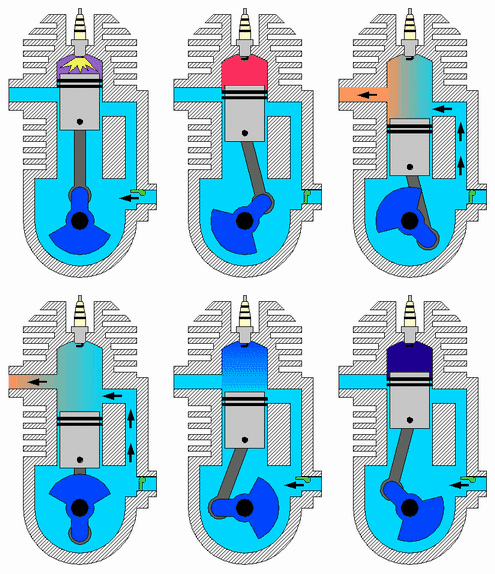
two-stroke engine
internal combustion engine type

connecting rod
mechanical element that connect the piston to the crank or crankshaft
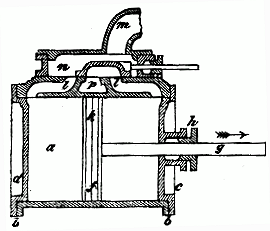
cylinder
central working part of a reciprocating engine or pump, the space in which a piston travels, often equipped with a cylinder liner
reciprocating engine
engine utilising one or more reciprocating pistons

gasket
thumb|Some seals and gaskets
A gasket is a mechanical seal which fills the space between two or more mating surfaces, generally to prevent leakage from or into the joined objects while under compression. It is a deformable material that is used to create a static seal and maintain that seal under various operating conditions in a mechanical assembly.
cylinder head
component of a cylinder of an internal combustion engine
combustion chamber
reaction chamber within a combustion engine
compression ratio
Ratio of the volume of a combustion chamber from its largest capacity to its smallest capacity
cylinder block
part of an internal combustion engine
engine displacement
measure of the cylinder volume swept by all of the pistons of a piston engine
babbitt
alloys used for the bearing surface in a plain bearing
specific impulse
how efficiently a reaction mass engine creates thrust, which is often proportional to effective exhaust gas velocity
Exhaust gas recirculation
NOx reduction technique used in gasoline and diesel engines
.jpg)
crankcase
thumb| De Dion-Bouton engine (circa 1905) with a crankcase formed from separate castings of the upper and lower halves

intercooler
thumb|right|Front-mounted air-to-air intercooler
thumb|Top-mounted air-to-liquid intercooler (the silver cuboid-shaped part) on a BMW S55 turbocharged engine
electronic control unit
control or regulate other devices

throttle
A throttle is a mechanism by which fluid flow is managed by construction or obstruction.

supercharger
thumb|right|upright=1.2|A supercharger (item 6) on a piston engine
thumb|right|upright=1.2|Roots-type Eaton Corporation|Eaton M62 supercharger (right) on a 2006 Saturn (GM) Ion Redline Ecotec LSJ [[4-cylinder engine]]
reaction engine
engine that produces thrust by expelling reaction mass
rotary engine
internal combustion engine with cylinders rotating around a stationary crankshaft
piston ring
split ring that fits into a groove on the outer diameter of a piston in a reciprocating engine
dead centre
stalling position of moving parts
engine control unit
device for controlling functions of an internal combustion engine
naturally aspirated engine
internal combustion engine that relies on atmospheric pressure for air intake without a supercharger or turbocharger

FADEC
In aviation, a full authority digital engine (or electronics) control (FADEC) () is a system consisting of a digital computer, called an "electronic engine controller" (EEC) or "engine control unit" (ECU), and its related accessories that control all aspects of aircraft engine performance. FADECs have been produced for both piston engines and jet engines.
stroke
reciprocating motion, used in reciprocating engines and other mechanisms
antiknock agent
agent used to increase a fuel's octane rating
transverse engine
internal combustion engine in which the crankshaft is oriented transverse to the long axis of the vehicle (i.e. sideways)
flathead engine
a type of four-stroke engine
bore
measurement of diameter of a cylinder through which a piston travels
longitudinal engine
internal combustion engine in which the crankshaft is oriented along the long axis of the vehicl (i.e. front to back)
exhaust manifold
structure collecting an engine's exhaust outlets
head gasket
gasket that sits between the engine block and cylinder head(s) in an internal combustion engine
crankcase ventilation system
system to relieve pressure in a combustion engine's crankcase
Scotch yoke
Mechanism to convert between rotational and reciprocating motion

crosshead
right|thumbnail|A crosshead as part of a reciprocating piston and slider-crank linkage mechanism.
thumb|Cylindrical trunk guide
thumb|Hudswell Clarke Nunlow; crosshead and two slide bars
six-stroke engine
Internal combustion engine designs
nitrous oxide engine
automotive accessory equipment
gudgeon pin
pin that holds connecting rod to piston head
wood gas generator
device for producing combustible gas from timber or charcoal
automotive engine
car and truck technology
Hybrid Synergy Drive
hybrid car drive train manufactured by Toyota Motor Corporation
balance shaft
weights used to balance otherwise unbalanced engine movement
oil pump
internal combustion engine
plasma propulsion engine
electric propulsion method for spacecraft
Inlet manifold
automotive technology
AUTOSAR
AUTOSAR (AUTomotive Open System ARchitecture) is a global development partnership founded in 2003 by automotive manufacturers, suppliers and other companies from the electronics, semiconductor and software industries. Its purpose is to develop and establish an open and standardized software architecture for automotive electronic control units (ECUs).
pistonless rotary engine
internal combustion engine
stationary engine
engine type
dry sump
a method of internal combustion engine lubrication with oil held in a separate reservoir
IOE engine
type of combustion engines
water injection
type of injection

free-piston engine
type of engine with no crank
restrictor plate
device installed at the intake of an engine to limit its power
volumetric efficiency
ratio of the mass density of a mixture drawn into a cylinder at atmospheric pressure to the mass density of the same volume of air in the intake manifold
axial engine
type of reciprocating engine