Category
page 1European folklore characters
Cinderella
Cinderella, or The Little Glass Slipper, is a French fairy tale with thousands of variants that are told throughout the world. The protagonist is a young girl living in unfortunate circumstances who is suddenly blessed with remarkable fortune, ultimately ascending to the throne through marriage. The earliest known version of the Cinderella story is usually considered to be the Greek story of Rhodopis, as described by the scholar Strabo sometime between 7BC and AD23, about a Greek slave girl who marries the king of Egypt.

Snow White
fairy tale version published by the Brothers Grimm

Little Red Riding Hood
European fairy tale (ATU 333)

Sleeping Beauty
classic fairytale (ATU 410)

Hansel and Gretel
fairy tale collected by the Brothers Grimm

Pinocchio
Pinocchio ( , ) is a fictional character and the protagonist of the children's novel The Adventures of Pinocchio (1881) by Italian writer Carlo Collodi of Florence, Tuscany. Pinocchio was carved by a poor man named Geppetto in a Tuscan village. He is created as a wooden puppet, but he dreams of becoming a real boy. He is known for his long nose, which grows when he lies.
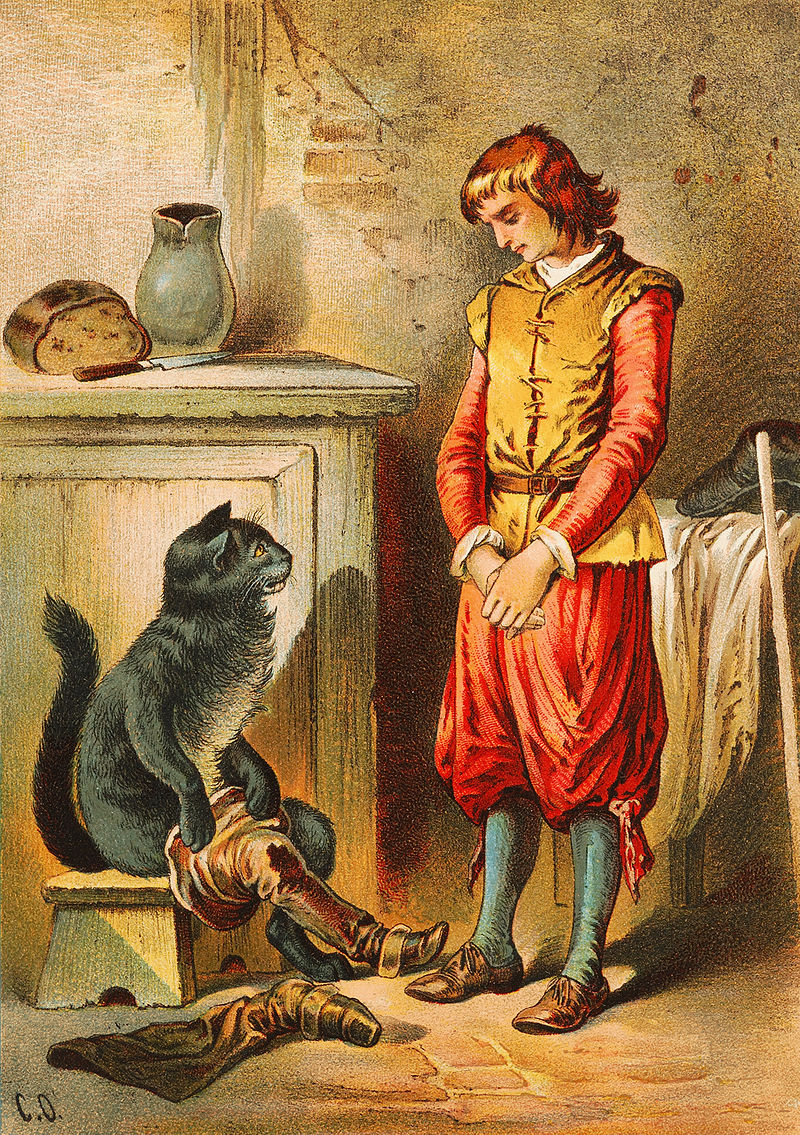
Puss in Boots
fairy tale with multiple variants (ATU 545B)

Till Eulenspiegel
fictional character from German folklore

Krampus
thumb|upright|1900s illustration of Saint Nicholas and Krampus visiting a child
The Krampus () is a horned anthropomorphic figure who, in the Central and Eastern Alpine folkloric tradition, is said to accompany Saint Nicholas on visits to children during the night of 5 December (Krampusnacht; "Krampus Night"), immediately before the Feast of St. Nicholas on 6 December. In this tradition, Saint Nicholas rewards well-behaved children with small gifts, while Krampus punishes badly behaved ones with birch rods.

The Frog Prince
fairy tale collected by the Brothers Grimm
Tooth fairy
European early childhood legendary figure, who visits children while they sleep, collects lost baby teeth, and recompenses with a small payment

shield-maiden
thumb|350px|right|Hervor dying after the Hlǫðskviða by [[Peter Nicolai Arbo]]
Abundantia
In ancient Roman religion, Abundantia (), also called Copia, was a divine personification of abundance and prosperity; abundantia means "abundance" in Latin. She helped protect savings and investments, and assisted with major purchases. She was among the embodiments of virtues in religious propaganda that cast the emperor as the ensurer of "Golden Age" conditions. Abundantia thus figures in art, cult, and literature, but has little mythology as such. She may have survived in some form in Roman Gaul and medieval France. Abundantia is depicted carrying a cornucopia filled with grain and coins, a

Sandman
The Sandman is a mythical character originating in Germanic and Scandinavian folklore. He visits children in the evening, sprinkles sleep-inducing sand into their eyes and brings dreams. In the morning, the sleep sand is rubbed from the corner of the eyes.

The Goose Girl
fairy tale by the Brothers Grimm
Dull Gret
painting by Pieter Bruegel the Elder
Big Bad Wolf
fairy tale character
.jpg)
Juha
thumb|Juha with his donkey
Giufà, or Giucà as he is referred to in some areas, is a character of Sicilian folklore. His antics have been retold and memorized through centuries of oral tradition. Although the anecdotes from his life mainly revolve around the southern Italian and Sicilian lifestyle, his character traits are visible in the folk characters of many Mediterranean cultures. In fact, scholars suggest that the character Giufà developed from stories of Nasrudin, a Turkish folk character. It is believed that during Islamic rule of the island of Sicily, stories of this manknown in Arabic
Pan Twardowski
fictional character

hag
thumb|1920 Arthur Rackham illustration for the Irish fairytale The Hag of the Mill. "Now the Hag of the Mill was a bony, thin pole of a hag with odd feet."
Martin Krpan
protagonist of the Slovene tale Martin Krpan z Vrha (F. Levstik, 1858); Slovene folk hero
Hershel of Ostropol
Jewish prankster (1757–1811)
Păcală
Păcală (Romanian, from a păcăli, "to dupe"; Romanian Cyrillic: Пъкалъ; sometimes rendered Pâcală or Pîcală) is a fictional character in Romanian folklore, literature and humor. Primarily associated with Transylvania and Oltenia, he is depicted as a native of Vaideeni, located in an area of contact between those two regions. An irreverent young man, seemingly a peasant, he reserves contempt and irony for the village authorities (whether Orthodox priest, boyar or judge), but often plays the fool, or displays an erratic and criminal behavior that scholars attribute to the eclecticism of sources w
Mattie the Goose-boy
Hungarian epic poem by Mihály Fazekas (1815)
crone
thumb|Archetypical appearance of a crone.Old Woman Seen from Behind,by Vincent van Gogh.
In folklore, a crone is an old woman who may be characterized as disagreeable, malicious, or sinister in manner, often with magical or supernatural associations that can make her either helpful or obsolete. As a concept, 'The Crone' is also often associated with the Jungian archetype of the Wise Woman or, if accompanied by 'The Maiden' and 'The Mother', as a member of the Triple Goddess deity archetype. As a character type, the crone shares characteristics with the hag.
Lord Reay
title in the Peerage of Scotland
loathly lady
motif in folklore and stock character; woman who appears to be hideous, often cursed