Category
page 1Extant Albian first appearances

Formicidae
thumb|Bright red ant, likely part of the Formica pallidefulva species group, on a flower

Poaceae
Poaceae ( ), also called Gramineae ( ), is a large and nearly ubiquitous family of monocotyledonous flowering plants commonly known as true grasses. It includes the cereal grasses, bamboos, the grasses of natural grassland and species cultivated in lawns and pasture. Poaceae is the most well-known family within the informal group known as grass.

sea turtle
superfamily of shelled marine reptiles

Vanilla
genus of plants
-%20water%20drops%20W%20IMG%208657.jpg)
Nelumbo
Nelumbo is a genus of aquatic plants with large, showy flowers. Members are commonly called lotus, though the name is also applied to various other plants and plant groups, including the unrelated genus Lotus. Members outwardly resemble those in the family Nymphaeaceae ("water lilies"), but Nelumbo is actually very distant from that family.

Cucurbitales
The Cucurbitales are an order of flowering plants, included in the rosid group of dicotyledons. This order mostly belongs to tropical areas, with limited presence in subtropical and temperate regions. The order includes shrubs and trees, together with many herbs and climbers. One major characteristic of the Cucurbitales is the presence of unisexual flowers, mostly pentacyclic, with thick pointed petals (whenever present). The pollination is usually performed by insects, but wind pollination is also present (in Coriariaceae and Datiscaceae).

Palinuridae
family of crustaceans

Carcharhiniformes
thumb|253px|Ground sharks, like this blacknose shark, have a [[nictitating membrane which can be drawn over the eye to protect it.]]

Chelidae
Chelidae is one of three living families of the turtle suborder Pleurodira, and are commonly called Austro-South American side-neck turtles. The family is distributed in Australia, New Guinea, parts of Indonesia, and throughout most of South America. It is a large family of turtles with a significant fossil history dating back to the Cretaceous. The family is entirely Gondwanan in origin, with no members found outside Gondwana, either in the present day or as a fossil.

Homarus
Homarus is a genus of lobsters, which include the common and commercially significant species Homarus americanus (the American lobster) and Homarus gammarus (the European lobster). The Cape lobster, which was formerly in this genus as H. capensis, was moved in 1995 to the new genus Homarinus.

Parastacidae
The Parastacidae are the family of freshwater crayfish found in the Southern Hemisphere. The family is a classic Gondwana-distributed taxon, with extant members in South America, Madagascar, Australia, New Zealand, and New Guinea, and extinct taxa also in Antarctica.

Parascylliidae
Parascylliidae, or the collared carpet sharks, is a family of sharks in the order Orectolobiformes, which are only found in shallow waters of the western Pacific. The family Parascylliidae contains two genera, Cirrhoscyllium and Parascyllium. They are relatively small sharks, with the largest species reaching no more than 91.0 cm in adult length. They have elongated, slender bodies, cat-like eyes, and barbels behind their chins. They feed on small fish and invertebrates.
left|thumb|Fossil specimen of Pararhincodon from [[Lebanon]]
The oldest known member of the group is the stem group-parascyl

Palinurus
genus of crustaceans

Scyliorhinus
Scyliorhinus is a genus of catsharks in the family Scyliorhinidae. This genus is known in the fossil records from the Cretaceous period, late Albian age to the Pliocene epoch.

Lepisosteus
Lepisosteus (from Greek lepis (), 'scale' and osteon (), 'bone') is a genus of gars in the family Lepisosteidae. It contains four extant species, found throughout eastern and central North America. It is one of two extant gar genera alongside Atractosteus.
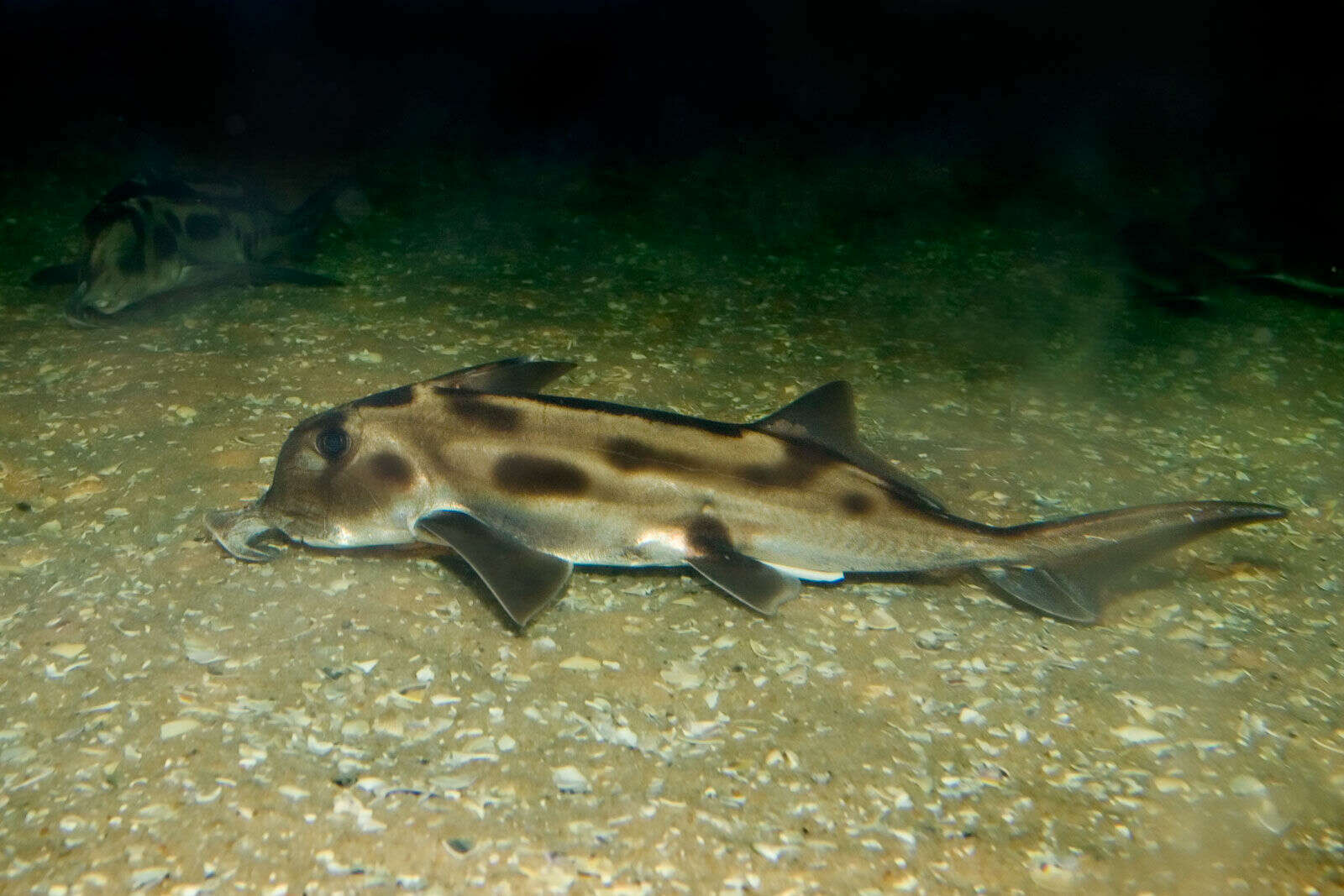
Callorhinchus
Callorhinchus, the plough-nosed chimaeras or elephantfish, are the only living genus in the family Callorhinchidae (sometimes spelled Callorhynchidae). A few extinct genera only known from fossil remains are recognized. Callorhinchus spp. are similar in form and habits to other chimaeras, but are distinguished by the presence of an elongated, flexible, fleshy snout, with a vague resemblance to a ploughshare. They are only found in the oceans of the Southern Hemisphere along the ocean bottom on muddy and sandy substrates. They filter feed, with small shellfish making up the bulk of their diet.

Raninidae
Raninidae is a family of unusual crabs, sometimes known as "frog crabs", on account of their frog-like appearance. They are taken by most scientists to be quite primitive among the true crabs. They closely resemble the (unrelated) mole crabs, due to parallel evolution or convergent evolution. In both groups, the claws are modified into tools for digging, and the body is a rounded shape that is easy to bury in sand. Unlike most other true crabs, the abdomens of raninids are not curled under the cephalothorax.

Labiduridae
Labiduridae, whose members are known commonly as striped earwigs, is a relatively large family of earwigs in the suborder Neodermaptera.
Ginglymostoma
Ginglymostoma (from the Ancient Greek words γίγγλυμος (gínglumos), meaning "hinge", and στόμα (stóma), meaning "mouth") is a genus of shark in the family Ginglymostomatidae. There are two members in the genus. Members of this genus eat small fish and crustaceans, and are commonly quite lethargic unless provoked. Members of this genus have the ability to suck in water in order to remove snails from their shells in a manner that can be described as 'vacuum-like'.
Aeglidae
The Aeglidae are a family of freshwater crustaceans currently restricted to South America. They are the only anomurans to be found in fresh water except for a single hermit crab species, Clibanarius fonticola, on Espiritu Santo, Vanuatu. They live between 20° S and 50° S, at altitudes between .
Trypanosomatida
Trypanosomatida is a group of kinetoplastid unicellular organisms distinguished by having only a single flagellum. The name is derived from the Greek trypano (borer) and soma (body) because of the corkscrew-like motion of some trypanosomatid species. All members are exclusively parasitic, found primarily in insects. A few genera have life-cycles involving a secondary host, which may be a vertebrate, invertebrate or plant. These include several species that cause major diseases in humans. Some trypanosomatida are intracellular parasites, with the important exception of Trypanosoma brucei.
Gonorynchidae
Gonorynchidae is a family of ray-finned fish in the order Gonorynchiformes, which has a number of fossil taxa and one extant genus, Gonorynchus, the beaked salmons. They are an ancient group, with fossils known from as far back as the Albian stage of the Early Cretaceous. The family name comes from Ancient Greek γωνία (gōnía), meaning "angle", and ῥύγχος (rhúnkhos), meaning "snout", referring to the angular snout that the type species use to dig themselves into the sand.

Thalassina anomala
species of crustacean