Category
page 1Extant Late Jurassic first appearances

Testudines
Turtles (order Testudines) are reptiles characterized by a special shell developed mainly from their ribs. Modern turtles are divided into two major groups, the Pleurodira (side necked turtles) and Cryptodira (hidden necked turtles), which differ in the way the head retracts. There are 360 living and recently extinct species of turtles, including land-dwelling tortoises and freshwater terrapins. They are found on most continents, some islands and, in the case of sea turtles, much of the ocean. Like other amniotes (reptiles, birds, and mammals) they breathe air and do not lay eggs underwater, a

Blattodea
Blattodea is an order of insects that contains cockroaches and termites. Collectively, Blattodea and the mantis order Mantodea are considered part of the superorder Dictyoptera. Formerly, termites were considered the separate order Isoptera, but genetic and molecular evidence suggests they evolved from within the cockroach lineage, which renders them cockroaches cladistically; the group of termites were subsumed into Blattodea and they are considered by some to be a divergent group of cockroaches. Blattodea includes approximately 4,400 species of cockroach in almost 500 genera, and about 3,000

Tabanidae
Horse flies and deer flies are true flies in the family Tabanidae in the insect order Diptera. The adults are often large and agile in flight. Females parasitize land vertebrates, including humans, biting them to obtain blood. They prefer to fly in sunlight, avoiding dark and shady areas, and are inactive at night. They are found all over the world except for some islands and the polar regions (Hawaii, Greenland, Iceland). Both horse flies and botflies (Oestridae) are sometimes referred to as gadflies. Contrary to popular belief, horse flies can not see infrared light or otherwise detect heat

Caudata
Salamanders are a group of amphibians typically characterized by their lizard-like appearance, with slender bodies, blunt snouts, short limbs projecting at right angles to the body, and the presence of a tail in both larvae and adults. All ten extant salamander families are grouped together under the order Urodela, the sole surviving order from the group Caudata. Urodela is a scientific Latin term based on the Ancient Greek : ourà dēlē "conspicuous tail". Caudata is the Latin for "tailed ones", from : "tail".

Zygoptera
Damselflies are flying insects of the suborder Zygoptera in the order Odonata. They are similar to dragonflies (which constitute the other odonatan suborder, Epiprocta) but are usually smaller and have slimmer bodies. Most species fold the wings along the body when at rest, unlike dragonflies which hold the wings flat and away from the body. Damselflies have existed since the Late Jurassic, and are found on every continent except Antarctica.

cockroach
Cockroaches (or roaches) are insects belonging to the order Blattodea (Blattaria). About 30 cockroach species out of 4,600 are associated with human habitats. Some species are well-known pests.

Phaeophyceae
class of algae

Acipenseriformes
thumb|Fossil of the Chondrosteidae|chondrosteid Strongylosteus hindenburgi, Tübingen
thumb|Fossil of the Peipiaosteidae|peipiaosteid Yanosteus longidorsalis, [[MHNT]]
thumb|The living Polyodontidae|polyodontid Polyodon spathula (American paddlefish)
thumb|The living Acipenseridae|acipenserid Acipenser ruthenus (sterlet)
thumb|The living Acipenseridae|acipenserid [[Pseudoscaphirhynchus kaufmanni (false shovelnose sturgeon)]]

Eutheria
Eutheria (from Ancient Greek εὐ- (eú-), meaning "true, well", and θηρίον (thēríon), meaning "beast", and thus, "true beasts"), also called Pan-Placentalia, is the clade consisting of placental mammals and all therian mammals that are more closely related to placentals than to marsupials. Placentalia is the only surviving taxon of Eutherians, and the two are synonymous outside of paleozoology.
Squatina
thumb|Angelsharks, off the coast of Fuerteventura
Angel sharks are sharks belonging to the genus Squatina. They are the only living members of the family Squatinidae and order Squatiniformes. They commonly inhabit sandy seabeds close to in depth.

Lepisosteidae
Gars are an ancient group of ray-finned fish in the family Lepisosteidae. They comprise seven living species of fish in two genera that inhabit fresh, brackish, and occasionally marine waters of eastern North America, Central America and Cuba in the Caribbean, though extinct members of the family were more widespread. They are the only surviving members of the Ginglymodi, a clade of fish which first appeared during the Triassic period, over 240 million years ago, and are one of only two surviving groups of holosteian fish, alongside the bowfins, which have a similar distribution.

Gymnotiformes
The Gymnotiformes are an order of teleost bony fishes commonly known as Neotropical knifefish or South American knifefish, which inhabit fresh water (the only exceptions are species that occasionally may visit brackish water to feed). These mostly nocturnal fish have long bodies and swim using undulations of their elongated anal fin. They are electric fish, are capable of producing electric fields for various purposes, such as detecting prey, for navigation, communication, and, in the case of the electric eels (Electrophorus spp.), attack and defense. A few species are familiar to the aquarium

Squaliformes
The Squaliformes are an order of sharks that includes about 126 species in seven families.
%2C%20Ecomare%2C%20Texel%2C%20the%20Netherlands.JPG)
Scyliorhinidae
Scyliorhinidae is a family of sharks, one of a few families whose members share the common name catsharks, belonging to the order Carcharhiniformes, the ground sharks. Although they are generally known as catsharks, some species can also be called dogfish due to previous naming. However, a dogfish may generally be distinguished from a catshark as catsharks lay eggs while dogfish have live young, as well as the fact that dogfish lack an anal fin. Like most bottom feeders, catsharks feed on benthic invertebrates and smaller fish. They are not harmful to humans. The family is paraphyletic, contai
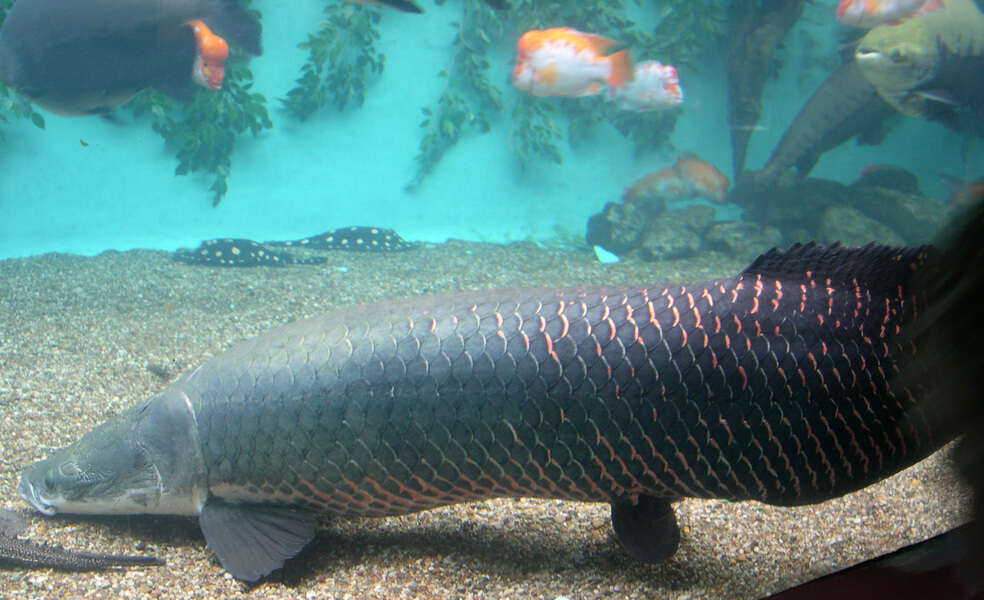
Osteoglossiformes
Osteoglossiformes , meaning "bony tongues" in Ancient Greek, is a relatively primitive order of ray-finned fish that contains two sub-orders, the Osteoglossoidei and the Notopteroidei. All of at least 245 living species inhabit freshwater. They are found in South America, Africa, Australia and southern Asia, having first evolved in Gondwana before that continent broke up. In 2008, several new species of marine osteoglossiforms were described from the Danish Eocene Fur Formation, dramatically increasing the diversity of this group. This implies that the Osteoglossomorpha is not a primary freshw

Pristiophoridae
A sawshark or saw shark is a member of a shark order (Pristiophoriformes ) bearing a unique long, saw-like rostrum (snout or bill) edged with sharp teeth, which they use to slash and disable their prey. There are ten species within the Pristiophoriformes, the longnose or common sawshark (Pristiophorus cirratus), shortnose sawshark (Pristiophorus nudipinnis), Japanese sawshark (Pristiophorus japonicas), Bahamas sawshark (Pristiophorus schroederi), Warren's sixgill sawshark (Pliotrema warreni), Anna's sixgill sawshark (Pliotrema annae), Kaja's sixgill sawshark (Pliotrema kajae), African dwarf sa
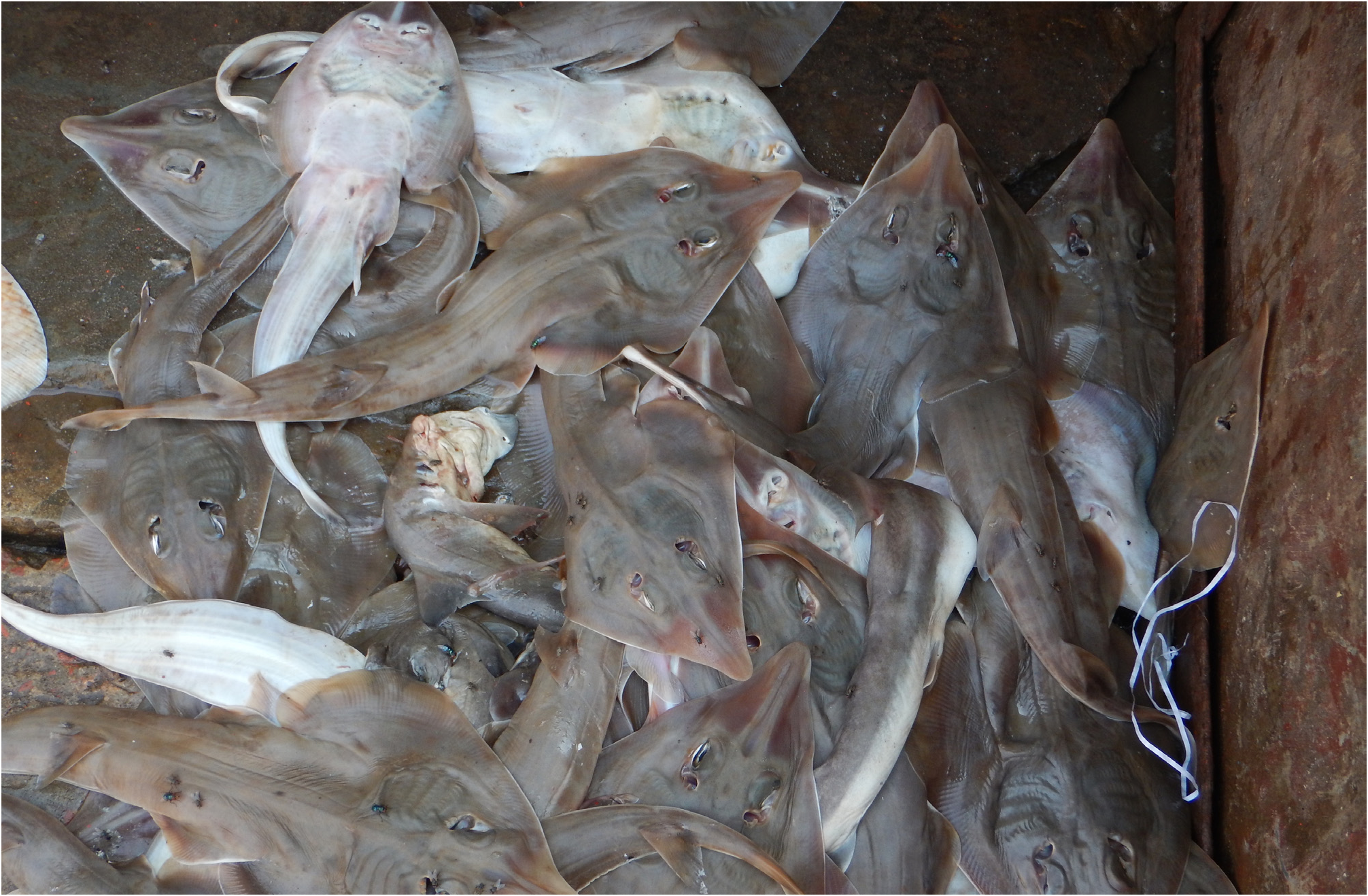
Rhinobatidae
The guitarfish, also referred to as shovelnose rays, are a family, Rhinobatidae, of rays. The guitarfish are known for an elongated body with a flattened head and trunk and small, ray-like wings. The combined range of the various species is tropical, subtropical, and warm temperate waters worldwide.

Albulidae
Albulidae is a family of fish, commonly known as the bonefishes, that are popular as game fish in Florida, select locations in the South Pacific and the Bahamas (where two bonefish are featured on the 10-cent coin) and elsewhere. The family is small, with 11 species in 3 genera. Presently, the bonefishes are in their own order: Albuliformes . The families Halosauridae and Notacanthidae were previously classified in this order, but are now, according to FishBase, given their own order Notacanthiformes. The largest bonefish caught in the Western Hemisphere is a 16-pound, 3 ounce example caught o

Orectolobidae
Wobbegong is the common name given to the 12 species of carpet shark in the family Orectolobidae. They are found in shallow temperate and tropical waters of the western Pacific Ocean and eastern Indian Ocean, chiefly around Australia and Indonesia, although one species (the Japanese wobbegong, Orectolobus japonicus) occurs as far north as Japan.

Pelobatidae
family of amphibians

Hexanchidae
family of fishes
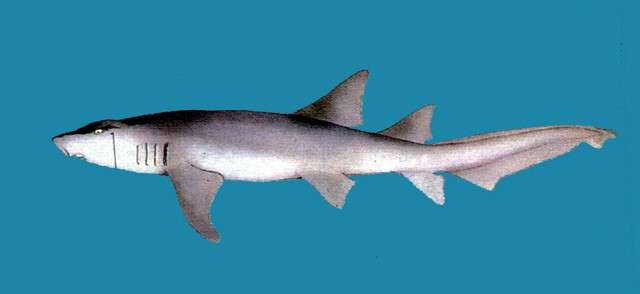
Ginglymostomatidae
The Ginglymostomatidae are a cosmopolitan family of carpet sharks known as nurse sharks, containing four species in three genera. Common in shallow, tropical and subtropical waters, these sharks are sluggish and docile bottom-dwellers. They are the most abundant species of shark found in shallow coastal waters. Nurse sharks typically attack humans only if directly threatened.

Hemiscylliidae
The Hemiscylliidae are a family of sharks in the order Orectolobiformes, commonly known as longtail carpet sharks and sometimes bamboo sharks. They are found in shallow waters of the tropical Indo-Pacific.

painted frogs
The Alytidae are a family of primitive frogs. Their common name is painted frogs or midwife toads. Most are endemic to Europe, but three species occur in northwest Africa, and a species formerly thought to be extinct is found in Israel.
Salamandroidea
The Salamandroidea are a suborder of salamanders, referred to as advanced salamanders. The members of the suborder are found worldwide except for Antarctica, sub-Saharan Africa, and Oceania. They differ from suborder Cryptobranchoidea as the angular and prearticular bones in their lower jaws are fused, their trunk ribs are bicapitate, and all members use internal fertilization. The female is fertilized by means of a spermatophore, a sperm-containing cap placed by the male in her cloaca. The sperm is stored in spermathecae on the roof of the cloaca until it is needed at the time of oviposition.
Osteoglossomorpha
Osteoglossomorpha is a superorder of bony fish in the Teleostei.

Ampullariidae
family of snails

Protacanthopterygii
Protacanthopterygii is a superorder of ray-finned fish. They inhabit both marine and freshwater habitats. They appear to have evolved in the Cretaceous or perhaps late Jurassic, originating probably roughly 150 million years ago; fossils of them and the closely related Otocephala are known from throughout the Cretaceous.

Achelata
The Achelata is an infraorder of the decapod crustaceans, holding the spiny lobsters, slipper lobsters and their fossil relatives.
Cryptobranchoidea
The Cryptobranchoidea are a suborder of salamanders found in Asia, European Russia, and the United States. They are known as primitive salamanders, in contrast to Salamandroidea, the advanced salamanders. It has two living subdivisions, Cryptobranchidae (Asian giant salamanders and hellbenders), and Hynobiidae, commonly known as Asian salamanders.

Porcellanidae
family of crustaceans

Turritella
Turritella is a genus of medium-sized sea snails with an operculum, marine gastropod mollusks in the family Turritellidae.
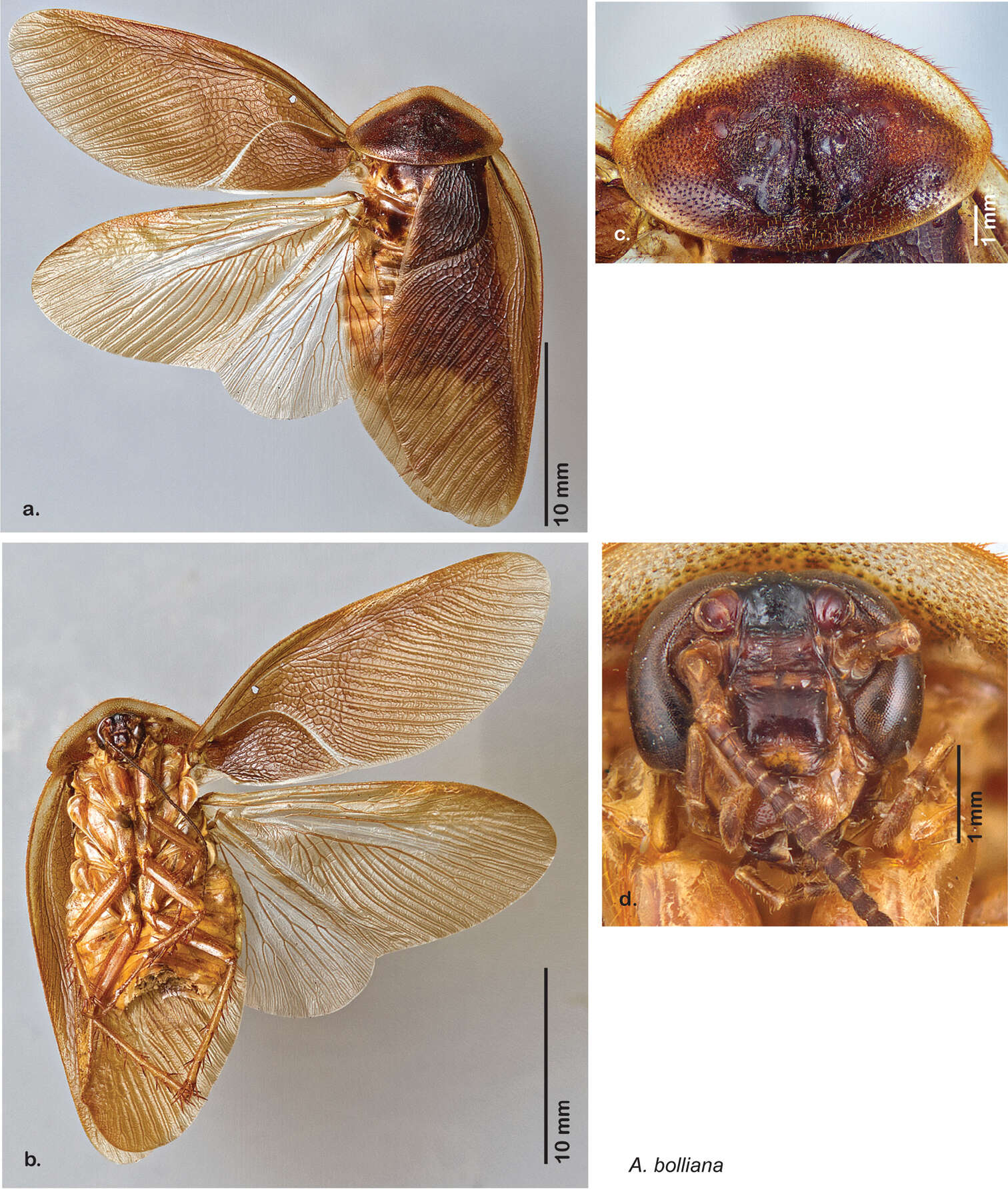
Corydiidae
Corydiidae, previously known as Polyphagidae, is a family of the order Blattodea (cockroaches). Many are known as sand cockroaches. The family is divided into five subfamilies, comprising some 40 genera. One prominent species is the desert cockroach, Arenivaga investigata.
Elopidae
The Elopidae are an ancient family of ray-finned fish, one of two living members of the order Elopiformes. They containing a single living genus, Elops, and many extinct genera dating back to the Late Jurassic, when the earliest stem-group elopids are known. They appear to have diverged from their closest relatives, the Megalopidae, during the Jurassic.''''
Dromioidea
Dromioidea is a superfamily of crabs mostly found in Madagascar. Dromioidea belongs to the group Dromiacea, taxonomically ranked as a section, which is the most basal grouping of Brachyura crabs. Dromiacea likely diverged from the rest of Brachyura around the Late Triassic or Early Jurassic, and the earliest fossils attributable to the Dromioidea date from the Late Jurassic.
.jpeg)
Pylochelidae
The Pylochelidae are a family of hermit crabs. Its members are commonly called the 'symmetrical hermit crabs'. They live in all the world's oceans, except the Arctic and the Antarctic, at depths of . Due to their cryptic nature and relative scarcity, only around 60 specimens had been collected before 1987, when a monograph was published detailing a further 400.
left|thumb
Clupeomorpha
Clupeomorpha is a superorder of ray-finned fish which belongs to the clade Otocephala. Represented today only by the diverse, economically-important order Clupeiformes (containing herrings, anchovies and allies), it was formerly even more diverse, with the extinct order Ellimmichthyiformes also known. Fossil records of this group date back to the Tithonian stage of the Late Jurassic, with the ellimmichthyiform genera Aijaichthys and Ancashichthys.

Cheilostomatida
Cheilostomatida, also called Cheilostomata, is an order of Bryozoa in the class Gymnolaemata.

Hydrolagus matallanasi
species of chordates
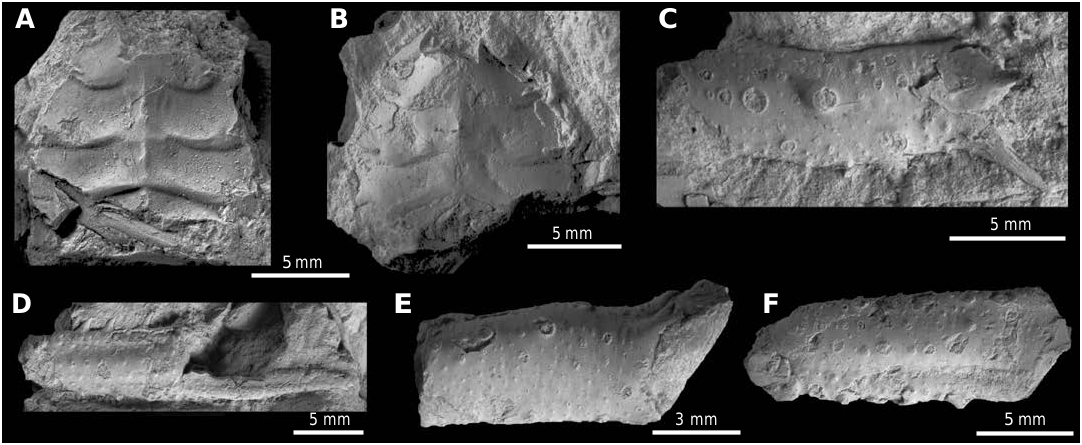
Munididae
Munididae is a family of squat lobsters, taxonomically separated from the family Galatheidae in 2010.

Neoceratodus
Neoceratodus is a genus of lungfish in the family Neoceratodontidae. The extant Australian lungfish (Neoceratodus forsteri) is the only surviving member of this genus, but it was formerly much more widespread, being distributed throughout Africa, Australia, and South America. Species were also much more diverse in body plan; for example, the Cretaceous species Neoceratodus africanus was a gigantic species that coexisted with Spinosaurus in what is now the Kem Kem Formation of Morocco. The earliest fossils from this genus are of Neoceratodus potkooroki from the mid Cretaceous (Albian-Cenomanian