Category
page 1Eye

eye
An eye is a sensory organ that allows an organism to perceive visual information. It detects light and converts it into electro-chemical impulses in neurons (neurones). It is part of an organism's visual system.

tear
thumb|upright=1.15|Human tears
Tears (tear film) are a transparent fluid secreted primarily by the lacrimal glands (tear gland) found in the eyes of all land mammals. According to the mode of production, tears are classified into four types: basal, closed eye, emotional, and reflex. The basal rate of tear secretion is ~0.5–2.2 μL/min, and irritation can increase secretion by up to ~100-fold, reaching ~300 μL/min. Tears are made up of water, electrolytes, proteins, lipids, and mucins that form layers on the surface of eyes. The four types of tears differ significantly in their composition.
upr
%20PHIL%204284%20lores.jpg)
cataract
A cataract is a cloudy area in the lens of the eye that impairs vision. Cataracts often develop slowly and can affect one or both eyes. Symptoms may include faded colours, blurry or double vision, halos around light, trouble with bright lights, and difficulty seeing at night. This may result in difficulty driving, reading and recognizing faces. Poor vision caused by cataracts may also result in an increased risk of falling and depression. In 2020 Cataracts caused 39.6% of all cases of blindness and 28.3% of visual impairment worldwide. Cataracts remain the single most common cause of global bl

eyelid
thumb|Blood vessels of the eyelids, front view

hordeolum

sclerasdcbn
The sclera, also known as the white of the eye or, in older literature, as the tunica albuginea oculi, is the opaque, fibrous, protective outer layer of the eye containing mainly collagen and some crucial elastic fiber.

eye color
polygenic phenotypic character
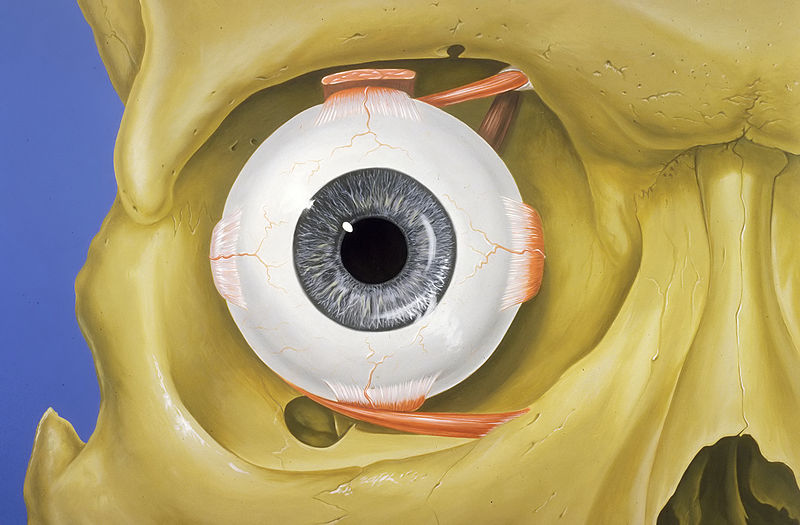
orbit
cavity or socket of the skull in which the eye and its appendages are situated

compound eye
arthropod eye
blind spot
blind point of human eye

accommodation
focusing ability of eye

rhodopsin
Rhodopsin, also known as visual purple, is a protein encoded by the RHO gene and a G-protein-coupled receptor (GPCR). It is a light-sensitive receptor protein that triggers visual phototransduction in rod cells. Rhodopsin mediates dim light vision and thus is extremely sensitive to light. When rhodopsin is exposed to light, it immediately photobleaches. In humans, it is fully regenerated in about 30 minutes, after which the rods are more sensitive. Defects in the rhodopsin gene cause eye diseases such as retinitis pigmentosa and congenital stationary night blindness.

epicanthic fold
fold on upper eye lid
intraocular pressure
fluid pressure inside the eye
nictitating membrane
transparent or translucent third eyelid in some animals
Simple eye in invertebrates
Simple eye without retina
red-eye effect
photography appearance

blinking
thumb|
intraocular lens
lens implanted in the eye to treat cataracts or myopia
night vision
ability to see in low light conditions
eyespot
color mark that looks somewhat like an eye

ommatidium
thumb|right| Ommatidium: A – cornea, B – crystalline cone, C & D – pigment cells, E – rhabdom, F – photoreceptor cells, G – membrana fenestrata, H – optic nerve
thumbnail|Ommatidia of a krill
The compound eyes of arthropods like insects, crustaceans and millipedes are composed of units called ommatidia (: ommatidium). An ommatidium contains a cluster of photoreceptor cells surrounded by support cells and pigment cells. The outer part of the ommatidium is overlaid with a transparent cornea. Each ommatidium is innervated by one axon bundle (usually consisting of 6–9 axons, depending on the numbe

lagophthalmos
thumb|An example of nocturnal lagophthalmos
Lagophthalmos is an inability to close the eyes while sleeping.
parietal eye
photoreceptive part of the epithalamus present in some animal species
photopic vision
visual perception under well-lit conditions
scotopic vision
vision of the eye under low light conditions
visual prosthesis
experimental visual device intended to restore functional vision in those suffering from partial or total blindness

saccade
thumb|Trace of saccades of the human eye on a face while scanning
thumb|200px |Saccades during observation of a picture on a computer screen
ocular adaptation
response of the eye to light and dark
sclerotic ring
ring of bone supporting the eye
evolution of the eye
origins and diversification of the organs of sight through geologic time
eye movement
voluntary or involuntary movement of the eyes, helping in acquiring, fixating and tracking visual stimuli

Vergence
thumb|250px|The two eyes converge to point to the same object.

emmetropia
Emmetropia is the state of vision in which a faraway object at infinity is in sharp focus with the ciliary muscle in a relaxed state. That condition of the normal eye is achieved when the refractive power of the cornea and eye lens and the axial length of the eye balance out, which focuses rays exactly on the retina, resulting in perfectly sharp distance vision. A human eye in a state of emmetropia requires no corrective lenses for distance; the vision scores well on a visual acuity test (such as an eye chart test).
mesopic vision
ability to see in low light conditions
lacrimal duct obstruction
Human disease

eyestalk
thumb|Pulmonata|Pulmonate [[land snails usually have two sets of tentacles on their head: the upper pair have an eye at the end; the lower pair are for olfaction.]]
redout
A redout occurs when the body experiences a negative g-force sufficient to cause a blood flow from the lower parts of the body to the head. It is the inverse effect of a greyout, where blood flows away from the head to the lower parts of the body. Usually, a redout will only ever be experienced by aircraft pilots, as planes are the most common devices that allow such negative g-forces to be exerted. Redouts are potentially dangerous and can cause retinal damage and hemorrhagic stroke.
periorbital puffiness
appearance of swelling in the tissues around the eyes
eye–hand coordination
coordinated control of eye movement with hand movement and processing of visual input to guide reaching and grasping along with the use of proprioception of the hands to guide the eyes
eye bank
center that stores parts of the eye for future use
madarosis
Madarosis is a condition that results in the loss of eyelashes, and sometimes eyebrows. The term "madarosis" is derived from the ancient Greek "madaros", meaning "bald". Eyelashes are important in the prevention of bacteria and other foreign objects entering the eye. Some studies found that between 45 and 76 percent of patients with various types of leprosy had madarosis.
oculophilia
thumb|Licking eyeballs may cause viral conjunctivitis (pictured).
averted vision
technique for viewing faint objects
congenital cataract
disorder of lens
accommodation reflex
reflex action of the eye, in response to focusing on a near object, then looking at a distant object
eye protection
protective gear for the eyes, guarding against particles, light, wind blast, heat, sea spray or some type of ball or puck used in sports
corneal tattooing
tattoo located on the cornea of the bearer's eye
Sanpaku
thumb|200px|John F. Kennedy, one of the twelve famous people [[George Ohsawa claimed were suffering from sanpaku because of visible sclerae under their irises.]]
pupillary distance
distance between the centers of the pupils of the eyes
eye movements in reading
retinal implant
visual prosthesis
optic cup
structure in embroyos that gives rise to the retina of the eye
scleral tattooing
eye tattooing
fixation
eye pause between eye movements
Stellwag's sign
medical sign in the eyes
eagle eye
eye of an eagle
Pseudopupil
thumb|right|The head of a mantis showing the black pseudopupil in its compound eyes
thumb|right|The eye of a mantis shrimp has three regions, each with its own pseudopupil.
Ocular immune system
Immune system of the human eye
Limbus sign
clinical sign