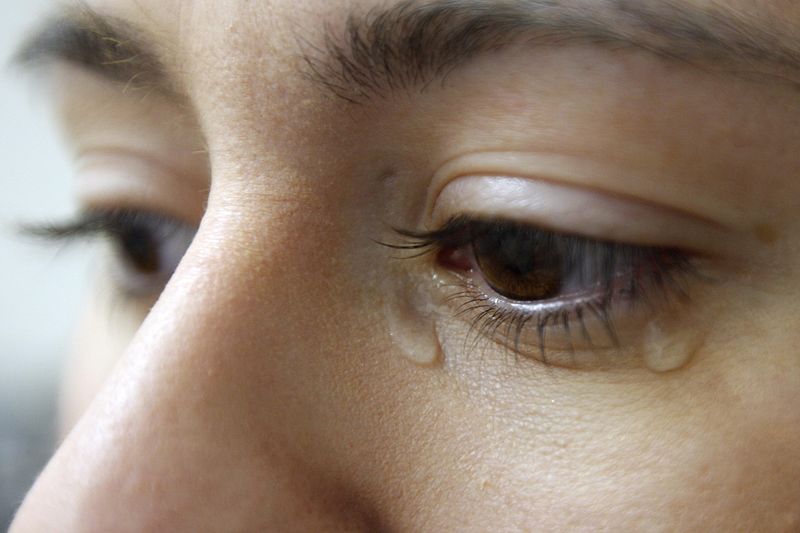
File:USMC-04952.jpg · Wikimedia Commons · See Wikimedia Commons
tear
Sign in to saveAlso known as tears, tearing, tear fluid
thumb|upright=1.15|Human tears Tears (tear film) are a transparent fluid secreted primarily by the lacrimal glands (tear gland) found in the eyes of all land mammals. According to the mode of production, tears are classified into four types: basal, closed eye, emotional, and reflex. The basal rate of tear secretion is ~0.5–2.2 μL/min, and irritation can increase secretion by up to ~100-fold, reaching ~300 μL/min. Tears are made up of water, electrolytes, proteins, lipids, and mucins that form layers on the surface of eyes. The four types of tears differ significantly in their composition. upr
Tears are a clear fluid produced by glands in the eyes of all land mammals, made up of water, electrolytes, proteins, lipids, and mucins that coat the eye's surface. They come in four different types—basal, closed eye, emotional, and reflex—each with distinct compositions, and their production can increase dramatically in response to irritation.
AI-generated from the Wikipedia summary — may contain errors.
Research
83,190 papers- Influence of pelvic floor muscle training alone or as part of a general physical activity program during pregnancy on urinary incontinence, episiotomy and third- or fourth-degree perineal tear: Systematic review and meta-analysis of randomized clinical trials.Acta obstetricia et gynecologica Scandinavica · 2024Zhang D, Bo K, Montejo R et al.DOI: 10.1111/aogs.14744
- Perineal tears - A review.ReviewAustralian journal of general practice · 2018Goh R, Goh D, Ellepola HDOI: 10.31128/AFP-09-17-4333
- Tear propagation in vaginal tissue under inflation.Acta biomaterialia · 2021McGuire JA, Monclova JL, Coariti ACS et al.DOI: 10.1016/j.actbio.2021.03.065
- Treatment of Degenerative Meniscus Tears.Arthroscopy : the journal of arthroscopic & related surgery : official publication of the Arthroscopy Association of North America and the International Arthroscopy Association · 2023Hohmann EDOI: 10.1016/j.arthro.2022.12.002
- Patient Outcomes After Horizontal Cleavage Tear Repair: A Systematic Review.Arthroscopy : the journal of arthroscopic & related surgery : official publication of the Arthroscopy Association of North America and the International Arthroscopy Association · 2020Morris JH, Magnussen RA, DiBartola AC et al.DOI: 10.1016/j.arthro.2020.04.027
- The International Skin Tear Advisory Panel: 10 Years in the Making.ReviewAdvances in skin & wound care · 2019LeBlanc KDOI: 10.1097/01.ASW.0000604188.00448.65
- Rehabilitation protocols following rotator cuff repair: a meta-analysis of current evidence.ANZ journal of surgery · 2021Bandara U, An VVG, Imani S et al.DOI: 10.1111/ans.17213
- Evaluation of ocular surface and tear function - A review of current approaches for dry eye.ReviewIndian journal of ophthalmology · 2022Koh S, Rao SK, Srinivas SP et al.DOI: 10.4103/ijo.IJO_1804_21
via PubMed
Wikidata facts
- Subclass of
- body fluid
- Has part
- sodium chloride
- Location
- eye
- Image
- Mary Magdalene Crying Statue.jpg
Show 7 more facts
- produced by
- lacrimal apparatus
- subject has role
- cleaning
- Commons category
- Tears
- Commons gallery
- Tears
- facet of
- crying
- Unicode character
- 💧
- described by source
- Explanatory Dictionary of the Living Great Russian Language
via Wikidata · CC0
~15 min read
Encyclopedic overview
15 sectionsContents
- Physiology
- Chemical composition
- Drainage of tear film
- Types
- Nictitating membrane
- Neurology
- Human culture
- Pathology
- Bogorad's syndrome
- Keratoconjunctivitis sicca ([[Dry eye syndrome|dry eye disease]])
- Familial dysautonomia
- Pseudobulbar affect
- See also
- References
- External links
thumb|upright=1.15|Human tears Tears (tear film) are a transparent fluid secreted primarily by the lacrimal glands (tear gland) found in the eyes of all land mammals. According to the mode of production, tears are classified into four types: basal, closed eye, emotional, and reflex. The basal rate of tear secretion is ~0.5–2.2 μL/min, and irritation can increase secretion by up to ~100-fold, reaching ~300 μL/min. Tears are made up of water, electrolytes, proteins, lipids, and mucins that form layers on the surface of eyes. The four types of tears differ significantly in their composition. upright=1.15|thumb|Anatomy of lachrymation, showing Some of the functions of tears include lubricating the eyes (basal tears), removing irritants (reflex tears), and also aiding the immune system. Tears also occur as a part of the body's natural pain response. Emotional secretion of tears may serve a biological function by excreting stress-inducing hormones built up through times of emotional distress. Tears have symbolic significance among humans.
== Physiology ==
Excerpted from Wikipedia’s “tear” article, available under the CC BY-SA 4.0 licence.
Gallery (15)
Available in 105 languages
- Español
- Français
- Deutsch
- 中文
- 日本語
- Русский
- Português
- Italiano
- العربية
- Albanian
- Aragonese
- Aramaic
- Armenian
- Avaric
- Azerbaijani
- Bahasa Indonesia
- Bangla
- Basque
Show 86 more
- Bavarian
- be_x_old
- Belarusian
- Bikol
- Bosnian
- Buginese
- Bulgarian
- Catalan
- cdo
- Croatian
- Czech
- Danish
- Divehi
- eml
- Esperanto
- Estonian
- Filipino
- Finnish
- Galician
- Gorontalo
- Greek
- Guarani
- Hakka Chinese
- Hebrew
- Hungarian
- hyw
- Ido
- Iloko
- Inupiaq
- Javanese
- Kabyle
- Kannada
- Kashmiri
- kbp
- Kyrgyz
- Latin
- Latvian
- lbe
- Lithuanian
- Low German
- Luxembourgish
- Macedonian
- Malay
- Malayalam
- Mazanderani
- Nederlands
- Newari
- Norwegian
- Norwegian Nynorsk
- Pashto
- Polski
- Quechua
- roa_rup
- Romanian
- Rusyn
- Santali
- Serbian
- Serbian (Latin)
- Shona
- Sicilian
- simple
- Sindhi
- Sinhala
- Slovenian
- Svenska
- Tajik
- Tamil
- Tatar
- Telugu
- Tiếng Việt
- Tswana
- Türkçe
- Ukrainian
- Urdu
- Uzbek
- Venetian
- Waray
- Wu Chinese
- Yiddish
- zh_classical
- zh_min_nan
- zh_yue
- Zhuang
- فارسی
- ไทย
- 한국어
via Wikidata sitelinks · CC0