Category
page 1Flood myths

Epic of Gilgamesh
epic poem from Mesopotamia, is amongst the earliest surviving works of literature

Noah's Ark
vessel in the Genesis flood narrative
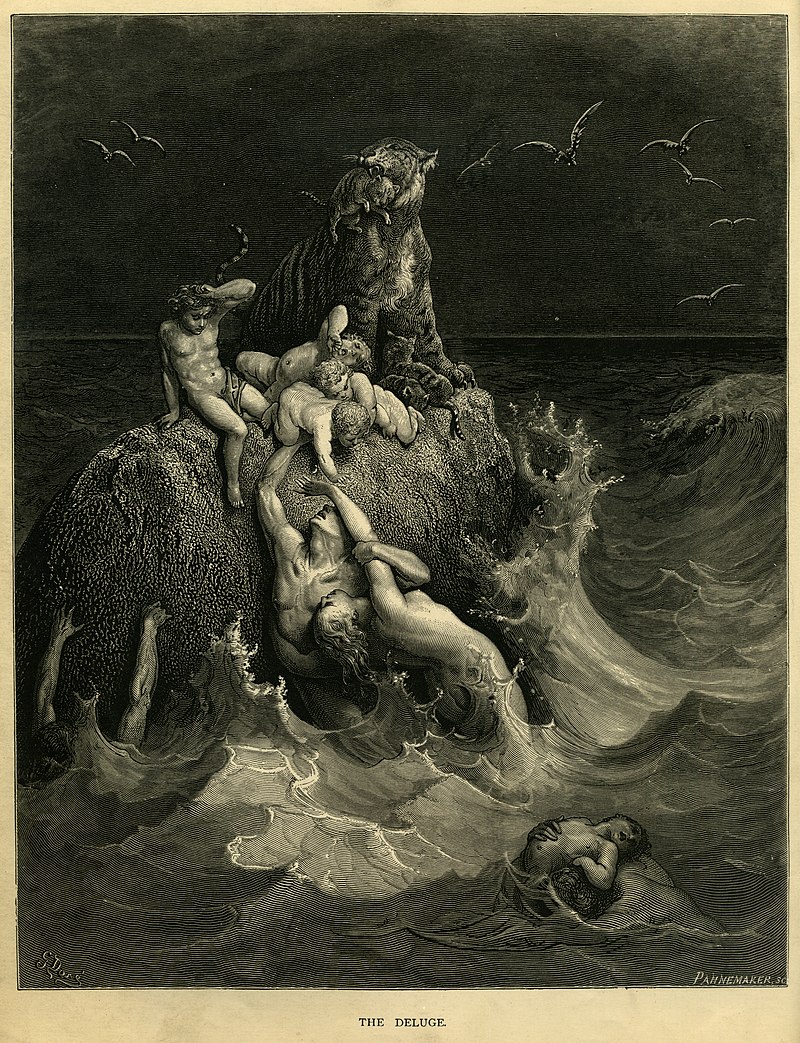
deluge myth
narrative in which a great flood destroys a civilization, commonly as divine retribution

Matsya
Matsya () is the fish avatar of the Hindu god Vishnu. Often described as the first of Vishnu's ten primary avatars, Matsya is described to have rescued the first man, Manu, from a great deluge. Matsya may be depicted as a giant fish, often golden in color, or anthropomorphically with the torso of Vishnu connected to the rear half of a fish.

Manu
first human being in Hindu tradition

Yu the Great
Xia Dynasty king and founder

Deucalion
thumb|Deucalion from Promptuarium Iconum Insigniorum

Pyrrha
thumb|16th-century woodcut by Virgil Solis, illustrating lines 347–415 of [[Ovid's Metamorphoses]]
In Greek mythology, Pyrrha (; ) was the daughter of Epimetheus and Pandora, or of Prometheus.

Utnapishtim
thumb|Cuneiform script|Cuneiform tablet with the [[Atra-Hasis epic in the British Museum]]
Uta-napishtim or Utnapishtim (, "he has found life") was a legendary mortal king of the ancient city of Shuruppak in southern Iraq who, according to the Gilgamesh flood myth, survived the Flood by making and occupying a boat.
Dardanus
mythological Greek character, son of Zeus
.jpg)
Ziusudra
thumb|Sumerian King List, 1800 BC, Larsa, Iraq
Ziusudra ( [ṣi₂-u₄-sud-ra₂], , ) of Shuruppak is listed in the WB-62 Sumerian King List recension as the last king of Sumer prior to the Great Flood. He is subsequently recorded as the hero of the Eridu Genesis and appears in the writings of Berossus as Xisuthros.
Shan Hai Jing
Chinese classic text and a compilation of mythic geography and myth
Genesis flood narrative
biblical flood myth
Bergelmir
Bergelmir ( ; Old Norse: ) is a jötunn in Norse mythology.

Lebor Gabála Érenn
11th century Irish chronicle

Ys
thumb|right|upright=1.5|Flight of King Gradlon, by Évariste Vital Luminais|E. V. Luminais, 1884 (Musée des Beaux-Arts, [[Quimper)]]
Ys (pronounced ), also spelled Is or Kêr-Is in Breton, and '''Ville d'Ys''' ("City of Ys") in French, is a mythical city on the coast of Brittany that was swallowed up by the ocean. Most versions of the legend place the city in the Baie de Douarnenez.

Atra-Hasis
Atra-Hasis () is an 18th-century BC Akkadian epic, recorded in various versions on clay tablets and named for one of its protagonists, the priest Atra-Hasis ('exceedingly wise'). The narrative has four focal points: An organisation of allied upper and lower gods shaping Mesopotamia agriculturally; a political conflict between them, pacified by creating the first human couples; the mass reproduction of these; and a great deluge linked to the intention of the upper gods to destroy their imperfect artificial creatures, as handed down in a remarkably similar manner in various other flood myths of

Ogyges
Ogyges, also spelled Ogygus (; or , ; or , or ) is a primeval mythological ruler in ancient Greece, generally of Boeotia, but an alternative tradition makes him the first king of Attica.
Xie of Shang
ancestor of the kings of the Shang dynasty

Lyonesse
Lyonesse (/liːɒˈnɛs/ lee-uh-NESS) is a kingdom which, according to legend, consisted of a long strand of land stretching from Land's End at the southwestern tip of Cornwall, England, to what is now the Isles of Scilly in the Celtic Sea portion of the Atlantic Ocean. It was considered lost after being swallowed by the ocean in a single night. The people of Lyonesse were said to live in fair towns, with over 140 churches, and work in fertile, low-lying plains. Lyonesse's most significant attraction was a castle-like cathedral that was presumably built on top of what is now the Seven Stones Reef
Johannes Stöffler
German astronomer
Cessair
Cessair or Cesair (, meaning 'sorrow, affliction') is a character from a medieval Irish origin myth, best known from the 11th-century chronicle text Lebor Gabála Érenn. According to the Lebor Gabála, she was the leader of the first inhabitants of Ireland, arriving before the Biblical flood. The tale may have been an attempt to Christianise an earlier pagan myth.
Vaivasvata Manu
current Manu of Hinduism

Bochica
Bochica (also alluded to as Nemquetaha, Nemqueteba and Sadigua) is a mythical figure in the religion of the Muisca, who inhabited the Altiplano Cundiboyacense before the Spanish invasion by conquistadors in the central Andean highlands of present-day Colombia. There is little documentation concerning Bochica, who was mentioned by name in records from 1563 from Ubaque. "Bochica was variously described by witnesses as a building which [Melchor] Pérez de Arteaga had destroyed - as the father of a 'tiger' - perhaps a puma or jaguar
that had recently been attacking travellers of local roads, and as
Sumerian creation myth
creation myth
Great Flood
major flood in ancient Chinese legends during the reign of Emperor Yao
flood geology
attempt to interpret and reconcile geological features of the Earth in accordance with a literal belief in the global flood described in Genesis
Gilgamesh flood myth
deluge myth
Cantre'r Gwaelod
legendary Kingdom
Khun Borom
legendary progenitor of the Southwestern Tai-speaking peoples
Nu'u
In Hawaiian mythology, Nuu was a man who built an ark with which he escaped a Great Flood. He landed his vessel on top of Mauna Kea on the Big Island. Nuu mistakenly attributed his safety to the moon, and made sacrifices to it. Kāne, the creator god, descended to earth on a rainbow and explained Nuu's mistake. The myth has been interpreted as depicting the hazards of the Oceanian environment and local peoples' ability to withstand them. Missionaries to Hawaii in the 19th century considered him analogous to Noah of the Bible.
==References==
Antediluvian
thumb|upright=1.35|right|The Creation, beginning of the Antediluvian (i.e., Pre-Flood) world. (Artist's rendition by James Tissot.)
Coxcox
thumb | right | Page 30 of the Codex Borgia.
In Aztec mythology, Coxcox was the only male survivor of a worldwide flood, which was the fourth destruction of the world in Aztec myth.
Nannacus
In Greek mythology, Nannacus (also Annacus; ancient Greek: Νάννακος, Άννακός) was a legendary king of Phrygia before the Flood of Deucalion. His city was Iconium in modern Turkey.
Legend of Trentren Vilu and Caicai Vilu
mapuche flood myth from Chile
Pūluga
Pūluga (or Puluga) is the creator in the religion of the indigenous inhabitants of the Andaman Islands. According to , Puluga ceased to visit the people when they became remiss of the commands given to them at the creation. Then, without further warning he sent a devastating flood. Only four people survived this flood: two men, Loralola and Poilola, and two women, Kalola and Rimalola. When they landed they found they had lost their fire and all living things had perished. Puluga then recreated the animals and plants but does not seem to have given any further instructions, nor did he return th