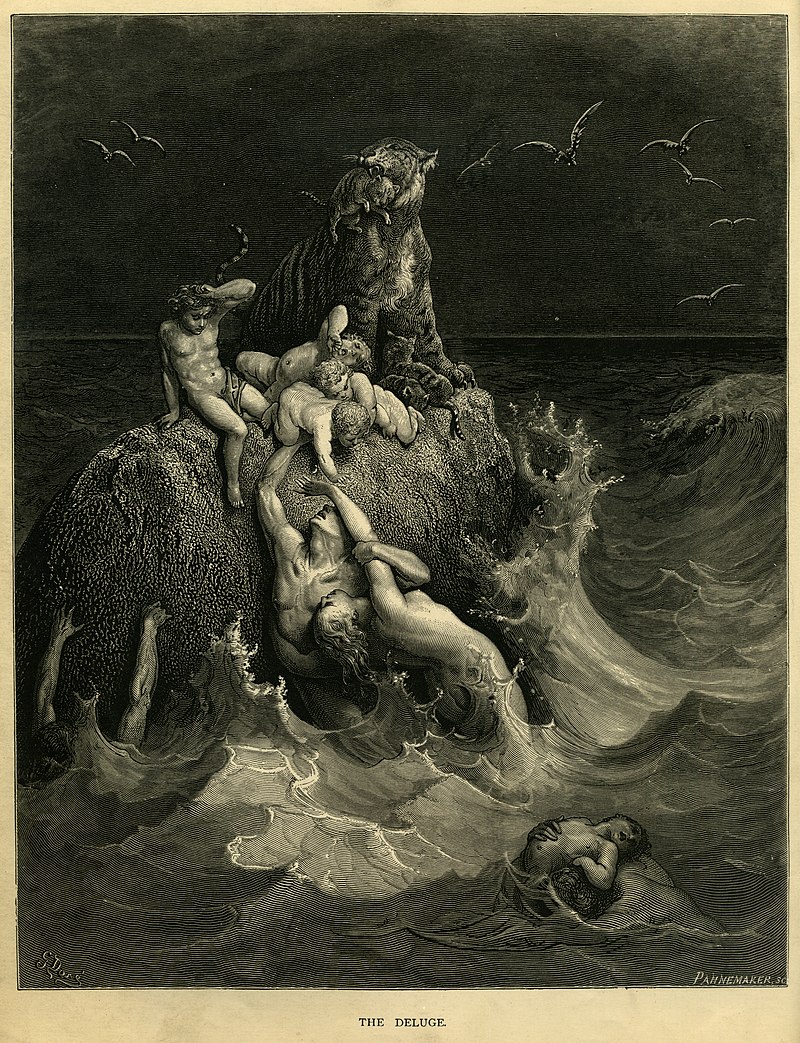
File:Gustave_Doré_-_The_Holy_Bible_-_Plate_I,_The_Deluge.jpg · Wikimedia Commons · See Wikimedia Commons
deluge myth
Sign in to saveAlso known as flood myth, deluge, universal deluge
narrative in which a great flood destroys a civilization, commonly as divine retribution
A deluge myth is a story found in many cultures about a massive flood that destroys civilization, often as punishment from the gods or divine forces. These myths matter because they appear across different ancient societies worldwide, offering insights into how various cultures understood catastrophe, morality, and humanity's relationship with the divine.
AI-generated from the Wikipedia summary — may contain errors.
Wikidata facts
- Subclass of
- flood
- Has part
- Atra-Hasis
- Image
- Gustave Doré - The Holy Bible - Plate I, The Deluge.jpg
Show 5 more facts
- described by source
- Wikitólica
- Commons category
- Deluge (mythology)
- topic's main category
- Category:Flood myths
- facet of
- comparative mythology
Sources (3)
via Wikidata · CC0
~17 min read
Encyclopedic overview
"The Deluge", frontispiece to Gustave Doré's illustrated edition of the Bible A flood myth or a deluge myth is a narrative in which a great flood—usually sent by one or more deities—destroys civilization, typically as an act of divine retribution. Parallels are often drawn between the floodwaters of these myths and the primordial cosmic ocean that appears in certain creation myths, because the floodwaters are described as a means of social cleansing or purifying humanity of its corruption, for example, in preparation for rebirth. Most flood myths also feature a culture hero who "represents the human craving for life".
The oldest known narrative of a divinely initiated flood originates from the Sumerian culture in Mesopotamia, among others expressed in the Akkadian Atra-Hasis epic, which dates to the 18th century BCE. Comparable flood narratives appear in many other cultures, including the biblical Genesis flood narrative, manvantara-sandhya in Hinduism, Deucalion in Greek mythology, and in indigenous North American cultures.
Excerpted from Wikipedia’s “deluge myth” article, available under the CC BY-SA 4.0 licence.
Gallery (11)
Available in 67 languages
- Español
- Français
- Deutsch
- 中文
- 日本語
- Русский
- Português
- Italiano
- العربية
- Afrikaans
- Albanian
- Armenian
- Asturian
- Azerbaijani
- Bahasa Indonesia
- Bangla
- Basque
- Belarusian
Show 48 more
- Breton
- Bulgarian
- Catalan
- Cebuano
- Czech
- Danish
- Esperanto
- Estonian
- Filipino
- Finnish
- Friulian
- Galician
- Georgian
- Greek
- Hebrew
- Hungarian
- Kurdish
- Kyrgyz
- Lithuanian
- Malagasy
- Nederlands
- Norwegian
- Norwegian Nynorsk
- Occitan
- Polski
- Romanian
- Romansh
- Scottish Gaelic
- Serbian
- Serbian (Latin)
- Sicilian
- simple
- Slovak
- Slovenian
- Svenska
- Tamil
- Tiếng Việt
- Türkçe
- Tuvinian
- Ukrainian
- Welsh
- Wu Chinese
- Yiddish
- Zaza
- zh_yue
- فارسی
- ไทย
- 한국어
via Wikidata sitelinks · CC0