Category
page 1Fluid dynamics

pressure
Pressure (symbol: p or P) is the force applied perpendicular to the surface of an object per unit area over which that force is distributed. Gauge pressure (also spelled gage pressure) is the pressure relative to the ambient pressure.

speed of sound
distance travelled during a unit of time by a sound wave propagating through an elastic medium

viscosity
When two fluid layers move relative to each other, a friction force develops between them and the slower layer acts to slow down the faster layer. This internal resistance to flow is described by the fluid property called viscosity, which reflects the internal stickiness of the fluid. In liquids, viscosity arises from cohesive molecular forces, while in gases it results from molecular collisions. Except for the case of superfluidity, there is no fluid with zero viscosity, and thus all fluid flows involve viscous effects to some degree.

fluid
In physics, a fluid is a liquid, gas, or other material that may continuously move and deform (flow) under an applied shear stress, or external force. They have zero shear modulus, or, in simpler terms, are substances which cannot resist any shear force applied to them.

Archimedes' principle
law of physics fundamental to fluid mechanics

jet engine
reaction engine which generates thrust by jet propulsion

river mouth
end of a river or stream

aerosol
thumb|upright=1.4|Mist and [[fog are aerosols|alt=photograph of heavy mist]]

Mach number
ratio of speed of object moving through fluid and speed of sound
surface tension
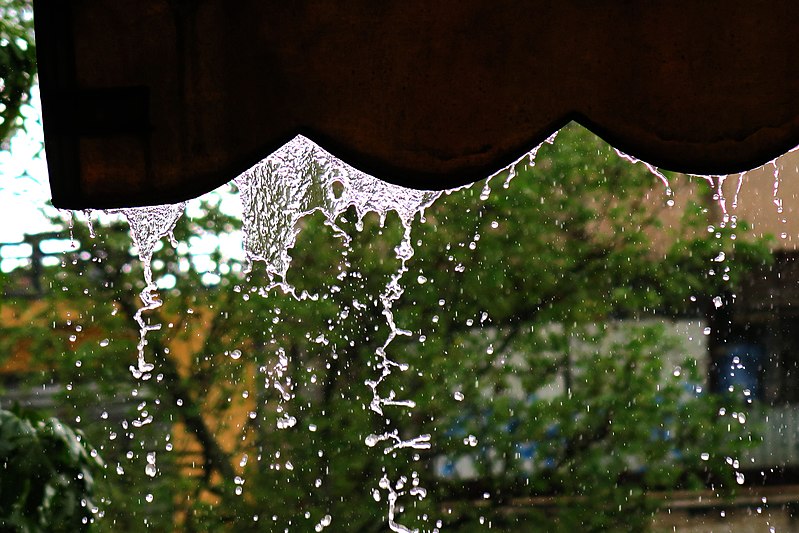
tendency of a liquid surface to shrink to reduce surface area
Bernoulli's principle
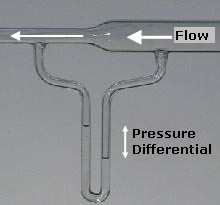
principle relating to fluid dynamics

drop
small unit of liquid

Reynolds number
dimensionless quantity that is used to help predict similar flow patterns in different fluid flow situations

superfluidity
thumb|right|Helium#Helium II|Helium II will "creep" along surfaces in order to find its own level—after a short while, the levels in the two containers will equalize. The [[Rollin film also covers the interior of the larger container; if it were not sealed, the helium II would creep out and escape.]]
thumb|right|The liquid helium is in the superfluid phase. A thin invisible film creeps up the inside wall of the bowl and down on the outside. A drop forms. It will fall off into the liquid helium below. This will repeat until the cup is empty—provided the liquid remains superfluid.

capillary action
ability of a liquid to flow in narrow spaces

turbulence
In fluid dynamics, turbulence or turbulent flow is fluid motion exhibiting chaotic changes in pressure and flow velocity. It is in contrast to laminar flow, which occurs when a fluid flows in parallel layers with no disruption between those layers.

fluid dynamics
subdiscipline of fluid mechanics that deals with fluid flow—the natural science of fluids (liquids and gases) in motion

cavitation
thumb|upright=1|right|Cavitating propeller model in a Water tunnel (hydrodynamic)|water tunnel experiment

ventilation
intentional introduction of outside air into a space

soap bubble
thin film of soapy water enclosing air

confluence
thumb|Confluence of the Bhagirathi and [[Alaknanda Rivers at the Ganges in Devprayag, India]]
thumb|The same confluence viewed from upstream at a different time; note the swirl of sediment from the Alaknanda River

siphon
thumb|right|Siphon principle
thumb|In the flying-droplet siphon, surface tension pulls the stream of liquid into separate droplets inside of a sealed air-filled chamber, preventing the liquid going down from having contact with the liquid going up, and thereby preventing liquid tensile strength from pulling the liquid up. It also demonstrates that the effect of atmospheric pressure at the entrance is not canceled by the equal atmospheric pressure at the exit.
compressibility
In thermodynamics and fluid mechanics, the compressibility (also known as the coefficient of compressibility or, if the temperature is held constant, the isothermal compressibility) is a measure of the instantaneous relative volume change of a fluid or solid as a response to a pressure (or mean stress) change. In its simple form, the compressibility \kappa (denoted in some fields) may be expressed as

vortex
thumb|Vortex created by the passage of an wing|aircraft wing, revealed by colored smoke
thumb|249x249px|Kármán vortex street|Von Kármán vortex street behind a drinking straw; milk was poured into the water to make the current visible
thumb|right|250px|A Kármán vortex street is shown in this photo, as winds from the west blow onto clouds that have formed over the mountains in the desert. This phenomenon observed from ground level is extremely rare, as most cloud-related Kármán vortex street activity is viewed from space.

atmospheric sciences
umbrella term for the study of the atmosphere

tidal bore
water wave traveling upstream a river or narrow bay due to incoming tide

Magnus effect
sidewise force on a spinning object in a liquid or gas

Venturi effect
reduction in fluid pressure that results when a fluid flows through a constricted section of a pipe
terminal velocity
highest velocity attainable by an object as it falls through a fluid
hydraulic machine
machinery and tools that use liquid fluid power to do simple work
Newtonian fluid
fluid in which the viscous stresses arising from its flow, at every point, are linearly proportional to the local strain rate—the rate of change of its deformation over time; the simplest mathematical model of fluid that account for viscosity
non-Newtonian fluid
fluid that does not follow Newton's Law of Viscosity, viscosity (the measure of a fluid's ability to resist gradual deformation by shear or tensile stresses) of non-Newtonian fluids is dependent on shear rate or shear rate history

soliton
thumb|250px|Solitary wave (water waves)|Solitary wave in a laboratory [[wave channel]]
Froude number
dimensionless number defined as the ratio of the flow inertia to the external field
mass flow rate
mass per time of a fluid passing through a cross section
Stokes' theorem
theorem in vector calculus

injector
thumb|right|350px|Injector typically used in steam locomotives
thumb|right|400px|A- Steam from boiler, B- Needle valve, C- Needle valve handle, D- Steam and water combine, E- Water feed, F- Combining cone, G- Delivery nozzle and cone, H- delivery chamber and pipe, K- Check valve, L- Overflow
atmospheric physics
application of physics to the study of the atmosphere
rogue wave
relatively large and spontaneous ocean surface waves that occur far out at sea
Stokes' law
expression for frictional force on small spherical object moving through a viscous fluid
Prandtl number
quotient of kinematic viscosity and thermal diffusivity for a fluid
soundproofing
upright=1.35|thumb|A pair of headphones being tested inside an [[anechoic chamber for soundproofing]]
volume flow rate
volume of fluid which passes per time

thixotropy
thumb|Mānuka honey is an example of a thixotropic material.
Thixotropy is a time-dependent shear thinning property. Certain gels or fluids that are thick or viscous under static conditions will flow (become thinner, less viscous) over time when shaken, agitated, shear-stressed, or otherwise stressed (time-dependent viscosity). They then take a fixed time to return to a more viscous state.
Some non-Newtonian pseudoplastic fluids show a time-dependent change in viscosity; the longer the fluid undergoes shear stress, the lower its viscosity. A thixotropic fluid is a fluid which takes a finite tim
Torricelli's law
theorem in fluid dynamics
Archimedes number
used to determine the motion of fluids due to density differences
.jpg)
microfluidics
thumb|NIST researchers have combined a glass slide, plastic sheets and double-sided tape to create an inexpensive and simple-to-build microfluidic device for exposing an array of cells to different concentrations of a chemical
geostrophic wind
theoretical wind that would result from an exact balance between the Coriolis force and the pressure gradient force
electro-osmosis
In chemistry, electro-osmotic flow (EOF, hyphen optional; synonymous with electro-osmosis or electro-endosmosis) is the motion of liquid induced by an applied potential across a porous material, capillary tube, membrane, microchannel, or any other fluid conduit. Because electro-osmotic velocities are independent of conduit size, as long as the electrical double layer is much smaller than the characteristic length scale of the channel, electro-osmotic flow will have little effect. Electro-osmotic flow is most significant when in small channels, and is an essential component in chemical separati
Grashof number
characteristic number in fluid dynamics
Pythagorean cup
practical joke device
primary wave
longitudinal seismic wave
ocean gyre
large system of rotating ocean currents
bulbous bow
Protruding bulb at the front of a ship
hydraulic head
specific measurement of liquid pressure above a vertical datum

vorticity
In continuum mechanics, vorticity is a pseudovector (or axial vector) field that describes the local spinning motion of a continuum near some point (the tendency of something to rotate), as would be seen by an observer located at that point and traveling along with the flow. It is an important quantity in the dynamical theory of fluids and provides a convenient framework for understanding a variety of complex flow phenomena, such as the generation of lift on wings.
pneumatic motor
propulsion engine powered by compressed gas
orifice plate
restriction used to measure flow or to control pressure or flow, sometimes given specialised names

hemodynamics
Hemodynamics or haemodynamics are the dynamics of blood flow. The circulatory system is controlled by homeostatic mechanisms of autoregulation, just as hydraulic circuits are controlled by control systems. The hemodynamic response continuously monitors and adjusts to conditions in the body and its environment. Hemodynamics explains the physical laws that govern the flow of blood in the blood vessels.
Ekman spiral
structure of currents or winds near a horizontal boundary in which the flow direction rotates as one moves away from the boundary