Category
page 1Force

force
In physics, a force is an action that can cause an object to change its velocity or its shape, or to resist other forces, or to cause changes of pressure in a fluid. In mechanics, force makes ideas like 'pushing' or 'pulling' mathematically precise. Because the magnitude and direction of a force are both important, force is a vector quantity (force vector). The SI unit of force is the newton (N), and force is often represented by the symbol .

power
rate at which energy is transferred, used, or transformed

work
energy transferred to an object via the application of force on it through a displacement

friction
thumb|360px|The blue plate has more friction on the sloped surface than the green one, so slides down slower.

Coulomb's law
a physical law that states the electric force between two point charges is proportional to the product of the charges and inversely proportional to the square of the distance between them.

Archimedes' principle
law of physics fundamental to fluid mechanics

torque
In physics and mechanics, torque is the rotational correspondent of linear force. It is also referred to as the moment of force, or simply the moment. Just as a linear force is a push or a pull applied to a body, a torque can be thought of as a twist applied to an object with respect to a chosen axis. For example, driving a screw uses torque to force it into an object. The torque is applied by the screwdriver, rotating around its axis, to the drive on the head of the screw.
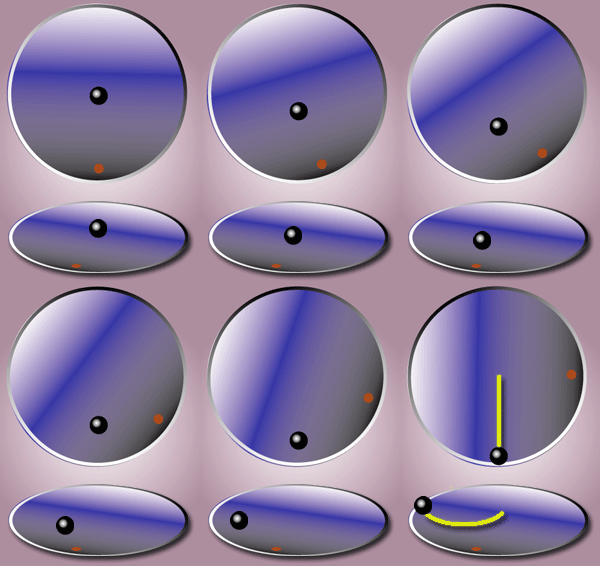
Coriolis force
apparent or fictitious force on objects moving within a reference frame that rotates with respect to an inertial frame
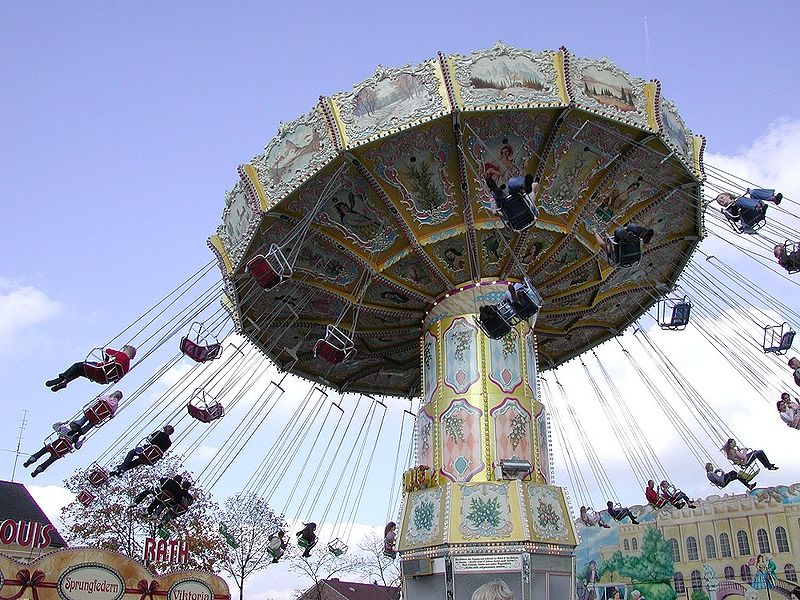
centrifugal force
type of inertial force

centripetal force
force that makes a moving body follow a curved path

buoyancy
thumb|The forces at work in buoyancy. The object floats at rest because the upward force of buoyancy is equal to the downward force of gravity.

lift
force; aerodynamics term

drag
retarding force on a body moving in a fluid

tidal force
secondary effect of the force of gravity of one body on another

thrust
upright=1.5|thumb|A Lockheed Martin F-35 Lightning II aircraft performing a vertical climb using its [[Pratt & Whitney F135 jet engine, which produces of thrust.]]
fictitious force
apparent force that acts on all masses whose motion is described using a non-inertial frame of reference, such as a rotating reference frame

conservative force
force with the property that the work done in moving a particle between two points is independent of the path taken

Casimir effect
Physical force caused by virtual particles

normal force
force exerted on an object by a body with which it is in contact, and vice versa
Bia
ancient Greek goddess, personification of force
spring scale
weighing scale consisting of a spring fixed at one end with a hook to attach an object at the other
central force
force directed towards or away from a point

counterweight
thumb|right|400px|A simple crane
restoring force
brings system back toward equilibrium
net force
the overall force acting on an object. In order to calculate the net force, the body is isolated and interactions with the environment or other constraints are represented as forces and torques in a free-body diagram
action at a distance
spatially nonlocal causation: the concept that an object can be directly influenced by one that is not adjacent to it
fifth force
hypothesized fundamental force in addition to gravitational, electroweak and strong interactions
reaction
part of Newton's laws
force field
physics term
parallelogram of force
addition of vectors
bending moment of force
moment that results in the bending of a structural element
conservative vector field
concept in vector calculus
traction
physical process in which a tangential force is transmitted across an interface between two bodies through dry friction or an intervening fluid film resulting in motion, stoppage or the transmission of power
resultant force
Static equivalence of systems of forces and moments
mass versus weight
(scientific contexts) mass refers loosely to the amount of "matter" in an object (though "matter" may be difficult to define), whereas weight refers to the force exerted on an object by gravity
body force
force that acts throughout the volume of a body
shear force
coplanar forces acting on the same body in opposite directions
four-force
In the special theory of relativity, four-force is a four-vector that replaces the classical force.
coupling
when two systems are interacting with each other, that is not being independent

bollard pull
measure of the pulling power of a watercraft
ponderomotive force
nonlinear force that a charged particle experiences in an inhomogeneous oscillating electromagnetic field
contact force
force that acts at the point of contact between two objects
apparent weight
the apparently visible weight of an object, which may or may not differ from the real weight
surface force
force which acts across an internal or external surface element in a material body
non-contact force
force which acts on an object without coming physically in contact with it
equilibrant force
force which brings a body into mechanical equilibrium
tractive effort
the force a locomotive can pull without losing traction with the rails (wheel slip)
circle of forces
dynamic model of interaction between tire and road
Irresistible force paradox
what happens when an unstoppable force meets an immovable object?
Absolute rotation
rotation independent of any external reference
reactive centrifugal force
reaction to centripetal force
line of action
geometric representation of a force on an object
cornering force
force produced by a vehicle tire during cornering