File:Torque_animation.gif · Wikimedia Commons · See Wikimedia Commons
torque
Sign in to saveAlso known as moment of force
In physics and mechanics, torque is the rotational correspondent of linear force. It is also referred to as the moment of force, or simply the moment. Just as a linear force is a push or a pull applied to a body, a torque can be thought of as a twist applied to an object with respect to a chosen axis. For example, driving a screw uses torque to force it into an object. The torque is applied by the screwdriver, rotating around its axis, to the drive on the head of the screw.
Torque is a twisting force that causes objects to rotate around an axis, similar to how a regular push or pull force causes objects to move in a straight line. It matters because many everyday tasks—like driving a screw with a screwdriver—depend on torque to work.
AI-generated from the Wikipedia summary — may contain errors.
Key facts
- Physical quantity.name
- Torque
- Physical quantity.image
- Torque animation.gif
- Physical quantity.caption
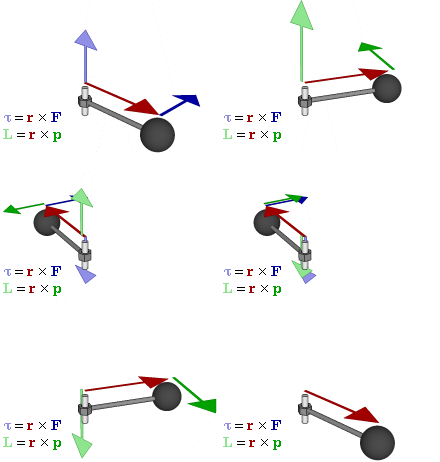
- Relationship between force F, torque τ, linear momentum p, and angular momentum L in a system which has rotation constrained to only one plane (forces and moments due to gravity and friction not considered)
- Physical quantity.unit
- N⋅m
- Physical quantity.otherunits
- pound-force-feet, lbf⋅inch, ozf⋅in
- Physical quantity.symbols
- \tau, M
- Physical quantity.baseunits
- kg⋅m2⋅s−2
- Physical quantity.dimension
- wikidata
via Wikipedia infobox
Research
37,652 papers- Investigating Torque-Speed Relationship of Self-Tapping Screws.Annual International Conference of the IEEE Engineering in Medicine and Biology Society. IEEE Engineering in Medicine and Biology Society. Annual International Conference · 2021Wilkie J, Docherty PD, Stieglitz T et al.DOI: 10.1109/EMBC46164.2021.9630356
- Just noticeable differences for elbow joint torque feedback.Scientific reports · 2021Kim H, Asbeck ATDOI: 10.1038/s41598-021-02630-3
- Torque control of maxillary anterior teeth with the double J retractor and palatal miniscrews during en masse retraction.The Angle orthodontist · 2022Liaw J, Huang G, Tsai FF et al.DOI: 10.2319/092621-725.1
- Experimentally quantifying the feasible torque space of the human shoulder.Journal of electromyography and kinesiology : official journal of the International Society of Electrophysiological Kinesiology · 2022Baillargeon EM, Ludvig D, Sohn MH et al.DOI: 10.1016/j.jelekin.2019.05.014
- Lower-Limb Joint Torque Prediction Using LSTM Neural Networks and Transfer Learning.IEEE transactions on neural systems and rehabilitation engineering : a publication of the IEEE Engineering in Medicine and Biology Society · 2022Zhang L, Soselia D, Wang R et al.DOI: 10.1109/TNSRE.2022.3156786
- Rotations of F-ATPase and V-ATPase analyzed by a torque approach.Journal of biomolecular structure & dynamics · 2023Jitapunkul K, Zhao Y, Lawtrakul L et al.DOI: 10.1080/07391102.2022.2154847
- Electrically elicited quadriceps muscle torque: Comparison at three knee angles.Physiotherapy theory and practice · 2021Scott W, Adams C, Fisher J et al.DOI: 10.1080/09593985.2019.1639867
- Object-centered sensorimotor bias of torque control in the chronic stage following stroke.Scientific reports · 2022Schneider TR, Hermsdörfer JDOI: 10.1038/s41598-022-18754-z
via PubMed
Wikidata facts
- Subclass of
- moment
- Image
- Koppel1.png
Show 5 more facts
- Commons category
- Torque
- topic's main category
- Category:Torque
- different from
- moment of force
- on focus list of Wikimedia project
- Wikipedia:Vital articles/Level/4
- maintained by WikiProject
- WikiProject Mathematics
Sources (2)
via Wikidata · CC0
~22 min read
Encyclopedic overview
21 sectionsContents
- Historical terminology
- Definition and relation to other physical quantities
- Torque as a cross product between linear force and the radius about the rotational axis
- Relationship with the angular momentum
- Proof of the equivalence of definitions
- Derivatives of torque
- Relationship with power and energy
- Proof
- Principle of moments
- Units
- Conversion to other units
- Derivation
- Special cases and other facts
- Moment arm formula
- Static equilibrium
- Net force versus torque
- Machine torque
- Torque multiplier
- See also
- References
- External links
In physics and mechanics, torque is the rotational correspondent of linear force. It is also referred to as the moment of force, or simply the moment. Just as a linear force is a push or a pull applied to a body, a torque can be thought of as a twist applied to an object with respect to a chosen axis. For example, driving a screw uses torque to force it into an object. The torque is applied by the screwdriver, rotating around its axis, to the drive on the head of the screw.
Torque is generally referred to using different vocabulary depending on geographical location and field of study, with torque generally being associated with physics and moment being associated with engineering. This article follows the definition used in US physics in its usage of the word torque.
Excerpted from Wikipedia’s “torque” article, available under the CC BY-SA 4.0 licence.
Gallery (13)
Available in 80 languages
- Español
- Français
- Deutsch
- 中文
- 日本語
- Русский
- Português
- Italiano
- العربية
- हिन्दी
- Afrikaans
- Albanian
- Armenian
- Assamese
- Asturian
- Azerbaijani
- Bahasa Indonesia
- Bangla
Show 61 more
- Basque
- Bavarian
- be_x_old
- Belarusian
- Bosnian
- Bulgarian
- Catalan
- Central Kurdish
- Chuvash
- Croatian
- Czech
- Danish
- Esperanto
- Estonian
- Finnish
- Galician
- Greek
- Haitian Creole
- Hebrew
- Hungarian
- Icelandic
- Ido
- Irish
- Kazakh
- Kurdish
- Latin
- Latvian
- Lithuanian
- Macedonian
- Malay
- Malayalam
- Marathi
- Nederlands
- Northern Frisian
- Norwegian
- Norwegian Nynorsk
- Occitan
- Oromo
- Polski
- Romanian
- Rusyn
- Serbian
- Serbian (Latin)
- simple
- Slovak
- Slovenian
- Svenska
- Tamil
- Telugu
- Tiếng Việt
- Türkçe
- Ukrainian
- Urdu
- Welsh
- Western Panjabi
- Wu Chinese
- Yiddish
- zh_classical
- zh_yue
- فارسی
- 한국어
via Wikidata sitelinks · CC0