Category
page 1Former populated places in Egypt
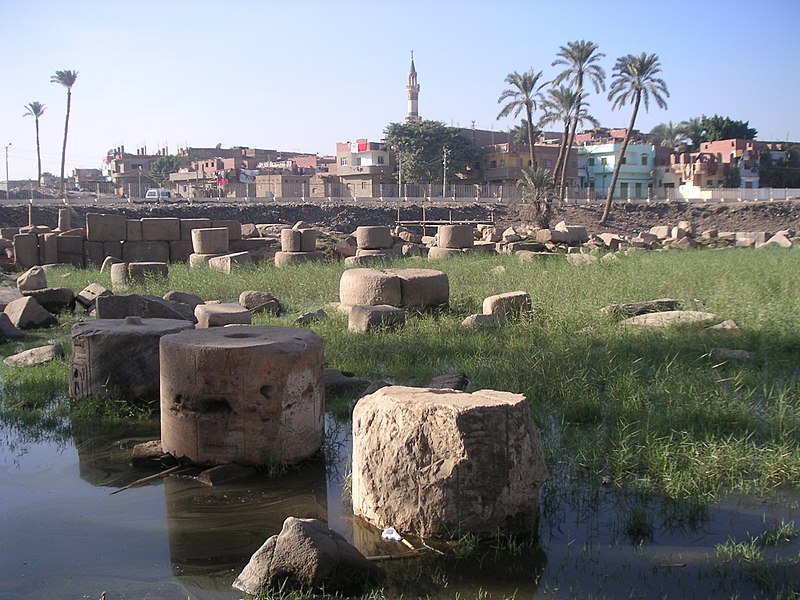
Memphis
ancient capital of Inebu-hedj, Egypt

Thebes
ancient Egyptian city

Asyut
Asyut ('''' ) is a city in Upper Egypt and the capital of the modern Asyut Governorate in Egypt. It was built close to the ancient city of the same name, which is situated nearby. The modern city is located at , while the ancient city is located at . The city is home to one of the largest Coptic Christian communities in the country.

Heliopolis
city of ancient Egypt

Abu Mena
town, monastery complex and Christian pilgrimage center in Late Antique Egypt. WHS#90

Edfu
Edfu (, , , ; also spelt Idfu, or in modern French as Edfou) is an Egyptian city, located on the west bank of the Nile River between Esna and Aswan, with a population of approximately 60,000 people. Edfu is the site of the Ptolemaic Temple of Horus and an ancient settlement, Tell Edfu. About south of Edfu are remains of ancient pyramids.

Amarna
Amarna (; ) is an extensive ancient Egyptian archaeological site containing the ruins of Akhetaten, the capital city during the late Eighteenth Dynasty. The city was established in 1346 BC, built at the direction of the Pharaoh Akhenaten, and abandoned shortly after his death in 1332 BC.

Abydos
city in ancient Egypt

Sohag
Sohag (, , ), also spelled as Suhag or Suhaj, is a city on the west bank of the Nile in Egypt. The city has been the capital of Sohag Governorate since 1960, before which the capital was Girga and the name of the governorate was Girga Governorate. The city also included Esna Governorate (nowadays part of Qena Governorate).

Sais
village in Gharbia Governorate, Egypt

Esna
Esna ( , or ; Snē from tꜣ-snt; Latópolis or (Pólis Látōn) or (Lattōn); Latin: Lato) is a city of Egypt. It is located on the west bank of the Nile some south of Luxor. The city was formerly part of the modern Qena Governorate, but as of 9 December 2009, it was incorporated into the new Luxor Governorate.

Tanis
thumb|Map of ancient Lower Egypt showing Tanis
Tanis ( ; ; ) or San al-Hagar (; ; ; or or ; ) is the Greek name for ancient Egyptian ḏꜥn.t, an important archaeological site in the northeastern Nile Delta of Egypt, and the location of a city of the same name. Tanis was the capital of the Egyptian Kingdom in its 21st and 22nd Dynasties. It is located on the Tanitic branch of the Nile, which has long since silted up.
Bubastis
thumb|Map of ancient Lower Egypt showing Bubastis
.jpg)
Nekhen
thumb|Possible illustration of the conflict between Abydos, Egypt|Abydos and Nekhen (Hierakonpolis), on the [[Gebel el-Arak Knife, Louvre Museum, 3300–3200 BCE.]]
Nekhen (, ), also known as Hierakonpolis (; , meaning City of Hawks or City of Falcons, a reference to Horus; ) was the religious and political capital of Upper Egypt at the end of prehistoric Egypt ( 3200–3100 BC) and probably also during the Early Dynastic Period ( 3100–2686 BC).
Herakleopolis Magna
archaeological site in Egypt

Hermopolis
Hermopolis (or Hermopolis Magna) was a major city in antiquity, located near the boundary between Lower and Upper Egypt. Its Egyptian name Khemenu derives from the eight deities (the Ogdoad) said to reside in the city.
right|thumb|upright|Black siltstone [[obelisk of King Nectanebo II (r. 358 to 340 BCE). According to the vertical inscriptions he set up this obelisk at the doorway of the sanctuary of Thoth Thrice-Great, Lord of Hermopolis. It is now on display in the British Museum, London.]]
A provincial capital since the Old Kingdom of Egypt, Hermopolis developed into a major city of Roman E

Avaris
thumb|An official wearing the "mushroom-headed" hairstyle also seen in contemporary paintings of Western Asiatic foreigners, from Avaris, the capital of the Hyksos. Dated to 1802–1640 BC. Staatliche Sammlung für Ägyptische Kunst.

El-Fustat
Fustat (), also Fostat, was the first capital of Egypt under Muslim rule, though it has been integrated into Cairo. It was built adjacent to what is now known as Old Cairo by the Rashidun Muslim general 'Amr ibn al-'As immediately after the Muslim conquest of Egypt in AD 641, and featured the Mosque of Amr, the first mosque built in Egypt.

Oxyrhynchus
Oxyrhynchus ( ; , ; ; ), also known by its modern name Al-Bahnasa (), is a city in Middle Egypt located about 160 km south-southwest of Cairo in Minya Governorate. It is also an important archaeological site. Since the late 19th century, the area around Oxyrhynchus has been excavated almost continually, yielding an enormous collection of papyrus texts dating from the Ptolemaic Kingdom and Roman Egypt. They also include a few vellum manuscripts, and more recent Arabic manuscripts on paper (for example, the medieval P. Oxy. VI 1006).

Deir el-Medina
ancient Egyptian village in the Valley of the Kings
Pi-Ramesses
Pi-Ramesses (; Ancient Egyptian: , meaning "House of Ramesses") was the new capital built by the Nineteenth Dynasty Pharaoh Ramesses II (1279–1213 BC) at Qantir, near the old site of Avaris. The city had served as a summer palace under Seti I (c. 1290–1279 BC), and may have been founded by Ramesses I (c. 1292–1290 BC) while he served under Horemheb.

Naucratis
Naucratis or Naukratis (; , "Naval Command"; Egyptian: , , ; ) was a city and trading-post in ancient Egypt, located on the Canopic (western-most) branch of the Nile river, south-east of the Mediterranean Sea and the city of Alexandria. Naucratis was the first and, for much of its early history, the only permanent Greek settlement in Egypt, serving as a symbiotic nexus for the interchange of Greek and Egyptian art and culture.
Pelusium
thumb|Map of ancient Lower Egypt showing Pelusium
.png)
Qift
Qift ( ; Keft or Kebto; Egyptian Gebtu; Coptos / Koptos; Roman Justinianopolis) is a city in the Qena Governorate of Egypt about north of Luxor, situated a little south of latitude 26° north, on the east bank of the Nile. In ancient times its proximity to the Red Sea made it an important trading emporium between India, Punt, Arabia Felix and the North. It was important for nearby gold and quartzite mines in the Eastern Desert, and as a starting point for expeditions to Punt (in modern Somalia) by way of the path through the Wadi Hammamat to the Red Sea port at Tjau (modern El Qoseir).
.svg)
Buto
Buto (, , Butu), Bouto, Butus (, Boutos) or Butosus was a city that the Ancient Egyptians called Per-Wadjet. It was located 95 km east of Alexandria in the Nile Delta of Egypt. What in classical times the Greeks called Buto, stood about midway between the Taly (Bolbitine) and Thermuthiac (Sebennytic) branches of the Nile, a few kilometers north of the east-west Butic River and on the southern shore of the Butic Lake (, Boutikē limnē).
Canopus
ancient Egyptian town
Maadi
Maadi ( ) is a leafy and once suburban district in the Southern Area of Cairo, Egypt, on the east bank of the Nile about upriver from downtown Cairo. The modern extensions north-east and east of Maadi, New Maadi and Zahraa al-Maadi are administratively part of the Basatin district.
Samannud
Samannud ( ) is a city (markaz) located in Gharbia Governorate, Egypt. Known in classical antiquity as Sebennytos (), Samannud is a historic city that has been inhabited since the Ancient Egyptian period. As of 2019, the population of the markaz of Samannud was estimated to be 410,388, with 83,417 people living in urban areas and 326,971 in rural areas.

Mendes
Mendes (, gen.: ), the Greek name of the ancient Egyptian city of Djedet, also known in ancient Egypt as Per-Banebdjedet ("The Domain of the Ram Lord of Djedet") and Anpet, is known today as Tell El-Ruba ().

Berenice Troglodytica
ancient port in Egypt
Buhen
Buhen, alternatively known as Βοὥν (Bohón) in Ancient Greek, stands as a significant ancient Egyptian settlement on the western bank of the Nile, just below the Second Cataract in present-day Northern State, Sudan. Its origins trace back to the Old Kingdom period (about 2686–2181BCE), where it served as an Egyptian colonial town, particularly recognized for copper smelting. In 1962, archaeological discoveries brought to light an ancient copper manufacturing facility encircled by an imposing stone barrier, indicating its origin during the rule of Sneferu in the 4th Dynasty. Inscriptions and gra

Heracleion
Heracleion (Ancient Greek: ), also known as Thonis (Ancient Greek: ; from the Ancient Egyptian: ; ) and sometimes called Thonis-Heracleion, was an ancient Egyptian port city located near the Canopic Mouth of the Nile, about northeast of Alexandria on the Mediterranean Sea. It became inundated; its remains are located in Abu Qir Bay, which in 2022 was off the coast and approximately underwater, and near Abukir. The sanctuary of Neith of Sais was located in Thonis. A stele found on the site indicates that late in its history the city was known by both its Egyptian and Greek names.

Hawara
thumb|Limestone pyramidion from the Hawara pyramid. Sir [[Flinders Petrie thought that this represented a model for Hawara pyramid. 12th Dynasty. From Hawara, Egypt. Petrie Museum, London.|alt=]]

Antinoöpolis
%20at%20El%20Kab%20(Nekheb)%2C%20Egypt.%20The%20Petrie%20Museum%20of%20Egyptian%20Archaeology%2C%20London.jpg)
El Kab
Elkab, also spelled El-Kab or El Kab, is an Upper Egyptian site on the east bank of the Nile at the mouth of the Wadi Hillal about south of Luxor (ancient Thebes). Elkab was called Nekheb in the Egyptian language ( , ), a name that refers to Nekhbet, the goddess depicted as a white vulture. In Greek it was called Eileithyias polis, "city of the goddess Eileithyia".

Itjtawy
Itjtawy or It-Towy ("Seizer of the Two Lands"), also known by its full name Amenemhat-itjtawy ("Amenemhat seizes the Two Lands"), was an ancient Egyptian royal city established by pharaoh Amenemhat I.
Leontopolis
Leontopolis was an ancient Egyptian city located in the Nile Delta, Lower Egypt. It served as a provincial capital and Metropolitan Archbishopric. The archaeological site and settlement are known today as Kafr Al Muqdam.
El-Lahun
village in Faiyum Governorate, Egypt

Malkata
Malkata (or Malqata; ), is the site of an Ancient Egyptian palace complex built during the New Kingdom, by the 18th Dynasty pharaoh Amenhotep III. It is located on the West Bank of the Nile at Thebes, Upper Egypt, in the desert to the south of Medinet Habu. The site also included a temple dedicated to Amenhotep III's Great Royal Wife, Tiy, which honors Sobek, the crocodile deity.

Pithom
Pithom (; ; or , and ) was an ancient city of Egypt. References in the Hebrew Bible and ancient Greek and Roman sources exist for this city, but its exact location remains somewhat uncertain. Some scholars identified it as the later archaeological site of Tell el-Maskhuta (). Others identified it as the earlier archaeological site of Tell El Retabeh ().
Medinet Maadi
archaeological site in the Egyptian depression of el-Faiyum
Aten
archeological site

Athribis
Athribis (; Greek: , from the original , ) was an ancient city in Lower Egypt. It is located in present-day Tell Atrib, just northeast of Benha on the hill of Kom Sidi Yusuf. The town lies around 40 km north of Cairo, on the eastern bank of the Damietta branch of the Nile. It was mainly occupied during the Ptolemaic, Roman, and Byzantine eras.
Myos Hormos
human settlement in Egypt
Busiris
village in Gharbia Governorate, Egypt
Qasr Ibrim
Archaeological site in Egypt

Letopolis
thumb|Standard of the Letopolite nome (Egypt)|nome
thumb|Five faience ushabti of Ankh-hapi, a priest in Letopolis during the Ptolemaic dynasty. The Archaeological Civic Museum (MCA) of Bologna|Bologna, Museo Civico Archeologico
Letopolis (Greek: Λητοῦς Πόλις) was an ancient Egyptian city, the capital of the second nome of Lower Egypt. Its Egyptian name was Khem 𓋊𓐍𓐝𓂜𓊖𓉐 (ḫm), and the modern site of its remains is known as Ausim (, from ). The city was a center of worship of the deity Khenty-irty or Khenti-kheti, a form of the god Horus. The site and its deity are mentioned in texts from as

Xois
village and archaeological site in Egypt

El Hiba
village in Beni Suef Governorate, Egypt
Ptolemais Hermiou
ancient city in Egypt
Cynopolis
Cynopolis ( for "city of the dog") was the Hellenistic toponym for two cities in ancient Egypt. Both Cynopolis superior and Cynopolis inferior were bishoprics in Christian times.

Medamud
thumb|right|Relief of the wall of Trajan representing a procession of singers and musicians in the honor of the [[Monthu at Medamoud.]]
Athribis
human settlement

El-Tod
El-Tod ( , from , , , ) was the site of an ancient Egyptian town and a temple to the Egyptian god Montu. It is located southwest of Luxor, Egypt, near the settlement of Hermonthis. A modern village now surrounds the site.

Nitria
human settlement in Egypt
Tjebu
human settlement

Thmuis
Thmuis (; Greek: ), modern Tell et-Timai () was a city in Lower Egypt, located on the canal east of the Nile, between its Tanitic and Mendesian branches. Its ruins are near the modern city of Timayy al-Imdid.
‘Aydhab
ʿAydhab (, also Aidab) was an important medieval port on the west coast of the Red Sea. The abandoned site of the town is located in the Halaib Triangle, a territory disputed between Egypt and the Sudan.

Karanis
thumb|right|Map of Fayum from 1895
Karanis (), located in what is now Kom Aushim, was an agricultural town in Ptolemaic and Roman Egypt located in the northeast corner of the Faiyum Oasis. It was roughly 60 hectares in size and its peak population is estimated to be 4000 people, although it could have been as much as three times greater.
Tjaru
Tjaru () was an ancient Egyptian fortress on the Way of Horus or Horus military road, the major road leading out of Egypt into Canaan. It was known in Greek as Selē (), in Latin as Sile or Sele, and in Coptic as Selē or Slē (). It has been suggested that its remains form the Tel el-Habua near Qantarah.