Category
page 1Freight transport

export
An export in international trade is a good produced in one country that is sold into another country or a service provided in one country for a national or resident of another country. The seller of such goods or the service provider is an exporter; the foreign buyer is an importer. Services that figure in international trade include financial, accounting and other professional services, tourism, education as well as intellectual property rights.
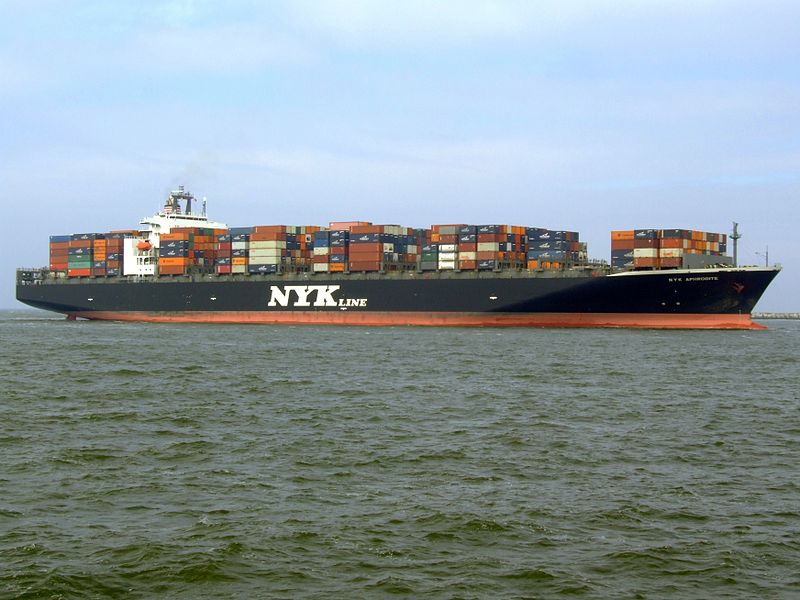
water transport
transportation on water surface (sea, lake, river, ...) or through water entity, using watercrafts

cargo
thumb|An articulated double-stack rail transport|double-stack [[well car owned by the TTX Company. The capacity car is a Gunderson Maxi-IV.]]

wholesale
thumb|The Birmingham Wholesale Markets

wharf
thumb|right|The Barbours Cut Terminal of the [[Port of Houston, US. This cargo shipping terminal has a single large wharf with multiple berths.]]
thumb|Wharf under construction on the Upper Mississippi River|Upper Mississippi in [[Fountain City, Wisconsin]]

trailer
vehicle that has a loading area but does not have its own propulsion

belt conveyor
motorized conveying system using a сlosed-loop rubber band
merchant vessel
civilian boat or ship that transports cargo or carries passengers for hire

roll-on/roll-off ship
thumb|upright=1.5|Roll-on/Roll-off car-carrying ship being boarded by articulated haulers at the [[Port of Baltimore]]
thumb|RoRo ports and Inland waterways of the United States|inland waterways of the United States
Roll-on/roll-off (RORO or ro-ro) ships are cargo ships designed to carry wheeled cargo, such as cars, motorcycles, trucks, semi-trailer trucks, buses, trailers, and railroad cars, that are driven on and off the ship on their own wheels or using a platform vehicle, such as a self-propelled modular transporter. This is in contrast to lift-on/lift-off (LoLo) vessels, which use a crane

Incoterms
The Incoterms or International Commercial Terms are a series of pre-defined commercial terms published by the International Chamber of Commerce (ICC) relating to international commercial law. Incoterms define the responsibilities of exporters and importers in the arrangement of shipments and the transfer of liability involved at various stages of the transaction. They are widely used in international commercial transactions or procurement processes and their use is encouraged by trade councils, courts and international lawyers. A series of three-letter trade terms related to common contractual
pallet jack
material-handling equipment
cabotage
Cabotage () is the transport of goods or passengers between two places in the same country by a carrier registered in a different country. The term originally applied to shipping along coastal routes, port to port, but now applies to aviation, railways, and road transport as well. Most countries do not permit cabotage, and there are strict sanctions against it, for reasons of economic protectionism, national security, or public safety. One notable exception is the European Union, whose member states all grant cabotage rights to each other.
freight transport
physical process of transporting commodities and merchandise goods and cargo

purchasing
Purchasing is the process a business or organization uses to acquire goods or services to accomplish its goals. Although there are several organizations that attempt to set standards in the purchasing process, processes can vary greatly between organizations.
freight forwarder
service company that handles the shipment of goods
merchant marine
organization, fleet and crew of merchant vessels operating under a national flag
cargo bike
bicycle used to move large and heavy loads with pedals
intermodal freight transport
cargo transport using multiple types of vehicles
semi-trailer truck
combination of a tractor unit and one or more semi-trailers to carry freight
inland navigation
water transportation on rivers and other internal waters
automated guided vehicle
type of industrial mobile robot
conveyor system
equipment used for conveying materials

materiel
thumb|upright=1.35|Materiel movements in exercise Cobra Gold in 1998
shipping list
delivery note
.png)
Cross-docking
thumb|upright=1.3|Example of cross-docking: incoming parcels (left) are sorted by label for output (right)
oversize load
load that exceeds the standard or ordinary legal size and/or weight limits
duty
tax
waybill
A waybill is a document issued by a carrier acknowledging the receipt of goods by the carrier and the contract for shipment of a consignment of that cargo. Typically it will show the names of the consignor and consignee, the point of origin of the consignment, its destination, and route. Most freight forwarders and trucking companies use an in-house waybill called a house bill. These typically contain "conditions of contract of carriage" terms on the back of the form that cover limits to liability and other terms and conditions.
multimodal transport
carriage of goods under a single contract
delivery drone
unmanned aerial vehicle (UAV) utilized to transport packages, food or other goods
tail lift
mechanical device installed on the rear of a carrier vehicle and used to facilitate moving goods to and from the level of the vehicle bed
spoke-hub distribution paradigm
form of transportation system
Freight rate
cost of transporting goods
contract of carriage
contract between carriers of goods/passengers and the sender/receiver or passenger

transshipment
thumb|Port of Singapore is currently the largest transshipment port in the world.
Transshipment, trans-shipment or transhipment is the shipment of goods or containers to an intermediate destination, then to another destination.
carrier
profession
lowboy
semi-trailer with two drops in deck height
last mile
final part of the transport of people and goods characterized by greater complexity
inventory control
subconcept of Inventory
transportation management system
supply chain management for transportation operations

port of entry
place where one may lawfully enter a country

pipeline
thumb|264x264px|HDPE pipeline on a mine site in Australia
Serial shipping container code
identifier number for logistics
loading dock
area of a building where goods vehicles are loaded and unloaded
consignor
The consignor is the party to a contract that dispatches goods to another party on consignment. In a contract of carriage, is the party sending a shipment to be delivered whether by land, sea or air. Some carriers, such as national postal entities, use the term "sender" or "shipper" but in the event of a legal dispute the proper and technical term "consignor" will generally be used.

weigh station
highway checkpoint to inspect vehicular weights
transloading
thumb|A transloading facility in Texas, between rail and road transport
Transloading, also known as cross-docking, is the process of transferring a shipment from one mode of transportation to another. It is most commonly employed when one mode cannot be used for the entire trip, such as when goods must be shipped internationally from one inland point to another. Such a trip might require transport by truck to an airport, then by airplane overseas, and then by another truck to its destination; or it might involve bulk material (such as coal) loaded to rail at the mine and then transferred to a
order picking
one of a logistic warehouse's processes
warehouse receipt
Logistics automation
application of computer software or automated machinery
boat trailer
something to move a boat, a boat trailer is a type of trailer specifically designed to transport boats over land (e.g. towing behind a vehicle). Boat trailer (Q893191) is classified as a subclass of trailer.
order fulfillment
fulfillment of orders
Logistics Performance Index
economic indicator

Sea transport systems
ocean traffick

Trade facilitation
policies intended to encourage trade between nations
freight exchange
freight internet exchange
parcel stamp
type of stamp issued to pay the fee for the transport of a parcel through the postal system
production leveling
prerequisite to allow 'flow' in the factory
Free shipping
delivering an order for free
Handelsgesetzbuch
The Handelsgesetzbuch (HGB, in English Commercial Code) contains the core of the commercial law in Germany. It regulates the legal relations of merchants and therefore it is also designated as "the special private law for merchants".