Category
page 1Freshwater algae
%20Figure%202.jpg)
Nostoc
Nostoc, also known as star jelly, '''troll's butter, spit of moon, fallen star, witch's butter''' (not to be confused with the fungi commonly known as witches' butter), and '''witch's jelly,' is the most common genus of cyanobacteria found in a variety of both aquatic and terrestrial environments that may form colonies composed of filaments of moniliform cells in a gelatinous sheath of polysaccharides. It may also grow symbiotically within the tissues of plants, providing nitrogen to its host through the action of terminally differentiated cells known as heterocysts. Nostoc is a genus that inc
%20Kutz.%20(AM%20AK310111-1).jpg)
Cladophora
thumb|Cladophora is a genus of branching filamentous green algae in the class Ulvophyceae. They may be referred to as reticulated algae, branching algae, or blanket weed. The genus has a worldwide distribution, mainly found in marine or brackish waters; a few species are found in freshwater. It is harvested for use as a food and medicine.
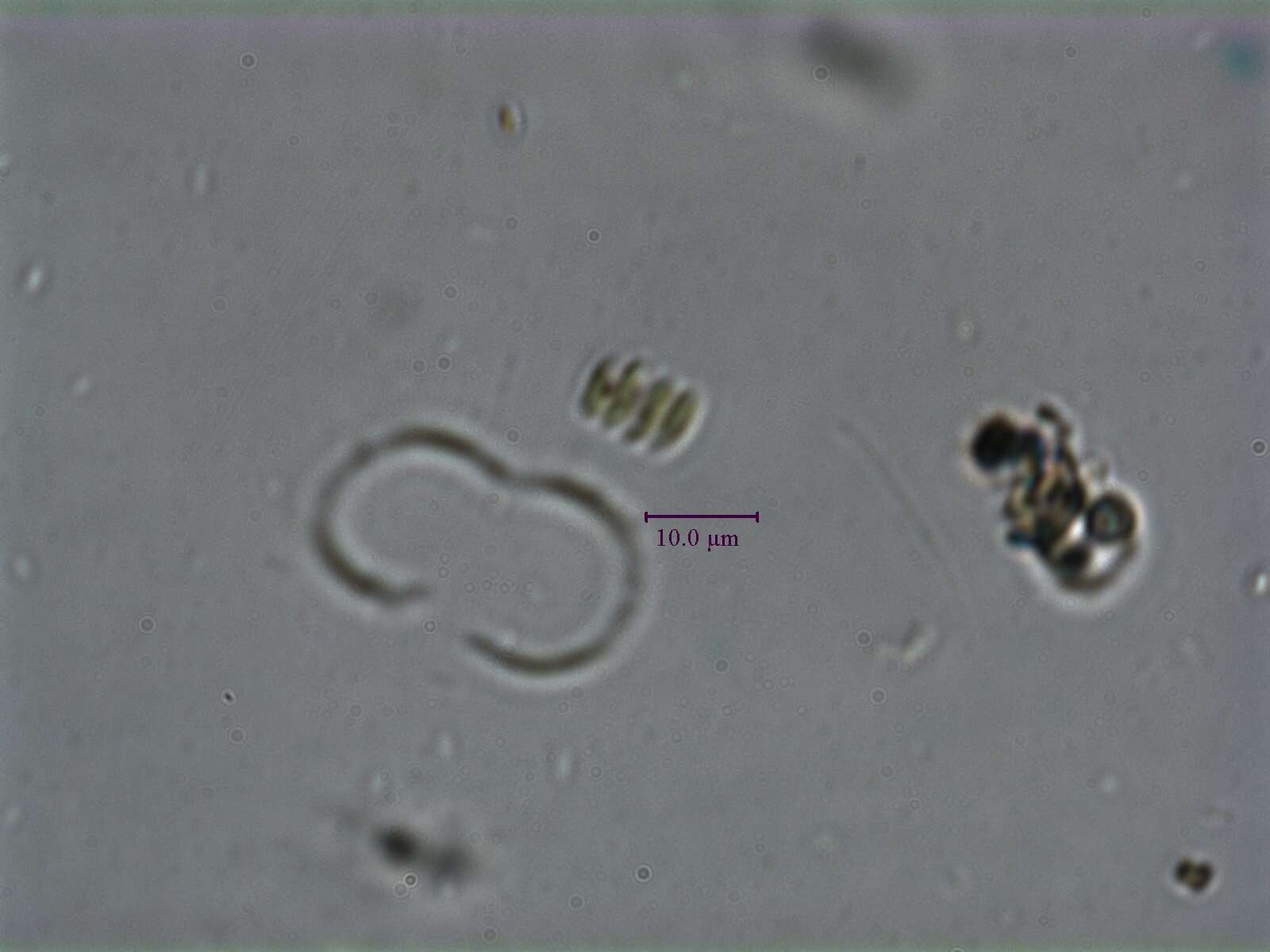
Scenedesmus
Scenedesmus is a genus of green algae, in the class Chlorophyceae. They are colonial and non-motile. They are one of the most common components of phytoplankton in freshwater habitats worldwide.
%20(7176264211)-80-v4.jpg)
Desmidiales
Desmidiales, commonly called the desmids (Gr. desmos, bond or chain), are an order in the Charophyta, a division of green algae in which the land plants (Embryophyta) emerged. Desmids consist of single-celled (sometimes filamentous or colonial) microscopic green algae. Because desmids are highly symmetrical, attractive, and come in a diversity of forms, they are popular subjects for microscopists, both amateur and professional.
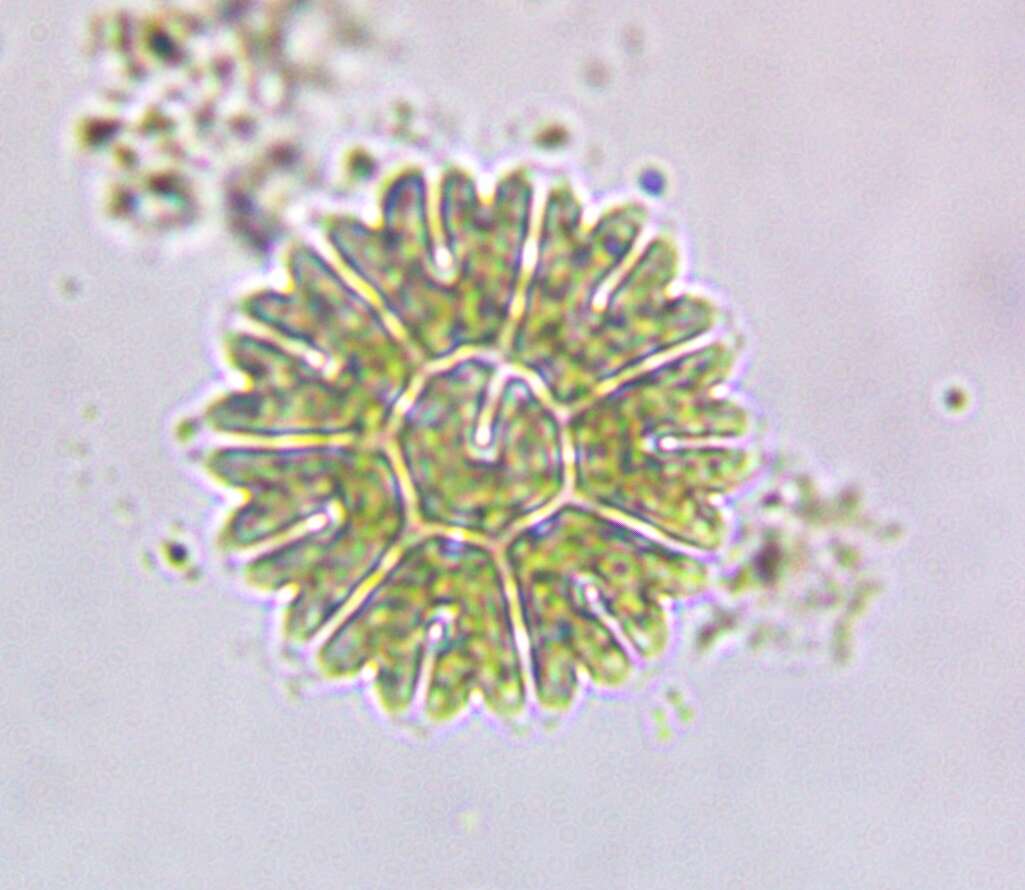
Pediastrum
Pediastrum is a genus of green algae, in the family Hydrodictyaceae. It is a photoautotrophic, nonmotile coenobial green alga that inhabits freshwater environments. The name Pediastrum comes from the Greek root words pedion, meaning "plane", and astron, meaning "star", referring to its overall shape.

Volvocaceae
Volvocaceae are a family of unicellular or colonial biflagellate algae, including the typical genus Volvox, and are collectively known as the volvocine algae. The family was named by Ehrenberg in 1834, and it is known in older classifications as the Volvocidae. All species are colonial and typically inhabit freshwater environments. They are particularly useful as model organisms for studying the evolution of multicellularity, the evolution of sex, and cellular motion and mechanics.

Chlamydomonadales
Chlamydomonadales, also known as Volvocales, are an order of flagellated or pseudociliated green algae, specifically of the Chlorophyceae. Chlamydomonadales can form planar or spherical colonies. These vary from Gonium (four to 32 cells) up to Volvox (500 cells or more). Each cell has two flagella, and is similar in appearance to Chlamydomonas, with the flagella throughout the colony moving in coordination.

Nostoc commune
species of Cyanobacteria
Phacus
Phacus is a genus of unicellular euglenoids, of the phylum Euglenozoa (also known as Euglenophyta), characterized by its flat, leaf-shaped structure, and rigid cytoskeleton known as a pellicle. These eukaryotes are mostly green in colour, and have a single flagellum that extends the length of their body. They are morphologically very flat, rigid, leaf-shaped, and contain many small discoid chloroplasts.

water net
genus of algae
.jpg)
Trebouxia
Trebouxia is a unicellular green alga. It is a photosynthetic organism that can exist in almost all habitats found in polar, tropical, and temperate regions. It can either exist in a symbiotic relationship with fungi in the form of lichen or it can survive independently as a free-living organism alone or in colonies. Trebouxia is the most common photobiont in extant lichens. It is a primary producer of marine, freshwater and terrestrial ecosystems. It uses carotenoids and chlorophyll a and b to harvest energy from the sun and provide nutrients to various animals and insects.

Mougeotia
Mougeotia is a genus of filamentous charophyte green algae of the order Zygnematales. It is a common component of freshwater aquatic habitats around the world. Described in 1824 by Carl Adolph Agardh, its name honors the French botanist Jean-Baptiste Mougeot.

Chlorella vulgaris
species of alga

Chara globularis
species of alga

Scytonema
thumb|Heterocyst of [[Scytonema crispum]]
Scytonema is a genus of photosynthetic cyanobacteria that contains over 100 species. It grows in filaments that form dark mats. Many species are aquatic and are either free-floating or grow attached to a submerged substrate, while others species grow on terrestrial rocks, wood, soil, or plants. Scytonema is a nitrogen fixer, and can provide fixed nitrogen to the leaves of plants on which it is growing. Some species of Scytonema form a symbiotic relationship with fungi to produce a lichen.
thumb|Scyptolin A
Scyptolins are a type of elastase inhibitors i

Chlorococcum
Chlorococcum is a genus of green algae, in the family Chlorococcaceae. The alga may be useful in the flocculation of lipids from wastewater. It can be found in fresh water, but is more commonly found in soil or subaerial habitats (such as growing on tree bark, wood, stones, or plaster).

Uronema
genus of algae

Prasiola
Prasiola is a genus of macroscopic green algae, found in a variety of habitats ranging from terrestrial, freshwater, to marine. The genus has a cosmopolitan distribution, ranging from the Arctic to the Antarctic.

Ankistrodesmus
thumb|250px|right|Ankistrodesmus falcatus

Carteria
Carteria is a genus of green algae in the family Chlamydomonadaceae. Carteria are similar in morphology to the common genus Chlamydomonas and differ by having four, rather than two, flagella at the vegetative stage.
Tetrabaenaceae
Tetrabaenaceae is a family of green algae in the order Chlamydomonadales. It is widespread but occasional, and found in freshwater habitats.

Botryococcus
Botryococcus is a genus of green algae. It is a microscopic or semi-microscopic alga that is found in freshwater habitats worldwide. It consists of colonies of cells in an irregular, gelatinous matrix.
Spondylomoraceae
Spondylomoraceae is a family of algae in the order Chlamydomonadales. It consists of various freshwater, microscopic algae.
Phacotaceae
Phacotaceae is a family of green algae in the order Chlamydomonadales. Members of this family are found in freshwater habitats worldwide.

Chaetophora
genus of algae
Microthamnion
Microthamnion is a genus of green algae in the family Microthamniaceae. It is found in freshwater habitats around the world, preferably with low levels of pollution; it is typically attached to solid substrates.
Schroederia
genus of algae
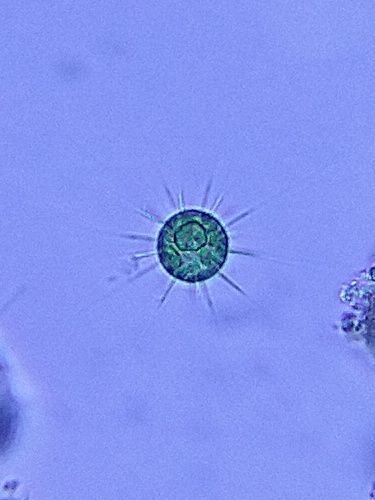
Acanthosphaera
Acanthosphaera is a genus of green algae, in the family Chlorellaceae. It contains the sole species Acanthosphaera zachariasii, although some sources list a second species, Acanthosphaera tenuissima. It is widely distributed, in freshwater habitats and exists as phytoplankton.

Crucigenia
Crucigenia is a genus of green algae in the family Scenedesmaceae. It is widespread, but not often abundant, in freshwater habitats (as phytoplankton) around the world.
Aphanochaetaceae
Aphanochaetaceae is a family of green algae in the order Chaetophorales. It occurs mainly in freshwater habitats; it may inhabit running or stagnant water, sometimes within the mucilage of red algae or other green algae.

Draparnaldia
Draparnaldia is a genus of freshwater green algae in the family Chaetophoraceae. It forms branched chains of cells, termed filaments, surrounded by mucilage. It is a cosmopolitan genus with wide distribution and it is usually found in cold aerated waters. They are either attached to sand or grow epiphytically on other aquatic plants. Draparnaldia can be seen growing in clear streams trailing on stones and boulders. Herman S. Forest of The Southern Appalachian Botanical Club has stated that while not common, it is present frequently enough to be recorded in almost all local flora lists of green

Actinastrum
Actinastrum is a genus of freshwater green algae. It was first described by Gustaf Lagerheim in 1882. Members of the genus are commonly found in eutrophic freshwater ponds and lakes, and have a cosmopolitan distribution.

Nostoc verrucosum
species of Cyanobacteria
Chlorogonium
Chlorogonium is a genus of green algae in the family Haematococcaceae. It was first described by Christian Gottfried Ehrenberg in 1837, with the type species Chlorogonium euchlorum; currently, around 30 species are accepted. They are found in freshwater habitats worldwide.

Sphaeroplea
Sphaeroplea is a genus of green algae in the family Sphaeropleaceae. It was first circumscribed by the Swedish botanist Carl Adolph Agardh in 1824.
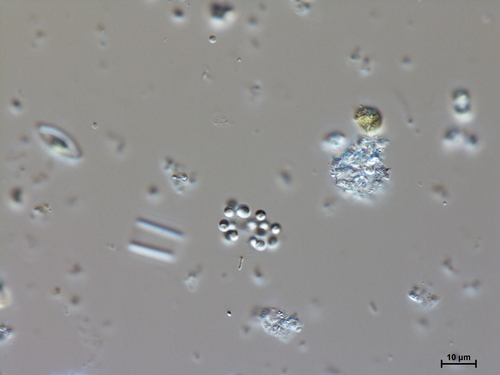
Dictyosphaerium
Dictyosphaerium is a genus of green algae, in the family Chlorellaceae. It occurs in freshwater habitats around the world and is planktonic. The name comes from the Greek roots diktyon, meaning "net", and sphaira, meaning "ball", referring to its morphology.
Raphidocelis
Raphidocelis is a genus of green algae in the family Selenastraceae. They are found in freshwater habitats.

Coelastrum
Coelastrum is a genus of green algae in the Scenedesmaceae family. It is a common component of the phytoplankton in freshwater habitats such as ponds, lakes, waterfalls, and temporary pools of water, particularly eutrophic ones. The genus has a more or less cosmopolitan distribution, although some species appear to have more restricted geographical distributions. The name comes from the Greek terms koilos, meaning hollow, and astron, meaning star.
Euglenales
Euglenales (also known as Euglenida) is an order of flagellates in the phylum Euglenozoa. The family includes the most well-known euglenoid genus, Euglena, as well as other common genera like Phacus and Lepocinclis.
Golenkiniopsis
Golenkiniopsis is a genus of green algae in the family Chlorellaceae. It is found in freshwater plankton worldwide, but is rare.

Kirchneriella
Kirchneriella is a genus of green algae in the family Selenastraceae. It is found in freshwater habitats, as phytoplankton or metaphyton.

Coccomyxa
Coccomyxa is a genus of green algae in the family Coccomyxaceae. This genus is defined by their small, elliptical to spherical shape, and the presence of a simple parietal chloroplast. These features, along with their occurrence in various lifestyles such as free-living, parasitic, or as , have been used to identify more than 40 species. Using additional morphological features, such as brown akinetes formation, allows for the differentiation between Coccomyxa and the genus Pseudococcomyxa, as they tend to share some morphological characteristics like the general cell shape and one-sided mucila
Sphaerodictyaceae
Sphaerodictyaceae is a family of green algae, in the order Chlamydomonadales.

Ankyra
Ankyra is a genus of green algae in the family Characiaceae. This genus of algae is closely related to Atractomorpha and Sphaeroplea. They are found in stagnant waters.
Treubaria
Treubaria is a genus of microscopic green algae, the sole genus in the family Treubariaceae. Treubaria is found in freshwater habitats and has a cosmopolitan distribution.
Micractinium
Micractinium is a genus of microscopic green algae in the family Chlorellaceae. Species of the genus Micractinium are found as phytoplankton, and are commonly found in freshwater habitats around the world. A few species are found as endosymbionts of ciliates. There is increasing interest in Micractinium due to its high growth rate and lipid production.

Geminella
genus of algae
Stichococcus
Stichococcus is a genus of green algae in the family Stichococcaceae. It is a very common algal genus found in a variety of habitats, such as tree trunks, soil, snow, freshwater and marine habitats. One species, Stichococcus bacillaris is economically important as it produces fatty acids useful for biofuels.

Monoraphidium
Monoraphidium is a genus of green algae in the family Selenastraceae. Monoraphidium is found free-floating or attached to surfaces in water, or in soils. It is one of the most common types of phytoplankton in freshwater habitats, and has a cosmopolitan distribution.
Desmodesmus
Desmodesmus is a genus of green algae in the family Scenedesmaceae.
Klebahniella
Klebahniella is a genus of green algae in the family Chaetophoraceae, containing the sole species Klebahniella elegans. It is a freshwater alga that occurs in or within the gelatinous colony of Nostoc verrucosum, a cyanobacterium.
Leptosira
Leptosira is a genus of green algae, in the class Trebouxiophyceae. It is epiphytic on aqutic plants, and is found in freshwater habitats or in soil.

Rhizoclonium
Rhizoclonium is a genus of green algae in the family Cladophoraceae. It is a cosmopolitan genus found in fresh, brackish and marine waters.
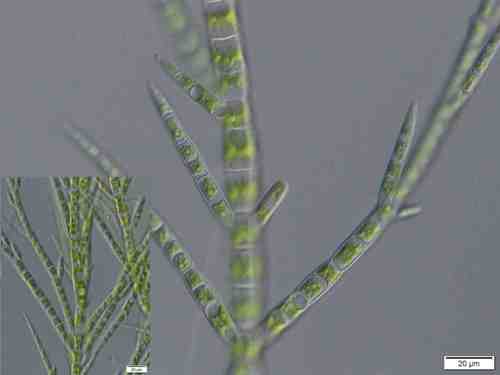
Stigeoclonium
Stigeoclonium is a genus of green algae in the family Chaetophoraceae. It is a common freshwater genus, found growing attached to various substrates; it has a cosmopolitan distribution.

Quadrigula
Quadrigula is a genus of green algae in the family Selenastraceae. It is commonly found in freshwater habitats as phytoplankton.

Asterococcus
Asterococcus is a genus of green algae in the order Chlamydomonadales. It is planktonic in freshwater ponds and lakes, or benthic within mires and swamps. It is a common and widespread genus, but is rarely abundant.
Koliella
Koliella is a genus of green algae in the order Prasiolales. Members of this genus are found in freshwater plankton, but some are also found on snow and ice.
Echinosphaeridium
Echinosphaeridium is a genus of green algae in the family Neochloridaceae. It is found in freshwater habitats, but it is very rare. It has only been recorded a few times since its original discovery in Sweden.
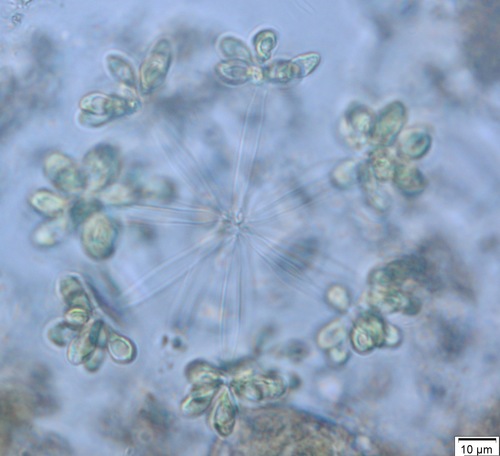
Actidesmium
Actidesmium is a small genus of green algae in the family Characiaceae. It was described by the German phycologist Paul Friedrich Reinsch in 1875.
Lagerheimia
Lagerheimia is a genus of green algae in the family Oocystaceae. It is commonly found in freshwater habitats all over the world, although some species are rare and have only been recorded from Europe or the United States.