Category
page 1Giant planets

51 Pegasi b
extrasolar planet

hot Jupiter
class of gas giant exoplanets that are inferred to be physically similar to Jupiter but that have very short orbital periods (P < 10 days)

HD 209458 b
extrasolar planet
giant planet
planet much larger than the Earth

WASP-12b
WASP-12b is a hot Jupiter (a class of extrasolar planets) orbiting the star WASP-12, discovered in April of 2008, by the SuperWASP planetary transit survey. The planet takes only a little over one Earth day to orbit its star, in contrast to about 365.25 days for the Earth to orbit the Sun. Its distance from the star (approximately ) is only \textstyle\frac{1}{43} the Earth's distance from the Sun, with an eccentricity the same as Jupiter's. Consequently, it has one of the lowest densities for exoplanets ("inflated" by the flux of energy from the star). On December 3, 2013, scientists working w

2M1207b
2M1207b is a planetary-mass object orbiting the brown dwarf 2M1207, in the constellation Centaurus, approximately 170 light-years from Earth. It is one of the first candidate exoplanets to be directly observed (by infrared imaging). It was discovered in April 2004 by the Very Large Telescope (VLT) at the Paranal Observatory in Chile by a team from the European Southern Observatory led by Gaël Chauvin. It is believed to be from 5 to 6 times the mass of Jupiter and may orbit 2M1207 at a distance roughly as far from the brown dwarf as Pluto is from the Sun.
TrES-4 b
TrES-4b is an exoplanet. It was discovered in 2006, and announced in 2007, by the Trans-Atlantic Exoplanet Survey, using the transit method. At the time of its discovery TrES-4 was the largest confirmed exoplanet ever found; now more than 10 larger planets have been discovered. It is approximately away orbiting the star GSC 02620-00648, in the constellation Hercules.

Ditsö̀
WASP-17b, officially named Ditsö̀, is an exoplanet in the constellation Scorpius that is orbiting the star WASP-17. Its discovery was announced on 11 August 2009. It is the first planet discovered to have a retrograde orbit, meaning it orbits in a direction counter to the rotation of its host star. This discovery challenged traditional planetary formation theory. In terms of diameter, WASP-17b is one of the largest exoplanets discovered and at half Jupiter's mass, this made it the most puffy planet known in 2010. On 3 December 2013, scientists working with the Hubble Space Telescope reported d
55 Cancri b
extrasolar planet

TrES-2b
TrES-2b (also known as Kepler-1b or GSC 03549-02811b) is an extrasolar planet orbiting the star GSC 03549-02811 located 750 light years away from the Solar System. The planet was identified in 2011 as the darkest known exoplanet, reflecting less than 1% of any light that hits it. Reflecting less light than charcoal, on the surface the planet is said to be pitch black, although it does emit dim red glow due to its temperature. The planet's mass and radius indicate that it is a gas giant with a bulk composition similar to that of Jupiter. Unlike Jupiter, but similar to many planets detected arou
55 Cancri c
extrasolar planet
Gliese 436 b
extrasolar planet

mini-Neptune
thumb|upright=1.1|Artist's conception of a mini-Neptune or "gas dwarf"
AEgir
exoplanet in the Ran planetary system
PSR B1620-26 b
extrasolar planet
55 Cancri d
extrasolar planet

HAT-P-1b
HAT-P-1b is an extrasolar planet orbiting the Sun-like star HAT-P-1, also known as ADS 16402 B. HAT-P-1 is the dimmer component of the ADS 16402 binary star system. It is located roughly 521 light years away from Earth in the constellation Lacerta. HAT-P-1b is among the least dense of any of the known extrasolar planets.
HAT-P-11 b
HAT-P-11b (or Kepler-3b) is an extrasolar planet orbiting the star HAT-P-11. It was discovered by the HATNet Project team in 2009 using the transit method, and submitted for publication on 2 January 2009.
Gliese 876 e
extrasolar planet

mega-Earth
upright=1.5|thumb|Size comparison of Earth and Neptune with the mega-Earth TOI-1853 b (center), a very dense Neptune-sized [[exoplanet believed to be nearly entirely made of solid rock, metal, and water.]]

Kepler-4 b
Kepler-4b, initially known as KOI 7.01, is an extrasolar planet first detected as a transit by the Kepler spacecraft. Its radius and mass are similar to that of Neptune; however, due to its proximity to its host star, it is substantially hotter than any planet in the Solar System. The planet's discovery was announced on January 4, 2010, in Washington, D.C., along with four other planets that were initially detected by the Kepler spacecraft and subsequently confirmed by telescopes at the W.M. Keck Observatory.
CoRoT-1 b
CoRoT-1b (previously named CoRoT-Exo-1b) is a transiting extrasolar planet approximately 2,630 light-years away in the constellation of Monoceros. The planet was discovered orbiting the yellow dwarf star CoRoT-1 in May 2007. The planet was the first discovery by the French-led CoRoT Mission.

WASP-18b
WASP-18b is an exoplanet that is notable for having an orbital period of less than one day. It has a mass equal to 10 Jupiter masses, just below the boundary line between planets and brown dwarfs (about 13 Jupiter masses). Due to tidal deceleration, it is expected to spiral toward and eventually merge with its host star, WASP-18, in less than a million years. The planet is approximately from its star, which is about from Earth. A team led by Coel Hellier, a professor of astrophysics at Keele University in England, discovered the exoplanet in 2009.
HD 149026 b
extrasolar planet
Gamma Cephei Ab
extrasolar planet in the constellation Cepheus
HD 80606 b
extrasolar planet in the constellation Ursa Major
Mu Arae b
extrasolar planet orbiting Cervantes
eccentric Jupiter
Jovian planet that orbits its star in an eccentric orbit

Kepler-7 b
Kepler-7b is one of the first five exoplanets to be confirmed by NASA's Kepler spacecraft, and was confirmed during the first 34 days of Kepler's science operations. It orbits a star slightly hotter and significantly larger than the Sun that is expected to soon reach the end of the main sequence. Kepler-7b is a hot Jupiter that is about half the mass of Jupiter, but is nearly 1.5 times its size; at the time of its discovery, Kepler-7b was the second most diffuse planet known, surpassed only by WASP-17b. It orbits its host star every five days at a distance of approximately . Kepler-7b was anno

HAT-P-7 b
HAT-P-7b (or Kepler-2b) is an extrasolar planet discovered in 2008. It orbits very close to its host star and is larger than Jupiter. Due to the extreme heat that it receives from its star, the dayside temperature is predicted to be , while nightside temperatures are . HAT-P-7b is also one of the darkest planets ever observed, with an albedo of less than 0.03—meaning it absorbs more than 97% of the visible light that strikes it.

XO-1b
XO-1b is an extrasolar planet approximately 536 light-years away from Earth.
WASP-1b
WASP-1b is an extrasolar planet orbiting the star WASP-1 located 1,300 light-years away in the constellation Andromeda.
Tau Boötis b
extrasolar planet
Mu Arae d
extrasolar planet orbiting the star Mu Arae
super-Jupiter
thumb|Artist's impression of 2M1207b
A super-Jupiter is a gas giant exoplanet that is more massive than the planet Jupiter. For example, companions at the planet–brown dwarf borderline have been called super-Jupiters, such as around the star Kappa Andromedae.
e Virginis b
extrasolar planet
CFBDSIR 2149-0403
rogue planet
Beta Pictoris b
extrasolar planet
CoRoT-4 b
CoRoT-4b (formerly known as CoRoT-Exo-4b) is an extrasolar planet orbiting the star CoRoT-4. It is probably in synchronous orbit with stellar rotation. It was discovered by the French CoRoT mission in 2008.
CoRoT-2 b
CoRoT-2b (formerly known as CoRoT-Exo-2b) is the second extrasolar planet to be detected by the French-led CoRoT mission, and orbits the star CoRoT-2 at a distance of 700 light years from Earth towards the constellation Aquila. Its discovery was announced on 20 December 2007. After its discovery via the transit method, its mass was confirmed via the radial velocity method.
Upsilon Andromedae b
extrasolar planet

TrES-1b
TrES-1b is an extrasolar planet approximately 523 light-years away in the constellation of Lyra (the Lyre). The planet's mass and radius indicate that it is a Jovian planet with a similar bulk composition to Jupiter. Unlike Jupiter, but similar to many other planets detected around other stars, TrES-1 is located very close to its star, and belongs to the class of planets known as hot Jupiters. The planet was discovered orbiting around GSC 02652-01324 (an orange dwarf star).
Pollux b
extrasolar planet
Kepler-5 b
__NOTOC__
COROT-9b
CoRoT-9b is an exoplanet orbiting the star CoRoT-9, approximately 1500 light years away in the constellation Serpens. CoRoT-9b's distance of nearest approach to its parent star of approximately 0.36 AU was the largest of all known transiting planets at the time of its discovery, with an orbital period of 95 days. The transit of this planet lasts 8 hours. The planet is at a distance from its star where there is a strong increase in albedo as the temperature decreases, because of the condensation of reflective water clouds in the atmosphere. This suggests its atmosphere may be locked into one of
18 Delphini b
extrasolar planet
WASP-2b
WASP-2b is an extrasolar planet orbiting the star WASP-2 located about 500 light years away in the constellation of Delphinus. It was discovered via the transit method, and then follow up measurements using the radial velocity method confirmed that WASP-2b was a planet. The planet's mass and radius indicate that it is a gas giant with a similar bulk composition to Jupiter. Unlike Jupiter, but similar to many other planets detected around other stars, WASP-2b is located very close to its star, and belongs to the class of planets known as hot Jupiters. A 2008 study concluded that the WASP-2b sys
XO-3b
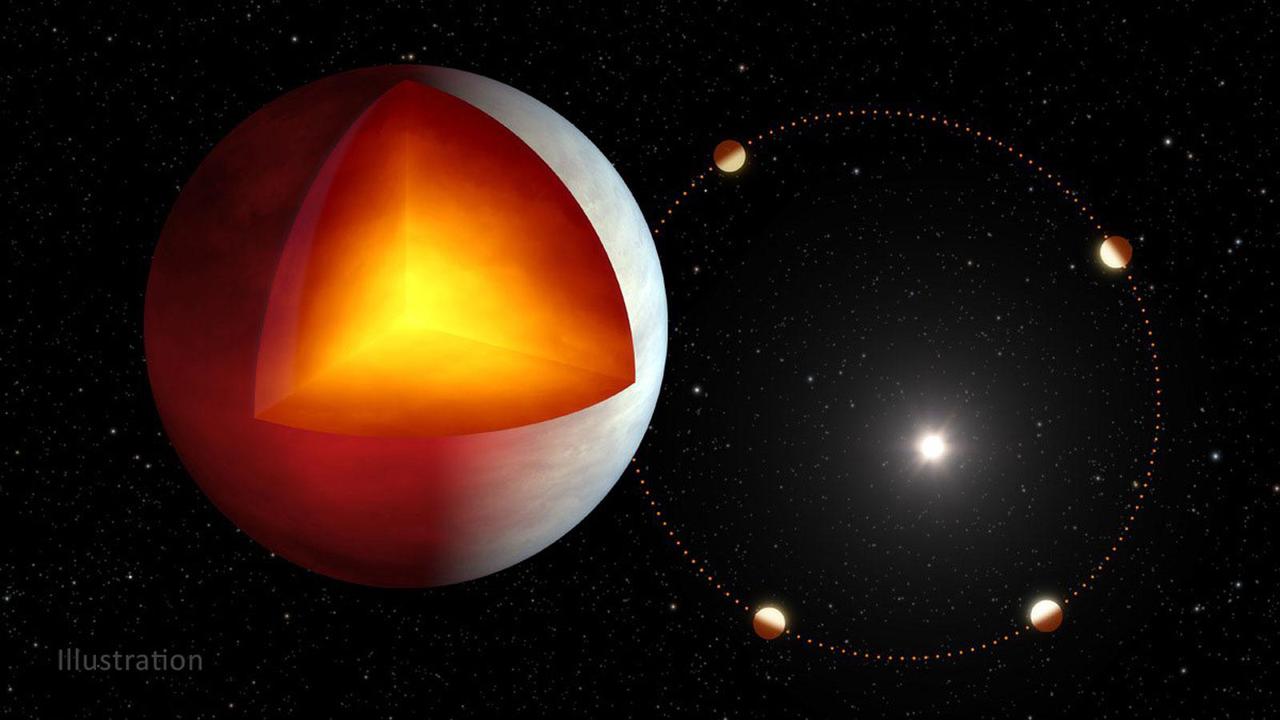
XO-3b is an exoplanet with about 11.79 times the mass of Jupiter, and it orbits its parent star XO-3 in about 3.2 days. The radius of this object is 1.217 times that of Jupiter. Astronomers announced their discovery on May 30, 2007, at the American Astronomical Society in Honolulu, Hawaii. Its discovery is attributed to the combined effort of amateur and professional astronomers working together on the XO Project using a telescope located on the Haleakala summit in Hawaii.
16 Cygni Bb
extrasolar planet
70 Virginis b
extrasolar planet
Mu Arae e
extrasolar planet in the constellation Ara
HR 8799 c
extrasolar planet

HR 8799 b
extrasolar planet
Kepler-9 b
__NOTOC__
14 Herculis b
extrasolar planet
WASP-11b/HAT-P-10b
WASP-11b/HAT-P-10b or WASP-11Ab/HAT-P-10Ab is an extrasolar planet discovered in 2008. The discovery was announced (under the designation WASP-11b) by press release by the SuperWASP project in April 2008 along with planets WASP-6b through to WASP-15b, however at this stage more data was needed to confirm the parameters of the planets and the coordinates were not given. On 26 September 2008, the HATNet Project's paper describing the planet which they designated HAT-P-10b appeared on the arXiv preprint server. The SuperWASP team's paper appeared as a preprint on the Extrasolar Planets Encyclopae
Mulchatna
extrasolar planet
Teberda
HAT-P-3b, also named Teberda, is an extrasolar planet that orbits the star HAT-P-3 approximately 450 light-years away in the constellation of Ursa Major. It was discovered by the HATNet Project via the transit method and confirmed with Doppler spectroscopy, so both its mass and radius are known quite precisely. Based on these figures it is predicted that the planet has about 75 Earth masses' worth of heavy elements in its core, making it similar to the planet HD 149026 b.
Magor
HAT-P-2b is an extrasolar planet detected by the HATNet Project in May 2007. It orbits a class F star HAT-P-2, (bigger and hotter than the Sun), located about 420 light-years away in the constellation Hercules.
79 Ceti b
extrasolar planet