Category
page 1Greek goddesses

Hera
thumb|right|360px|Iris (on the left) with Zeus and Hera, east frieze of the Parthenon, [[British Museum.]]

Demeter
In ancient Greek religion and mythology, Demeter (; Attic: Dēmḗtēr ; Doric: Dāmā́tēr) is the Olympian goddess of the harvest and agriculture, presiding over crops, grains, food, and the fertility of the earth. Although Demeter is mostly known as a grain goddess, she also appeared as a goddess of health, birth, and marriage, and had connections to the Underworld. She is also called Deo ( Dēṓ).

Muse
thumb|Muse, perhaps Clio, reading a scroll (Attic red-figure [[lekythos, Boeotia, )]]
In ancient Greek religion and mythology, the Muses (, ; singular: , Moúsa, ; , ) were the inspirational goddesses of literature, science, and the arts. They were considered the source of the knowledge embodied in the poetry, lyric songs, and myths that were related orally for centuries in ancient Greek culture.
.JPG)
Persephone
In ancient Greek mythology and religion, Persephone ( ; , classical pronunciation: ), also called Kore () or Cora, is the daughter of Zeus and Demeter. She became the queen of the underworld after her abduction by her uncle Hades, the king of the underworld, who later took her into marriage. The myth of her abduction, her sojourn in the underworld, and her cyclical return to the surface represents her functions as the embodiment of spring and the personification of vegetation, especially grain crops, which disappear into the earth when sown, remain hidden for a period, sprout from the earth, a

Gaia
In Greek mythology, Gaia (; , a poetic form of (''''), meaning 'land' or 'earth'), also spelled Gaea (), is the personification of Earth. She is the mother of Uranus (Sky), with whom she conceived the Titans (themselves parents of many of the Olympian gods), the Cyclopes, and the Giants, as well as of Pontus (Sea), from whose union she bore the primordial sea gods. Her equivalent in the Roman pantheon was Terra.

Rhea
female Titan in Greek mythology, mother of Zeus and mother of Hera

Selene
In ancient Greek mythology and religion, Selene (; ) is the goddess and personification of the Moon. Also known as Mene (; ), she is traditionally the daughter of the Titans Hyperion and Theia, and sister of the sun god Helios and the dawn goddess Eos. She drives her moon chariot across the heavens. Several lovers are attributed to her in various myths, including Zeus, Pan, her brother Helios and the mortal Endymion. In post-classical times, Selene was often identified with Artemis, much as her brother, Helios, was identified with Apollo. Selene and Artemis were also associated with Hecate and

Pandora
thumb|Pandora by John William Waterhouse, 1896

Themis
In Greek mythology and religion, Themis (; ) is the goddess and personification of justice, divine order, law, and custom. She is one of the twelve Titan children of Gaia and Uranus, and the second wife of Zeus. She is associated with oracles and prophecies, including the Oracle of Delphi.

Nyx
In Greek mythology, Nyx (; ) is the goddess and personification of the night. In Hesiod's Theogony, she is the offspring of Chaos, and the mother of Aether (Upper Sky) and Hemera (Day) by Erebus (Darkness). By herself, she produces a brood of children which are mainly personifications of primarily negative forces. She features in a number of early cosmogonies, which place her as one of the first deities to exist. In the works of poets and playwrights, she lives at the ends of the Earth, and is often described as a black-robed goddess who drives through the sky in a chariot pulled by horses. In

Nike
goddess of victory in Greek mythology

Eos
In ancient Greek mythology and religion, Eos (; Ionic and Homeric Greek Ēṓs, Attic Héōs, "dawn", or ; Aeolic Aúōs, Doric Āṓs) is the goddess and personification of the dawn, who rose each morning from her home at the edge of the river Oceanus to deliver light and disperse the night. In Greek tradition and poetry, she is characterized as a goddess with a great sexual appetite, who took numerous human lovers for her own satisfaction and bore them several children. Like her Roman counterpart Aurora and Rigvedic Ushas, Eos continues the name of an earlier Indo-European dawn goddess, Hausos. Eos, o

Leto
In ancient Greek mythology and religion, Leto (; ) is a childhood goddess, the daughter of the Titans Coeus and Phoebe, the sister of Asteria, and the mother of Apollo and Artemis.

Mnemosyne
In Greek mythology, Mnemosyne (; ) was one of the Titans, who are the children of Uranus (Sky) and Gaia (Earth). She was the goddess of memory and the mother of the nine Muses by Zeus. The name Mnemosyne is derived from the Greek word mnēmē ('remembrance, memory').

Hebe
ancient Greek goddess of youth

Circe
<!--

Ariadne
In Greek mythology, Ariadne (; ) was a Cretan princess, the daughter of King Minos of Crete. There are variations of Ariadne's myth, but she is known for helping Theseus escape from the Minotaur and being abandoned by him (or herself dying) on the island of Naxos. There, Dionysus saw Ariadne sleeping, fell in love with her, and later married her. Many versions of the myth recount Dionysus throwing Ariadne's jeweled crown into the sky to create a constellation, the Corona Borealis.

Erinyes
thumb|upright=1.2|Clytemnestra tries to awaken the sleeping Erinyes. Detail from an [[Apulian red-figure bell-krater, 380–370 BC.]]

Theia
In Greek mythology, Theia (; ) also called Thea, Thia, Euryphaessa, Aethra or Basileia, was one of the Titans, the children of Uranus (Sky) and Gaia (Earth).

Phoebe
titan in Greek mythology

Eris
Greek goddess of discord
.jpg)
Nemesis
In ancient Greek religion and myth, Nemesis (; ), also called Rhamnousia (or Rhamnusia; ), was the goddess who personified retribution for the sin of hubris: arrogance before the gods.

Iris
the personification of the rainbow in ancient Greek religion and mythology
.jpg)
Charites
thumb|300x300px|The Three Graces in a fresco at [[Pompeii, 1–50 AD]]

Cybele
Cybele ( ; 'Kubeleya Mother', perhaps 'Mountain Mother'; ; Kybélē, Kybēbē, Kybelis) is an Anatolian mother goddess; she may have a possible forerunner in the earliest Neolithic at Çatalhöyük. Greek colonists in Asia Minor adopted and adapted her Phrygian cult and spread it to mainland Greece and to the more distant western Greek colonies around the sixth century BC.
%20-%20Day%20(1884).jpg)
Hemera
thumb|Hemera (1884) by William-Adolphe Bouguereau

Metis
Oceanid of Greek mythology, goddess of wisdom, daughter of Oceanid and Tethys

Horae
thumb|upright=1.3|Dionysus leads the Horae. Dionysus carries his [[thyrsus, and the middle Hora hold ears of wheat. Neo-Attic Roman relief, c. 50–25 BC.]]
In Greek mythology, the Horae (), Horai () or Hours (, ) were the goddesses of the seasons and the natural portions of time.
.jpg)
Semele
In Greek mythology, Semele (; ), or Thyone (; ), was the youngest daughter of Cadmus and Harmonia, and the mother of Dionysus by Zeus (her own great-grandfather).

Harmonia
thumb|250px|Statue of Harmonia in the Harmony Society gardens in Old Economy Village, Pennsylvania.

Pasiphaë
In Greek mythology, Pasiphaë (, derived from the dative plural 'for all' and 'light'; , or , ) was the daughter of Helios, queen of Crete, and mother of the Minotaur. After her husband Minos failed to sacrifice the Cretan Bull to Poseidon as promised, the god cursed Pasiphaë to fall in love with the bull. She had Daedalus build a hollow wooden cow for her to hide in, which she then used to mate with the bull; afterwards, she gave birth to the Minotaur.
.jpg)
Hygieia
[[File:Statue of Hygieia (cropped).jpg|thumb|upright|Image of a marble statue depicting the lower portion of the goddess Hygieia while seated with a portion of a snake coiled atop the legs. Located in the Roman collection in The Metropolitan Museum of Art, inv: 03.12.11a Dates to the 1st or 2nd century, A.D.]]

Ceto
Ceto (; ) is a primordial sea goddess in Greek mythology, the daughter of Pontus and his mother, Gaia. As a mythological figure, she is considered to be one of the most ancient deities, and bore a host of monstrous children fathered by Phorcys, another child of Gaia and Pontus. The small Solar System body 65489 Ceto was named after her, and its satellite after Phorcys.

Eileithyia
Eileithyia or Ilithyia (; , ; (Eleuthyia, ) in Crete, also (Eleuthia, ) or (Elysia, ) in Laconia and Messene, and (Eleuthō) in literature) was the Greek goddess of childbirth and midwifery, and the daughter of Zeus and Hera.

Dione
Greek goddess, mother of Aphrodite

Ananke
thumb|Ananke as represented by a modern illustration of Plato's Republic
Ino
queen in Greek mythology
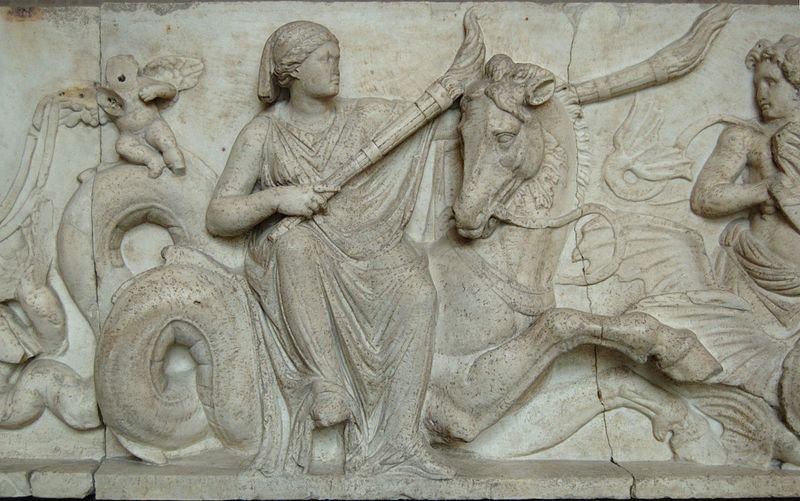
Doris
Oceanid of Greek mythology
Bia
ancient Greek goddess, personification of force

Graeae
thumb|Perseus and the Graeae by [[Edward Burne-Jones (1892)|255x255px]]
The Graeae (alternatively spelled Graiai; ; Graiai, ,), also called the Grey Sisters and the Phorcides (), were three sisters of Greek mythology who had gray hair from their birth and shared one eye and one tooth among them. They were the daughters of the primordial sea gods Phorcys and Ceto and sisters of, among others, the Gorgons. Their names were Deino (), Pemphredo (), and Enyo (; not to be confused with the war goddess, Enyo). They are best known from their encounter with Perseus, who, after capturing their eye, forc

Enyo
In Greek mythology, Enyo (; ) is a war-goddess, frequently associated with the war-god Ares. The Romans identified her with Bellona.
Eurynome
Oceanid of Greek mythology

Asteria
In Greek mythology, Asteria or Asterie ( ; ) is a daughter of the Titans Phoebe and Coeus (Polus) and the sister of Leto. According to Hesiod, by the Titan Perses she had a single child, a daughter named Hecate, the goddess of witchcraft. Other authors made Asteria the mother of the fourth Heracles and Hecate by Zeus.
Atë
ancient Greek goddess of mischief
Apate
In Greek mythology, Apate (; Ancient Greek: Ἀπάτη Apátē) is the goddess and personification of deceit. Her mother is Nyx, the personification of the night. In Roman mythology her equivalent is Fraus (Fraud), while her male counterpart is Dolus (Deception), both considered children of Nyx and Erebus according to Cicero. Her opposite number Aletheia, the goddess of truth.
Asia
Oceanid of Greek mythology

Despoina
Despoina or Despoena (; ) was the epithet of a goddess worshipped by the Eleusinian Mysteries in Ancient Greece as the daughter of Demeter and Poseidon and the sister of Arion. Surviving sources refer to her exclusively under the title Despoina ("the Mistress," cognate of "Despot") alongside her mother Demeter, as her real name could not be revealed to anyone except those initiated into her mysteries and was consequently lost with the extinction of the Eleusinian religion.
Philyra
Oceanid of Greek mythology
Pheme
In Greek mythology, Pheme ( ; Greek: , Phēmē), also known as Ossa ("Rumor") in Homeric literature, was the divine personification of fame, renown, and rumors. Her equivalent in Roman mythology, Fama, was likewise the personification of fame, and was depicted similarly in Roman literature and art. Both goddesses represented the two-sided nature of fame; those in their favor received notability and praise, while those subject to their wrath were haunted by scandal and rumors.

Bendis
thumb|right|Artemis Bendis, moulded terracotta figurine, perhaps from Tanagra, BC ([[Louvre)]]
Oizys
In Greek mythology, Oizys (; ), or Oezys (Οἰζύς), is the personification of pain or distress. In Hesiod's Theogony, Oizys is one of the offspring of Nyx (Night), produced without the assistance of a father. Oizys has no distinct mythology of her own.

Aphaea
thumb|right|260px|Temple of Aphaea|Temple of Aphaia on the island of [[Aegina.]]
Aphaia (, Aphaía) was a Greek goddess who was worshipped almost exclusively at a single sanctuary on the island of Aegina in the Saronic Gulf.
Pandia
In Greek mythology, the goddess Pandia or Pandeia (, meaning "all brightness") was a daughter of Zeus and the goddess Selene, the Greek personification of the moon. From the Homeric Hymn to Selene, we have: "Once the Son of Cronos [Zeus] was joined with her [Selene] in love; and she conceived and bare a daughter Pandia, exceeding lovely amongst the deathless gods." An Athenian tradition perhaps made Pandia the wife of Antiochus, the eponymous hero of Antiochis, one of the ten Athenian tribes (phylai).

Ersa
thumb|
Potnia Theron
female divinitiy associated with animals

Alala
Alala (Ancient Greek: (alalá); "battle-cry" or "war-cry") was the personification of the war cry in Greek mythology. Her name derives from the onomatopoeic Greek word (alalḗ), hence the verb (alalázō), "to raise the war-cry". Greek soldiers attacked the enemy with this cry in order to cause panic in their lines and it was asserted that Athenians adopted it to emulate the cry of the owl, the bird of their patron goddess Athena.
Aura
divine personification of the breeze in Greek and Roman mythology
Eidyia
In Greek mythology, Idyia () or Eidyia (; ) was a daughter of the Titans Oceanus and Tethys, and queen to Aeëtes, king of Colchis. She was the mother of Medea, Chalciope and Absyrtus. According to Apollonius of Rhodes, she was the youngest of the Oceanides. Her name means "the fair-faced" or "the knowing one" derived from the Greek word () meaning "to see" or "to know".
Lampetia
In Greek mythology, Lampetia ( or ) also spelled Lampetie, was a nymph or goddess and a daughter of the sun god, Helios. She and her sister Phaethusa watched over their father's prized herds of cattle and sheep on the island of Thrinacia (Sicily). Lampetia wielded an orichalcum staff and herded the cattle.
Benthesikyme
In Greek mythology, Benthesikyme or Benthesicyme (; ) was, according to the mythographer Apollodorus, a daughter of Poseidon and Amphitrite, and the foster mother of Eumolpus. After Chione slept with Poseidon, she gave birth to Eumolpus, but, to avoid the detection of her father, she threw the infant into the sea. Poseidon rescued the child, and gave it to Benthesikyme to raise. Once Eumolpus had grown up, the husband of Benthesikyme gave to him one of their own two daughters; he was later expelled for attempting to violate the sister of wife.