Category
page 1Happiness

happiness
thumb|upright=1.2|A 93-year-old man from Pichilemu, Chile. His smile and facial expression indicates his happiness.

laughter
thumb|A child in [[Laos laughing|upright=.97]]
Audio of a woman laughing|thumb|right|upright=.97

smile
thumb|Detail of the Mona Lisa, who is known for her smilethumb|A smiling child
A smile is a facial expression formed primarily by flexing the muscles at the sides of the mouth. Some smiles include a contraction of the muscles at the corner of the eyes, an action known as a Duchenne smile.
Among humans, a smile expresses delight, sociability, happiness, joy, or amusement. It is distinct from a similar but usually involuntary expression of anxiety known as a grimace. Although cross-cultural studies have shown that smiling is a means of communication throughout the world, there are large differe

joy
thumb|upright=1.2|Laughter is a typical expression of joy

utilitarianism
In ethical philosophy, utilitarianism is a family of normative ethical theories that prescribe actions that maximize happiness and well-being for the affected individuals. In other words, utilitarian ideas encourage actions that lead to the greatest good for the greatest number. Although different varieties of utilitarianism admit different characterizations, the basic idea that underpins them all is, in some sense, to maximize utility, which is often defined in terms of well-being or related concepts. For instance, Jeremy Bentham, the founder of utilitarianism, described utility as the capaci
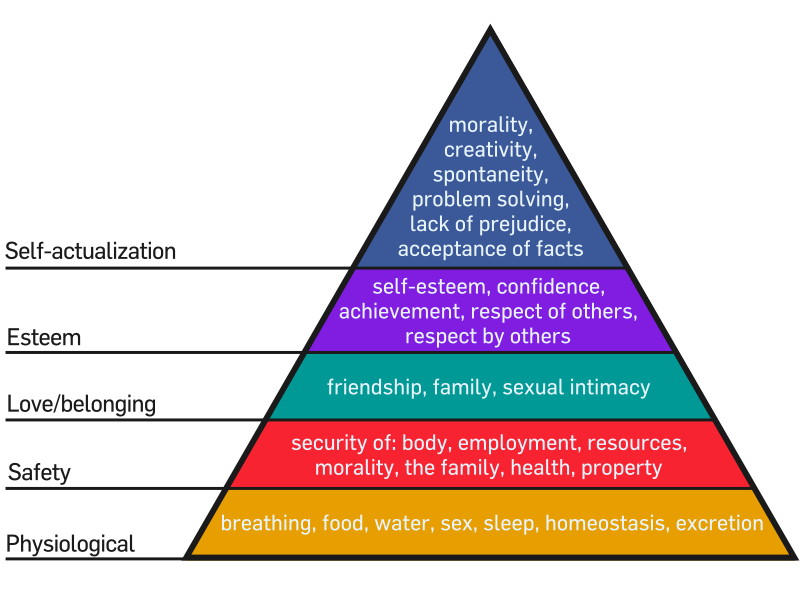
Maslow's hierarchy of needs
theory in developmental psychology proposed by Abraham Maslow, comprising a five-tier model of human needs: physiological, safety, love and belonging, esteem, and self-actualization

self-esteem
Self-esteem is confidence in one's own worth, abilities, or morals. Self-esteem encompasses beliefs about oneself (for example, "I am loved", "I am worthy") as well as emotional states, such as triumph, despair, pride, and shame. Smith and Mackie define it by saying "The self-concept is what we think about the self; self-esteem, is the positive or negative evaluations of the self, as in how we feel about it (see self)."

ecstasy
advanced emotion, subjective experience of total involvement of the subject, with an object of their awareness

euphoria
Euphoria ( ) is the experience (or affect) of pleasure or excitement and intense feelings of well-being and happiness. Certain natural rewards and social activities, such as aerobic exercise, laughter, listening to or making music and dancing, can induce a state of euphoria. Euphoria is also a symptom of certain neurological or neuropsychiatric disorders, such as mania. Romantic love and components of the human sexual response cycle are also associated with the induction of euphoria. Certain drugs, many of which are addictive, can cause euphoria, which at least partially motivates their recrea

quality of life
term for the quality of the various domains in human life and general well-being of individuals and societies

contentment
Contentment is a moderate form of happiness, a state of being or emotion in which one is satisfied with their current life situation, and the state of affairs in one's life as they presently are. If one is content, they are at inner peace with their situation and how the elements in one's life are situated. Contrary to popular belief, it is possible to be content with one's life regardless of the circumstance, regardless of whether things are going as one expected or not.

positive psychology
scientific study of the positive aspects of the human experience that make life worth living

ataraxia
thumb|299x299px|Bust of Epicurus. Achieving is an important goal in Epicurean philosophy.
In Ancient Greek philosophy, '''''' (, from indicating negation or absence and with the abstract noun suffix ), generally translated as , , , or , is a lucid state of robust equanimity characterized by ongoing freedom from distress and worry. In non-philosophical usage, was the ideal mental state for soldiers entering battle. Achieving is a common goal for Pyrrhonism, Epicureanism, and Stoicism, but the role and value of within each philosophy varies in accordance with their philosophical theories. The me

Ikigai
is a Japanese concept of an individual's definition of the meaning of their life.
.jpg)
Kama
Kama (Sanskrit: काम, ) is the concept of pleasure, enjoyment and desire in Hinduism, Buddhism, Jainism, and Sikhism. It can also refer to "desire, wish, longing" in Hindu, Buddhist, Jain, and Sikh literature. However, the term is also used in a technical sense to refer to any sensory enjoyment, emotional attraction or aesthetic pleasure experienced in connection with the arts, dance, music, painting, sculpture, and nature.

Euphrosyne
In ancient Greek religion and mythology, Euphrosyne (; ) is a goddess, one of the three Charites. She was sometimes named Euthymia () or Eutychia ().

hygge
thumb|Illustration of a hygge situation, with Meik Wiking's The Little Book of Hygge
thumb|"Hygge" sign in a restaurant in Nørrebro

comfort
thumbnail|A comfortable dog

eudaimonia
Eudaimonia (also spelled eudaemonia; ; ) is a Greek word literally translating to the state or condition of good spirit, and which is commonly translated as happiness or welfare.
self-actualization
Self-actualization, in Maslow's hierarchy of needs, is the highest personal aspirational human need in the hierarchy. It represents where one's potential is fully realized after more basic needs, such as for the body and the ego, have been fulfilled, and is recognised in psychological teaching as the peak of human needs. Maslow later added the category self-transcendence (which, strictly speaking, extends beyond one's own "needs").
job satisfaction
attitude of a person towards work
hedonic treadmill
observed tendency of humans to quickly return to a relatively stable level of happiness despite major positive or negative events or life changes
ERG theory
theory

The Alchemy of Happiness
book by Al-Ghazali

calmness
thumb|right|A Calm, by James Gillray
thumb|200px|Meditation can help people be in a calm state.
Calmness or, nonchalance is the mental state of peace of mind, being free from agitation, excitement, or disturbance. It also refers to being in a state of serenity, tranquillity, or peace. Calmness can most easily occur for the average person during relaxation, but it can also be found during much more alert and aware states. Some people find that focusing the mind on something external, such as studying, or internal, such as breathing, can be very calming.

fun
thumb|Children having fun playing with snow
thumb|upright|Surfing|Surfers enjoying their sport
Fun is defined by the Oxford English Dictionary as "light-hearted pleasure, enjoyment, or amusement; boisterous joviality or merrymaking; entertainment".
aversion to happiness
People wanting to deliberately avoid positive emotions and / or happiness
happiness economics
quantitative and theoretical study of happiness, positive and negative affect, well-being, quality of life, life satisfaction and related concepts, typically combining economics with other fields such as psychology, health and sociology
Easterlin paradox
empirical paradox that point in time happiness varies with income but over time happiness does not
joie de vivre
cheerful enjoyment of life; an exultation of spirit

Felicitas
thumb|upright=1.5|Felicitas Augusta holding a caduceus and a [[cornucopia, two symbols of health and wealth, on the reverse of an aureus issued under the emperor Valerian]]
In ancient Roman culture, felicitas (from the Latin adjective felix, "fruitful, blessed, happy, lucky") is a condition of divinely inspired productivity, blessedness, or happiness. Felicitas could encompass both a woman's fertility and a general's luck or good fortune. The divine personification of Felicitas was cultivated as a Roman goddess, wherein she is a goddess not just of good fortune but also happiness, wealth and s
subjective well-being
self-reported measure of well-being
Euthymia
mental state

Life, liberty and the pursuit of happiness
Phrase in the United States Declaration of Independence
life satisfaction
measure of well-being assessed in terms of mood, satisfaction with relationships, achieved goals, self-concepts, and self-perceived ability to cope with one's daily life
philosophy of happiness
philosophical theory
Ac-Cent-Tchu-Ate the Positive
original song composed by Harold Arlen, lyrics by Johnny Mercer; from the 1944 film "Here Come the Waves"
gratification
thumb|American basketball player Kevin Durant, after receiving the gold medal at the 2010 [[FIBA World Championship]]
Ānanda
eternal bliss which accompanies the ending of the rebirth cycle
Rosenberg self-esteem scale
Self-report questionnaire
peak experience
altered state of consciousness characterized by euphoria
euthymia
ancient Greek philosophical concept
self-fulfillment
In philosophy and psychology, self-fulfillment is the realizing of one's deepest desires and capacities. The history of this concept can be traced to Ancient Greek philosophers and it still remains a notable concept in modern philosophy.

The Happiness Hypothesis
book by Jonathan Haidt