Category
page 1Health goddesses

Isis
thumb|Isis wall painting in the tomb of Seti I (KV17)

Minerva
thumb|upright|Mosaic of the Minerva of Peace in the Library of Congress

Nephthys
Nephthys or Nebet-Het in ancient Egyptian () was a goddess in ancient Egyptian religion. A member of the Great Ennead of Heliopolis in Egyptian mythology, she was a daughter of Nut and Geb. Nephthys was typically paired with her sister Isis in funerary rites because of their role as protectors of the mummy, with her brother Osiris, and as the sister-wife of Set.

Sekhmet
In Egyptian mythology, Sekhmet ( or Sachmis , from ; ) is a warrior goddess as well as goddess of medicine.
Serket
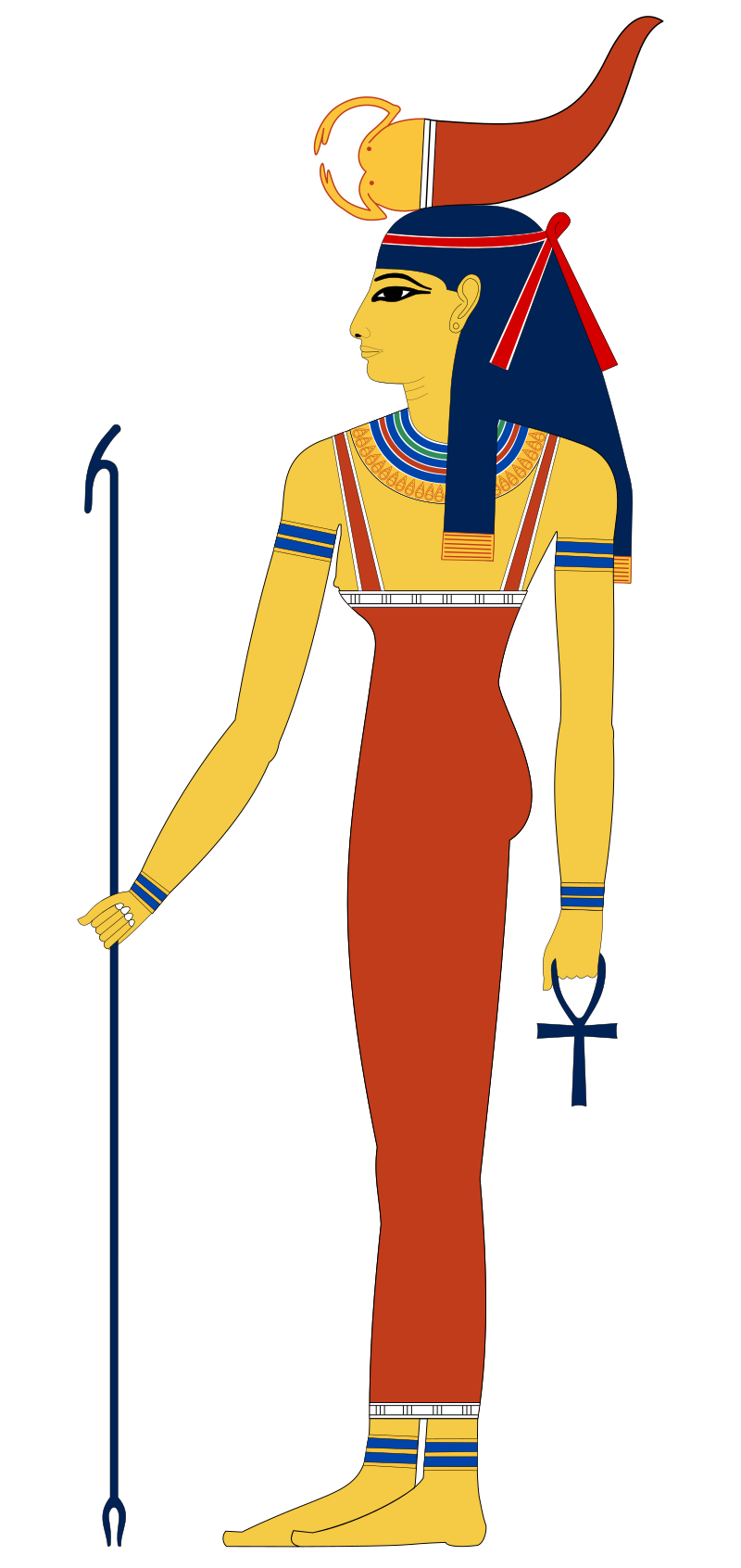
Serket /ˈsɜːrˌkɛt/ (Ancient Egyptian: srqt) is the goddess of protection against the venomous stings and bites of scorpions in Egyptian mythology. She was primarily worshiped in Lower Egypt during the Predynastic Period (c. 6000 – c. 3150 BCE). Serket is often depicted as a woman whose head is surmounted by a scorpion with its tail is ready to sting, an ankh in one hand, and a was-sceptre in her other. Her name, also rendered as Serqet, Selkis, or Selket, is a shortened version of 'Serket hetyt' which means "she who causes the throat to breathe."
Bona Dea
Roman deity of chastity, fertility, and healing; brought from Magna Græcia during the early/middle Republic; her rites let women use strong wine and do blood-sacrifice (things otherwise forbidden to women); men were barred from her mysteries
Brigid
Brigid or Brigit ( , ; meaning 'exalted one'), also Bríg, is a goddess of pre-Christian Ireland. She appears in Irish mythology as a member of the Tuatha Dé Danann, the daughter of the Dagda and wife of Bres, with whom she had a son named Ruadán.
Coatlicue
Coatlicue (; , , "skirt of snakes"), wife of Mixcōhuātl, also known as '''''' (, "mother of the gods") is the Aztec goddess who gave birth to the moon, stars, and Huītzilōpōchtli, the god of the sun and war. The goddesses Toci "our grandmother" and Cihuacōātl "snake woman", the patron of women who die in childbirth, were also seen as aspects of Cōātlīcue.
Santa Muerte
Mexican cult image, female deity, and folk saint
Anahit
Anahit () was the goddess of fertility and healing, wisdom and water in Armenian mythology. In the early periods, she was the goddess of war. By the 5th century BCE, she was the main deity in Armenia along with Aramazd. The Armenian goddess Anahit is related to the similar Iranian goddess Anahita. Artaxias I erected statues of Anahit, and promulgated orders to worship them.

Ixchel
thumb|right|Ixchel in the Dresden Codex
Ixchel or Ix Chel is the 16th-century name of the aged jaguar goddess of midwifery and medicine in ancient Maya culture.
Queen Mother of the West
mother goddess in Chinese religion and mythology

Putana
thumb|A 17th-century wooden sculpture of Putana with Krishna from Kerala
Angerona
In ancient Gallo-Roman religion Angerona or Angeronia was an old Celtic goddess adopted by Romans, whose name and functions are variously explained. She is sometimes identified with the goddess Feronia.
Menrva
Menrva (also spelled Menerva or Menfra) was an Etruscan goddess of war, art, wisdom, and medicine. She contributed much of her character to the Roman Minerva. She was the child of Uni and Tinia.

Eir
thumb|300px|Menglöð sits with the nine maidens, including Eir, on [[Lyfjaberg (1893) by Lorenz Frølich.]]
In Norse mythology, Eir (Old Norse: , "protection, help, mercy") is a goddess or valkyrie associated with medical skill. Eir is attested in the Poetic Edda, compiled in the 13th century from earlier traditional sources; the Prose Edda, written in the 13th century by Snorri Sturluson; and in skaldic poetry, including a runic inscription from Bergen, Norway from around 1300. Scholars have theorized about whether these three sources refer to the same figure, and debate whether Eir may have be
Mami Wata
pagan water spirit
Feronia
italic goddess of wilderness and liberty
Immortal Woman He
one of the Eight Taoist Immortals

Angitia
thumb|Terracotta statue believed to depict Angitia, in Marsica, Italy
Angitia was a goddess among the Marsi, the Paeligni and other Oscan-Umbrian peoples of central Italy. She was associated in antiquity with snake-charmers who claimed her as their ancestor. Roman interpretations probably obscure her Marsian significance.

Cardea
Cardea or Carda was the ancient Roman goddess of the hinge (Latin cardo, cardinis), Roman doors being hung on pivot hinges. The Augustan poet Ovid conflates her with another archaic goddess named Carna, whose festival was celebrated on the first day of June and for whom he gives the alternative name Cranê or Cranea, a nymph. Ovid's conflation of the goddesses is likely to have been his poetic invention, but it has also been conjectured that Carna was a contracted form of Cardina, and at minimum Ovid was observing that their traditions were congruent.

Toci
thumb|Statue of Toci (Tlazolteotl) from Mexico, 900–1521 CE (British Museum, id:)
Toci is a prominent deity in the religion and mythology of the pre-Columbian Aztec civilization of Mesoamerica.

Febris
Febris (), or Dea Febris (), is the Roman goddess of fevers, who embodied, but also protected people from, fever and malaria. Because of this, Febris was a feared goddess whom people wanted the favour of. She does not have a myth of her own nor is she mentioned in a myth. Among her characteristic attributes are "shrewdness" and "honesty", according to Seneca the Younger's Apocolocyntosis.
Sirona
Celtic healing deity associated with healing springs

Vasoorimala
Vasoorimala is a female deity worshiped in many parts of Kerala and Kodagu region of Karnataka. She is worshipped as an Upa Devata (sub-deity) in Bhadrakali or Shiva temples. Vasoorimala is believed to be a deity that prevents contagious diseases like smallpox, chickenpox, and measles. In North Kerala, Vasoorimala is worshipped and performed as Vasoorimala Theyyam. According to myths, Manodari, wife of Asura named Darikan was later named as Vasoorimala.

Šauška
Šauška (Shaushka), also called Šauša or Šawuška, was the highest ranked goddess in the Hurrian pantheon. She was associated with love and war, as well as with incantations and by extension with healing. While she was usually referred to as a goddess and with feminine titles, such as allai (Hurrian: "lady"), references to masculine Šauška are also known. The Hurrians associated her with Nineveh, but she was also worshiped in many other centers associated with this culture, from Anatolian cities in Kizzuwatna, through Alalakh and Ugarit in Syria, to Nuzi and Ulamme in northeastern Mesopotamia. S
Xuan Nü
daoist deity
Maman Brigitte
Vodou goddess
Gun Ana
Turkic solar deity
Airmed
In Irish mythology, the goddess Airmed (also given as Airmid) was one of the Tuatha Dé Danann. With her father Dian Cecht and brother Miach, she healed those injured in the Second Battle of Magh Tuiredh.
Oladevi
Oladevi is the goddess of cholera and is worshipped by people of Bengal region (consisting of the present-day Bangladesh and the Indian state of West Bengal) and Marwar, Rajasthan. The goddess is also known as Olaichandi, Olabibi and Bibima. She is venerated by Hindus of Bengal.

Parṇa-śāvari
thumb|Goddess Parnashavari
Kamrusepa
Kamrušepa was a Hittite and Luwian goddess of medicine and magic, analogous to Hattic and Palaic goddess Kataḫzipuri. She is best known as one of the deities involved in the Telepinu Myth, in which her actions were crucial to pacify the anger of the "missing" vegetation god.
María Lionza
Venezuelan female deity
Ta-Bitjet
Ta-Bitjet is an ancient goddess of Egyptian mythology. She is identified as the consort of Horus. Ta-Bitjet is a scorpion goddess and the blood that flowed from when Horus ruptured her hymen can serve as a panacea for poisons. She could be associated with another bride of one of Horus, Serket.
.jpg)
Chimalma
thumb|Chīmalmā, Códice Laud
Chimalman or Chīmalmā /t͡ʃiːmalmaː/ is a goddess in Aztec mythology, and was considered by the Aztecs to be the mother of the Toltec gods Quetzalcoatl and Xolotl. Her name means "shield-hand."
Reitia
Reitia (Venetic: 𐌓𐌄:𐌉:𐌕𐌉:𐌀) was a goddess, one of the best known deities of the Adriatic Veneti of northeastern Italy.
Damona
In Gallo-Roman religion, Damona was a goddess worshipped in Gaul as the consort of Apollo Borvo and of Apollo Moritasgus.
Mens
thumb|upright|An altar dedicated to Bona Mens by a vilicus named Felix (Castello Malaspina)
In ancient Roman religion, Mens, also known as Mens Bona (Latin for "Good Mind"), was the personification of thought, consciousness and the mind, and also of "right-thinking". The founding (dies natalis) of her temple in Rome was celebrated on June 8. A temple on the Capitoline Hill in Rome was vowed to Mens in 217 BC on advice from the Sibylline Books, after the defeat of Lake Trasimene, and was dedicated in 215 BC.
Beaivi
thumb|250px|Beivve Sami Solar symbol|Sun symbol
thumb|250px|Sami Shamanism|Shaman [[drum found in Nærøysund Municipality, Norway]]
Xochitlicue
Xochitlicue (meaning in Nahuatl 'the one that has her skirt of flowers') is the Aztec goddess of fertility, patroness of life and death, guide of rebirth, younger sister of Coatlicue, Huitzilopochtli's mother according Codex Florentine; and Chimalma, Quetzalcoatl's mother according to Codex Chimalpopoca. One of the three daughters of Tlaltecuhtli and Tlalcihuatl, the couple of the earth gods created by the Tezcatlipocas.
Pinga
goddess of the hunt, fertility and medicine in Inuit mythology
Jengu
A jengu (pl. miengu, also called bisima) is a water spirit in the traditional beliefs of the Sawabantu groups of Cameroon, like the Duala, Bakweri, Malimba, Subu, Bakoko, and Oroko people. Among the Bakweri, the term used is liengu (plural: maengu). Miengu are similar to bisimbi (singular: simbi) in the Bakongo spirituality and Mamba Muntu, who is present in many West and Central African cultures.
Hiʻiaka
In Hawaiian religion, Hiʻiaka is a daughter of Haumea and Kāne.
Kotharat
Kotharat (, kṯrt) were a group of seven goddesses associated with conception, pregnancy, birth and marriage, worshiped chiefly in the northern part of modern Syria in the Bronze Age. They are attested in texts from Mari, Ugarit and Emar. There is no agreement among translators over whether they had individual names in Ugaritic tradition. They were considered analogous to the Mesopotamian Šassūrātu, a collective term referring to assistants of the goddess Ninmah, and to Hurrian Hutena and Hutellura. It has been suggested that the latter were at least in part patterned after the Kotharat.
Bormana
Bormana was a Celtic goddess, the female equivalent of the god Borvo (Bormanus). Bormana was worshipped alongside Bormanus as his consort.
Kivutar
Kivutar (), Kiputyttö () or Vammatar () is a spirit or goddess in Finnish mythology who is asked take the pains and injuries of humans to herself. She lives on Kipumäki/Kipuvaara ("Pain Hill") or Kipuvuori ("Pain Mountain"), and is often called a maiden of the underworld (Tuonen neito).