Category
page 1Hexacorallia

Actiniaria
order of cnidarians

Hexacorallia
thumb|Aspidiscus cristatus from the Cenomanian (Upper [[Cretaceous) of southern Israel; oral view.]]
thumb|Aspidiscus cristatus from the Cenomanian (Upper Cretaceous) of southern Israel; aboral view.

Scleractinia
Scleractinia, also called stony corals or hard corals, are marine animals in the phylum Cnidaria that build themselves a hard skeleton. The individual animals are known as polyps and have a cylindrical body crowned by an oral disc in which a mouth is fringed with tentacles. Although some species are solitary, most are colonial. The founding polyp settles and starts to secrete calcium carbonate to protect its soft body. Solitary corals can be as much as across but in colonial species the polyps are usually only a few millimetres in diameter. These polyps reproduce asexually by budding, but rema
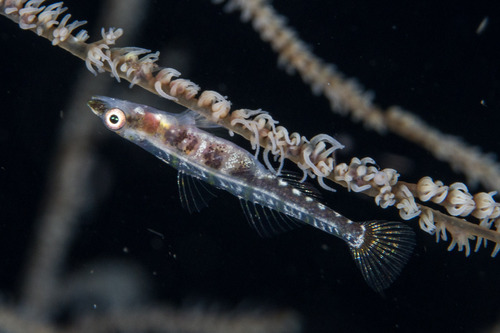
Antipatharia
order of cnidarians

Zoantharia
Zoanthids (also known as: zoanthiniarians, zoantharians (proper), colonial anemones, button polyps; scientific names: Zoanthiniaria, Zoanthinaria, Zoantharia, Zoanthidea, Zoanthidia, Zoantharida) are an order of hexacorals.
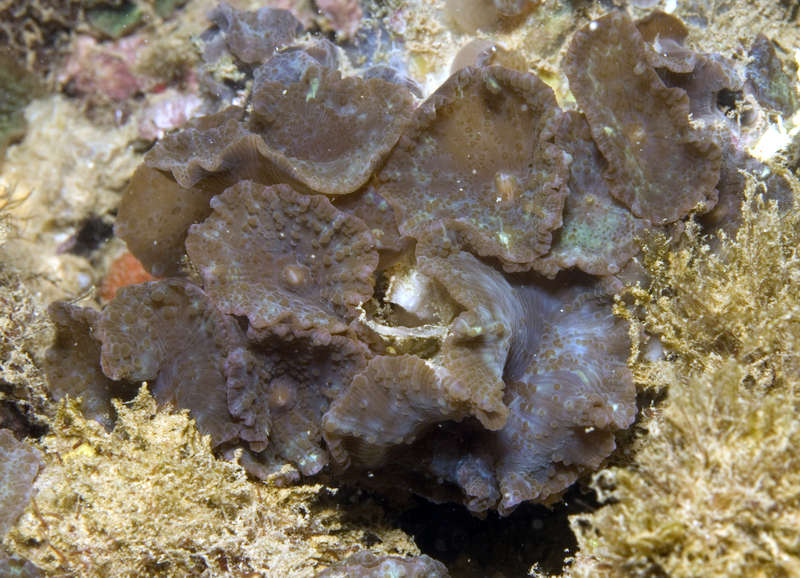
Corallimorpharia
Corallimorpharia is an order of marine cnidarians closely related to stony or reef building corals (Scleractinia). They occur in both temperate and tropical climates, although they are mostly tropical. Temperate forms tend to be very robust, with wide and long columns, whereas tropical forms tend to have very short columns with a wide oral disc and very short tentacles. The tentacles are usually arranged in rows radiating from the mouth. Many species occur together in large groups, although there are recorded instances of individuals. In many respects, they resemble the stony corals, except fo
Tabulata
Tabulata, commonly known as tabulate corals, is a class of extinct corals.
They are almost always colonial, forming colonies of individual hexagonal cells known as corallites defined by a skeleton of calcite, similar in appearance to a honeycomb. Adjacent cells are joined by small pores. Their distinguishing feature is their well-developed horizontal internal partitions (tabulae) within each cell, but reduced or absent vertical internal partitions (septa). They are usually smaller than rugose corals, but vary considerably in shape, from flat to conical to spherical.
Ceriantipatharia
Ceriantipatharia (rare synonym: Hexacorallia Goette, 1902 [non Haeckel, 1866]) is a taxon (usually a subclass) of Anthozoans used in some systems. It consists of the two taxa (usually orders) Ceriantharia (tube anemones) and Antipatharia (black corals).