Category
page 1Human hair

hair
Hair is a protein filament that grows from follicles found in the dermis. Hair is one of the defining characteristics of mammals.
The human body, apart from areas of glabrous skin, is covered in follicles which produce thick terminal and fine vellus hair. Most common interest in hair is focused on hair growth, hair types, and hair care, but hair is also an important biomaterial primarily composed of protein, notably alpha-keratin.

shaving
thumb|right|A man shaving his neck using a straight razor
thumb|A woman leg shaving using a razor
thumb|right|Cartridge razor with two blades

bald head
state where most or all of hair from the head has been lost or intentionally removed
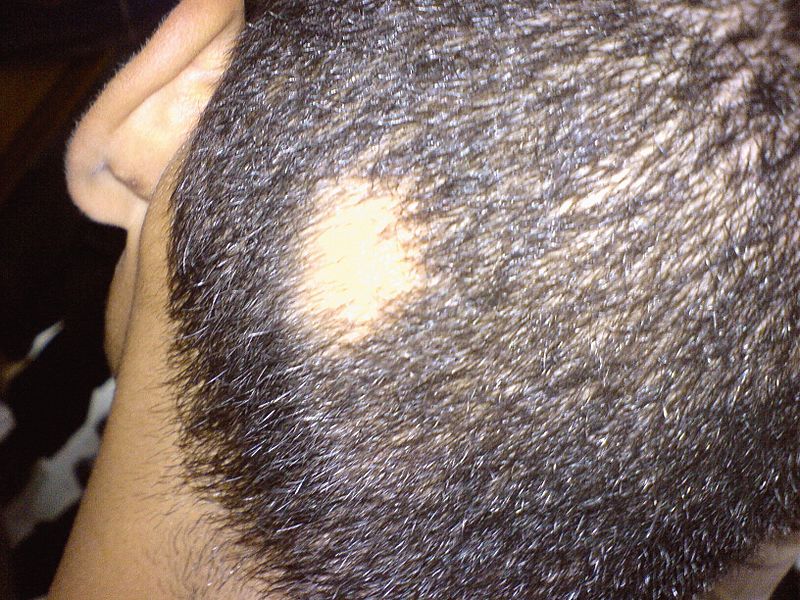
alopecia areata
condition in which hair is lost from some or all areas of the body
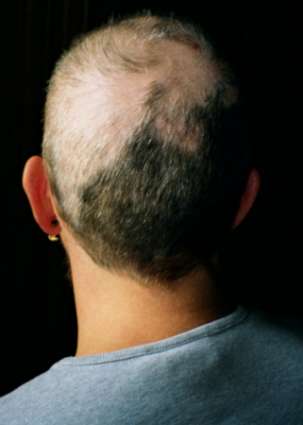
trichotillomania

scalp
The scalp is the area of the head where head hair grows. It is made up of skin, layers of connective and fibrous tissues, and the membrane of the skull. Anatomically, the scalp is part of the epicranium, a collection of structures covering the cranium. The scalp is bordered by the face at the front, and by the neck at the sides and back. The scientific study of hair and scalp is called trichology.
hirsutism
Hirsutism is excessive body hair on parts of the body where hair is normally absent or minimal. The word is from the early 17th century: from Latin hirsutus meaning "hairy". It usually refers to a male pattern of hair growth in a female that may be a sign of a more serious medical condition, especially if it develops well after puberty. Cultural stigma against hirsutism can cause much psychological distress and social difficulty. Discrimination based on facial hirsutism often leads to the avoidance of social situations and to symptoms of anxiety and depression.

hypertrichosis
Hypertrichosis (sometimes known as werewolf syndrome or Ambras syndrome) is an abnormal amount of hair growth over the body. The two distinct types of hypertrichosis are generalized hypertrichosis, which occurs over the entire body, and localized hypertrichosis, which is restricted to a certain area. Hypertrichosis can be either congenital (present at birth) or acquired later in life. The excess growth of hair occurs in areas of the skin with the exception of androgen-dependent hair of the pubic area, face, and axillary regions.
hair removal
temporary removal of body hair
androgenic hair
terminal hair that develops on the human body during and after puberty
androgenic alopecia
hair loss due to susceptibility of hair follicles to androgenic miniaturization
underarm hair
human body hair
lanugo
Lanugo is very thin, soft, usually unpigmented hair that is sometimes found on the body of a fetus or newborn. It is the first hair to be produced by the fetal hair follicles, and it usually appears around sixteen weeks of gestation and is abundant by week twenty. It is normally shed before birth, around seven or eight months of gestation, but is sometimes present at birth. It disappears on its own within a few weeks.
chest hair
hair that develops during the period of puberty, mainly in males
head shaving
practice of shaving the hair from a person's head, for practicality, convenience, religion, culture, or aesthetics
hair fetishism
paraphilia in which sexual arousal is achieved by interaction with human hair
nasal hair
thick hair in the area of the nasal entrance
trichophagia
Trichophagia is a form of disordered eating in which persons with the disorder suck on, chew, swallow, or otherwise eat hair. The term is derived from ancient Greek θρίξ, ("hair") and φαγεῖν, ("to eat"). Tricho- refers only to the chewing of hair, whereas tricho- is ingestion of hair, but many texts refer to both habits as just trichophagia. It is considered a chronic psychiatric disorder of impulse control. Trichophagia belongs to a subset of pica disorders and is often associated with trichotillomania, the compulsive pulling out of ones own hair. People with trichotillomania often also have
trichology
Trichology is the study of the hair and scalp. The term derives from Ancient Greek θρίξ (thríx), "hair" and -λογία -logia. In most jurisdictions the title of a trichologist, not the field of trichology, is considered a para-medical discipline.
abdominal hair
hair that grows on the abdomen
widow's peak
hairline, a V-shaped point on the forehead
%20(b).jpg)
bald-hairy
Bald–hairy () is a common joke in Russian political discourse, referring to the observation that the state leaders' succession is often from a bald or balding leader to a hairy one and vice versa. This consistent pattern can be traced back to as early as 1825, when Nicholas I succeeded his late brother Alexander as the emperor of Russia. Nicholas I's son Alexander II formed the first "bald–hairy" pair of the sequence with his father.

Upsherin
thumb|Upsherin celebration by Rabbi Eliezer Shlomo Schick
thumb|alt=Upsherin, 1992|Upsherin, 1992
thumb|alt=Upsherin, 1992|Upsherin, 1992
Upsherin, Upsheren, Opsherin or Upsherinish (, ) is a first haircut ceremony observed by a wide cross-section of Jews and is particularly popular in Haredi Judaism. It is typically held when a boy turns three years old.
telogen effluvium
Human disease
monilethrix
Monilethrix (also referred to as beaded hair) is a rare autosomal dominant hair disease that results in short, fragile, broken hair that appears beaded. It comes from the Latin word for necklace (monile) and the Greek word for hair (thrix). Hair becomes brittle, and breaks off at the thinner parts between the beads. It appears as a thinning or baldness of hair and was first described in 1897 by Walter Smith
alopecia universalis
human disease
hair tattoo
scalp tattoo giving the illusion of hair
hair whorl
patch of hair growing in a circular direction around a visible center point

hair oil
Additive for human hair
white piedra
mycosis that is a superficial fungal infection of the hair shaft caused by Trichosporon beigelii
kinky hair
human hair texture indigenous to sub-Saharan Africa, Melanesia, and Australia
Hair washing without commercial shampoo
keeping hair clean without commercial shampoo
hair jewellery
thumb|Mrs. Gabriel Manigault (Margaret Izard), converse of miniature portrait, circa 1795
Hairwork, or jewelry or artwork made of human hair, has appeared throughout the history of craft work, particularly to be used for private worship or mourning. From the Middle Ages through the early twentieth century, memorial hair jewelry remained common. Hair, considered to be a remnant off the person it was cut from, also has often played a part in myths and legends; in a Swedish book of proverbs, one can read that “rings and bracelets of hair increase love” (Vadstena stads tankebok). One example can b
kopexil
Kopexil (INCI name diaminopyrimidine oxide, trade name Aminexil) is a chemical compound similar to minoxidil. Minoxidil was originally used to treat high blood pressure; a side effect was increased body hair. Both compounds have been used for therapy of alopecia. Kopexil is not approved for use as a drug in the United States or in Europe.
black piedra
superficial mycosis that is a superficial fungal infection of the hair shaft caused by Piedraia hortae
bear's grease
body fat from bears, used for many applications and once thought to be a treatment for hair loss
Trichoptilosis
Trichoptilosis (from the Greek τριχο- tricho- "hair" and the New Latin ptilosis "arrangement of feathers in definite areas" from the Greek πτίλον "feather"), schizotrichia, and informally split ends, is the splitting or fraying of the hair-shaft due to excessive heat and mechanical stress. This condition occurs when the outer layer of the hair is damaged and the hair fibre divide into two or more strands.
ear hair
terminal hair arising from folliculary cartilage inside the external auditory meatus in humans
lovelock
long lock of hair, ofter braided, resting over the left shoulder
alopecia totalis
Alopecia totalis is a form of alopecia areata, an inflammatory disease of the hair follicle, characterized by a complete loss of hair of the entire scalp which becomes glabrous
frizz
thumb|right|Silent film star Mary Pickford in 1919
Frizz is hair that does not align with the surrounding hair, but stands up or curls independently, creating a fuzzy or irregular texture. The three main causes of frizz are genetics, hair damage, and humidity. Frizzy hair can be seen as a positive or a negative trait depending on the current fashion and one's personal preference. Many hair products, such as gels, pomades, and hair waxes, are designed to reduce frizz.
piedra
Piedra is a hair disease caused by a fungus, which causes formation of nodules on the hair shaft.
human hair growth
process through which human hair grows