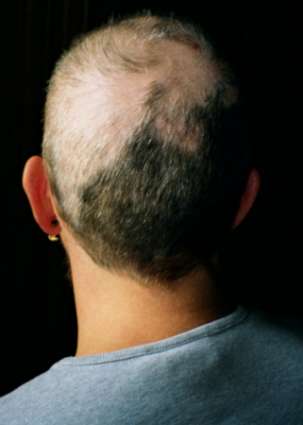
File:Trichotillomania_1.jpg · Wikimedia Commons · See Wikimedia Commons
trichotillomania
Sign in to saveAlso known as TTM, trichotillosis, hair pulling disorder, compulsive hair-pulling disorder
Key facts
- Medical condition.name
- Trichotillomania
- Medical condition.image
- Trichotillomania 1.jpg
- Medical condition.caption
- A pattern of incomplete hair loss on the scalp of a person with trichotillomania
- Medical condition.field
- Dermatology, psychiatry
- Medical condition.synonyms
- Trichotillosis, hair-pulling disorder, hairs-pulling disorder, compulsive hair pulling
- Medical condition.symptoms
- Visible hair loss, distress
- Medical condition.onset
- Childhood or adolescence
- Medical condition.risks
- Family history, anxiety, obsessive–compulsive disorder
- Medical condition.diagnosis
- Based on symptoms, seeing broken hairs
- Medical condition.differential
- Body dysmorphic disorder
- Medical condition.treatment
- Cognitive behavioral therapy, clomipramine
- Medical condition.frequency
- ~2%
via Wikipedia infobox
Research
1,898 papers- Trichotillomania.The American journal of psychiatry · 2016
- Recent advances in trichotillomania: a narrative review.Acta dermatovenerologica Alpina, Pannonica, et Adriatica · 2023
- [Trichotillomania].Ugeskrift for laeger · 2022
- [Trichotillomania].Tidsskrift for den Norske laegeforening : tidsskrift for praktisk medicin, ny raekke · 2018
- Trichotillomania.Journal of the American Academy of Dermatology · 2002
via PubMed
Wikidata facts
- Instance of
- mental disorder
- Subclass of
- disease
- Image
- Trichotillomania 1.jpg
Show 13 more facts
- Commons category
- Trichotillomania
- health specialty
- psychology
- exact match
- purl.obolibrary.org/obo/HP_0012167
- NCI Thesaurus ID
- C94336
- ICD-9-CM
- 312.39
- genetic association
- SLITRK1
- different from
- feather-plucking
- native label
- trichotillomanie
- IPA transcription
- ˌtraɪkəˌtɪləˈmeɪni.ə
- symptoms and signs
- alopecia
- has cause
- stress
- comorbidity
- obsessive-compulsive disorder
- short name
- TTM
via Wikidata · CC0
~18 min read
Encyclopedic overview
16 sectionsContents
- Signs and symptoms
- Causes
- Diagnosis
- Classification
- Treatment
- Psychotherapy
- Medication
- Devices
- Prognosis
- Epidemiology
- History
- Society and culture
- Media
- Fiction
- See also
- References
Trichotillomania (TTM), also known as hair-pulling disorder or compulsive hair pulling, is a mental disorder characterized by a long-term urge that results in the pulling out of one's own hair. A brief positive feeling may occur as hair is removed. Efforts to stop pulling hair typically fail. Hair removal may occur anywhere; however, the head and around the eyes are most common. The hair pulling is to such a degree that it results in distress and can cause visible hair loss.
As of 2023, the specific cause or causes of trichotillomania are unclear. Trichotillomania is probably due to a combination of genetic and environmental factors. The disorder may run in families. It occurs more commonly in those with obsessive–compulsive disorder (OCD). Episodes of pulling may be triggered by anxiety. People usually acknowledge that they pull their hair, and broken hairs may be seen on examination. Other conditions that may present similarly include body dysmorphic disorder; however, in that condition people remove hair to try to improve what they see as a problem in how they look.
Excerpted from Wikipedia’s “trichotillomania” article, available under the CC BY-SA 4.0 licence.