Category
page 1Inca

Machu Picchu
15th-century Inca citadel in the Peruvian Andes and UNESCO World Heritage Site

Inca Empire
1438–1533 empire in South America
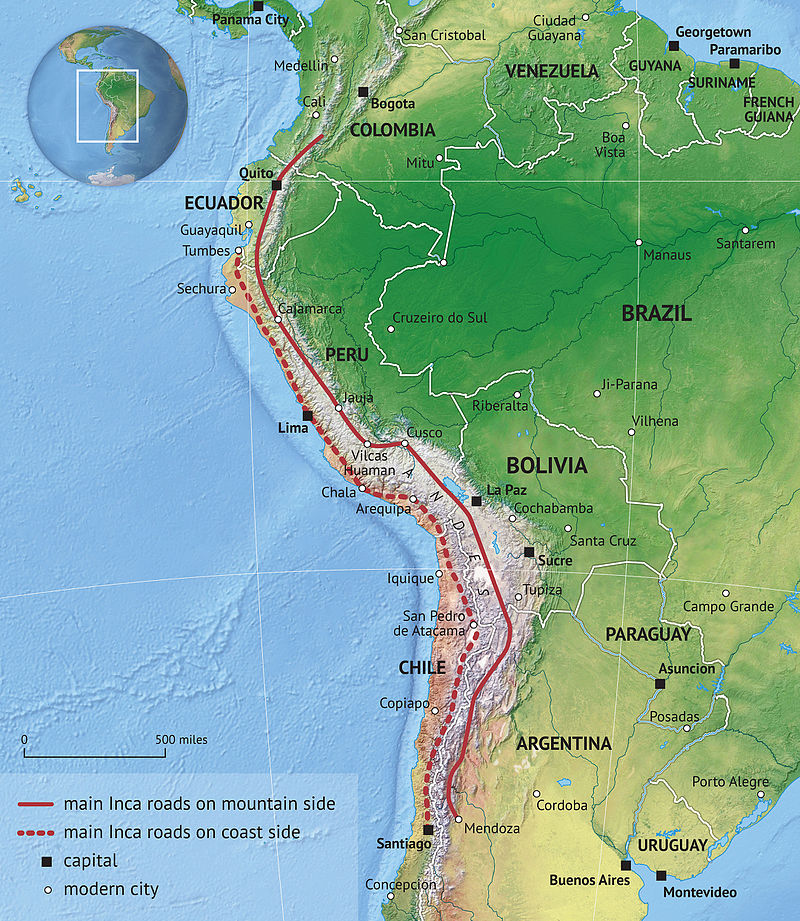
Inca road system
transportation system of the Inca empire

Ollantaytambo
Ollantaytambo () is a town and an Inca archaeological site in southern Peru some by road northwest of the city of Cusco. It is located at an altitude of above sea level in the district of Ollantaytambo, province of Urubamba, Cusco region. During the Inca Empire, Ollantaytambo in the Sacred Valley of the Incas was the royal estate of Emperor Pachacuti, after the mid-15th century. He built a town and a ceremonial center there. At the time of the Spanish conquest of Peru, it served as a stronghold for Manco Inca Yupanqui, leader of the Inca resistance. It is now an important tourist attraction on

Saqsaywaman
thumb|right|Sideways view of the walls of Sacsayhuamán showing the details of the stonework and the angle of the walls.
thumbnail|Muyuq Marka
thumb|Close up of stone wall

chicha
thumb|250px|Chicha served at the yearly Archaeology Museum, Sogamoso|Fiesta del Huán, to celebrate the December solstice at the Sun Temple in [[Sogamoso, Boyacá, Colombia]]
Chicha is a fermented (alcoholic) or non-fermented beverage of Latin America, emerging from the Andes and Amazonia regions. In both the pre- and post-Spanish conquest periods, corn beer (chicha de jora) made from a variety of maize landraces has been the most common form of chicha. However, chicha is also made from a variety of other cultigens and wild plants, including, among others, quinoa (Chenopodium quinia), kañiwa (Ch
Huayna Picchu
mountain in Peru
Isla del Sol
island in the southern part of Lake Titicaca
Sacred Valley
cultural region of Peru

Písac
Písac or Pisac (possibly from Quechua for Nothoprocta, also spelled ''p'isaqa'') is a Peruvian town in the Sacred Valley of the Incas. It is situated on the Urubamba River. Pisac is most known for its Incan ruins and large market which attracts heavy tourist traffic from nearby Cusco.

Choquequirao
Choquequirao is a 16th-century Incan site in the Cusco Region of southern Peru. Often called the "sister city" of Machu Picchu due to its similar structure and architecture, the site consists of an extensive complex of buildings and agricultural terraces built around the Sunch'u Pata, the truncated hill top, on a steep mountainside overlooking the Apurímac River. The ruins are situated in the Santa Teresa district (La Convención province) at an elevation of 3,050 metres (10,010 ft) in the rugged Vilcabamba mountain range. The site overlooks the Apurimac River canyon that has an elevation of .

Paititi
thumb|Minerva, together with Mercury, bring [[Atahualpa out of the tomb.]]
Paititi is a legendary Inca lost city or utopian rich land. It allegedly lies east of the Andes, hidden somewhere within the remote rainforests of southeast Peru, northern Bolivia or northwest Brazil. The Paititi legend in Peru revolves around the story of the culture-hero Inkarri, who, after he had founded Q'ero and Cusco, retreated toward the jungles of Pantiacolla to live out the rest of his days in his refuge city of Paititi. Other versions of the legend see Paititi as an Inca refuge in the border area between Boliv

Ingapirca
Ingapirca (Kichwa: Inka Pirka, "Inca wall") is a town in Cañar Province, Ecuador, and the name of the older Inca ruins and archeological site nearby.
mit'a
'''Mit'a''' () was a system of mandatory labor service in the Inca Empire, as well as in Spain's empire in America. ''Mit'a'' (federal work) was effectively a form of tribute to the Inca government in the form of labor, i.e. a corvée. Tax labor accounted for much of the Inca state tax revenue; beyond that, it was used for the construction of the road network, bridges, agricultural terraces, and fortifications in ancient Peru. Military service was also mandatory.
Inca architecture
pre-Columbian architecture in South America
Puka Pukara
cultural heritage site in Peru
Inca rope bridge
traditional Peruvian suspension bridge
Patallaqta
Patallacta (possibly from Quechua pata elevated place / above, at the top / edge, bank (of a river), shore, llaqta place (village, town, city, country, nation), "settlement on a platform" pronounced "pahta-yakta"), Llactapata or '''Q'ente Marka' (possibly from Quechua q'inti hummingbird, marka'' village, "hummingbird village") is an archaeological site in Peru located in the Cusco Region, Urubamba Province, Machupicchu District. It is situated southeast of the site Machu Picchu, at the confluence of the rivers Cusichaca and Vilcanota on a mountain named Patallacta.

Tipón
Tipón is a sprawling early fifteenth-century Inca archaeological site that is situated between and above sea level, located southeast of Cusco near the village of Tipón.
It consists of several ruins enclosed by a powerful defensive wall about long. The most renowned (and easily accessible) part of the park is the group of precise and right angled monumental terraces irrigated by a network of water canals fed by a monumental fountain channeling water from a natural spring. The site includes ancient residential areas and a remarkable amount of petroglyphs in its upper part.
thumb|400px|Tipón sk
Tambo Colorado
archaeological site
Wiñay Wayna
cultural heritage site in Peru

Maras
town in Cusco, Peru
Inca Trail to Machu Picchu
Ancient trail in Peru
.jpg)
tumi
thumb|200px|right|Early/Middle Sican tumi knife, 750–1100 AD, held at the Birmingham Museum of Art, it portrays the Sican Lord who abruptly disappeared from Sican art in the Late Sican phase (1100–1375)
thumb|200px|right|Sican Culture ceremonial knife (tumi) from the Metropolitan Museum of Art, [[New York City]]
200px|right|thumb|Sican-style tumi, 750–1100 AD, from the north coast of Peru, gold with [[turquoise, exhibited in the Art Institute of Chicago]]
Comentarios Reales de los Incas
book by Inca Garcilaso de la Vega
Incallajta
Inkallaqta (Quechua inka Inca, llaqta place (village, town, city, country, nation), "Inca place", Hispanicized spellings Incallacta, Incallajta, Incallakta, Inkallajta, Inkallakta) is a monumental Inca site in central Bolivia. It is located in the Cochabamba Department, Carrasco Province, Pocona Municipality, approximately 130 kilometers east of Cochabamba. It was most recently excavated by Larry Coben. He believes that the site was used to perform rites for the ceremonial calendar. The site has several important structures such as the Kallanka. It was the largest single roofed room in the wes

Vitcos
Vitcos was a residence of Inca nobles and a ceremonial center of the Neo-Inca State (1537–1572). The archaeological site of ancient Vitcos, called Rosaspata, is in the Vilcabamba District of La Convención Province, Cusco Region in Peru. The ruins are on a ridge overlooking the confluence of two small rivers and the village of Pucyura. The Incas had occupied Vilcabamba, the region in which Vitcos is located, about AD 1450, establishing major centers at Machu Picchu, Choquequirao, Vitcos, and Vilcabamba. Vitcos was often the residence of the rulers of the Neo-Inca state until the Spanish conques
Chinchaypujio District
district in Cusco, Peru
tambo
Inca military and administrative structure

Accla
thumb|250px|right|Acllas in the manuscript of Guamán Poma of 1615.
Aclla (), also called Chosen Women, Virgins of the Sun, and Wives of the Inca, were sequestered women in the Inca Empire. They were virgins, chosen at about age 10. They performed several services. They were given in marriage to men who had distinguished themselves in service to the empire; they produced luxury items, weaving fine cloth, preparing ritual food, and brewing the chicha (beer) drunk at religious festivals; and some, the most "perfect," were selected as human sacrifices for religious rites. Others lived out their li
Inca agriculture
agriculture by the Inca Empire

Quriwayrachina, La Convención
Site of Inca settlement in Peru
Queshuachaca
QueshuachacaThe name gets spelled very differently, mostly with the first element varying between and the second between .
Inca cuisine
cuisine of the Inca civilization
El primer nueva corónica y buen gobierno
Peruvian chronicle finished around 1615 by Felipe Huamán Poma de Ayala
Capayán
The Capayán were an Indigenous people, now extinct, that lived in Argentine territory.
Willaq Umu
high priest of the Sun in the Inca Empire
Q'ero
'''Q'ero (spelled Q'iru''' in the official three-vowel Quechua orthography) is a Quechua-speaking community or ethnic group dwelling in the province of Paucartambo, in the Cusco Region of Peru.
Panaka
thumb|300x300px|Genealogía de los Incas (Genealogy of the Incas) of the Cusco School, 18th century.
A panaca or panaqa, or panaka (, , ) was a family clan of the Sapa Inca, the kuraka or emperor of the Inca Empire. The panakas were formed by the descendants of a Sapa Inca or his wife. The basic social institution of the Incas is the ayllu. An ayllu is a group of families that descended from a common ancestor, united by culture and religion, in addition to the agricultural work, livestock and fishing of the same territory. The ayllu concept transcended into nobility, so that the royal kinship c
Yanaconas
Yanakuna were originally individuals in the Inca Empire who left the ayllu system and worked full-time at a variety of tasks for the Inca, the quya (Inca queen), or the religious establishment. A few members of this serving class enjoyed high social status and were appointed officials by the Sapa Inca. They could own property and sometimes had their own farms, before and after the conquest. The Spanish continued the yanakuna tradition developing it further as yanakuna entered Spanish service as Indian auxiliaries or encomienda Indians.
Runkuraqay
Runkuraqay or Runku Raqay (Quechua runku basket, raqay shed / derelict house / ruin) is an archaeological site on a mountain of the same name in Peru located in the Cusco Region, Urubamba Province, Machupicchu District. It is situated southeast of the archaeological site Machu Picchu and south of the Vilcanota river. The ruins lie on the southern slope of the mountain Runkuraqay near the Runkuraqay pass, northeast of the archaeological site Sayacmarca and southeast of the site Qunchamarka.
Pukara de La Compañia
archaeological site containing the remains of a promaucae fortress, later used by the Incas, located on the large hill overlooking the village of La Compañia, Graneros, Chile, It is the southernmost building which remains of the Inca Empire
Pinkuylluna
Pinkuylluna or Pinkulluna (Quechua, Hispanicized spellings Pincuylluna, Pinculluna) is an archaeological site on a mountain of the same name in Peru located in the Cusco Region, Urubamba Province, Ollantaytambo District.
Huchuy Qosqo
human settlement
history of the Incas
history of the Inca people
Inka Wasi, Ayacucho
archaeological site in Ayacucho Region, Peru
llawt'u
thumb|Incan head with llawt'u and maskapaycha (symbol of power)
The '''llawt'u or llawthu' (Quechua, Hispanicized spellings llauto, llautu'') was an outfit of the ruling Sapa Incas. It was a variety of turban with the colours of the Tahuantinsuyo. The llawt'u was traditionally woven from vicuña wool with different-colored plaits. On the front was a stripe of wool called the maskapaycha. The symbol of the quriqinqi was displayed on the front. It has been said that small dried frogs were worn under the garment as part of a tradition whose origins have been long lost.
Llaqtapata
Llaqtapata (Quechua) llaqta place (village, town, city, country, nation), pata elevated place / above, at the top / edge, bank (of a river), shore, pronounced 'yakta-pahta', Hispanicized Llactapata) is an archaeological site about west of Machu Picchu. The complex is located in the Cusco Region, La Convención Province, Santa Teresa District, high on a ridge between the Ahobamba and Santa Teresa drainages.
== Discovery and mapping ==
It appears to be the site originally reported by Hiram Bingham as having this name. Although the site was little explored by Bingham, it was more extensively explo
Ayni
Ayni (Quechua and Aymara; also spelled Ayniy or Aini) can refer to either the concept of reciprocity or mutualism among people of the Andean mountain communities or the practice of this concept. As a noun, the law of ayni states that everything in the world is connected, and is the only commandment that rules daily life in many communities like the Q'ero. As a verb, this often refers to the cooperation between the members of a community when one member gives to another, he or she is entitled to receive something back. Well-known practitioners of Ayni include the Quechuas and Aymara, as well as
Inca Bridge
Bridge providing access to Machu Picchu in Peru
Treasure of the Llanganatis
Supposed treasure in Ecuador

Twelve angle stone
incan archaeological artifact in Peru
Temple of the Moon
Peru
Minka
tradicional culture of Andes
Intipunku
archaeological site in Peru
Cahuide
thumb|Cahuide was an Inca nobleman and warrior of the 16th century (1536) in Cuzco, Peru, who participated in the battle of Sacsayhuamán, led by Manco Inca.