Category
page 1Inductive reasoning

theory
thumb|200px|Sketch from Charles Darwin's Notebooks on Transmutation of Species (1837), arguably the first example of a phylogenetic tree. (1) represents a common ancestor, the barred branches represent extant descendants, and the unmarked branches represent extinct descendants.
A theory is, in general, any hypothesis or set of ideas about something, formed in any number of ways through any sort of reasoning for any sort of reason.
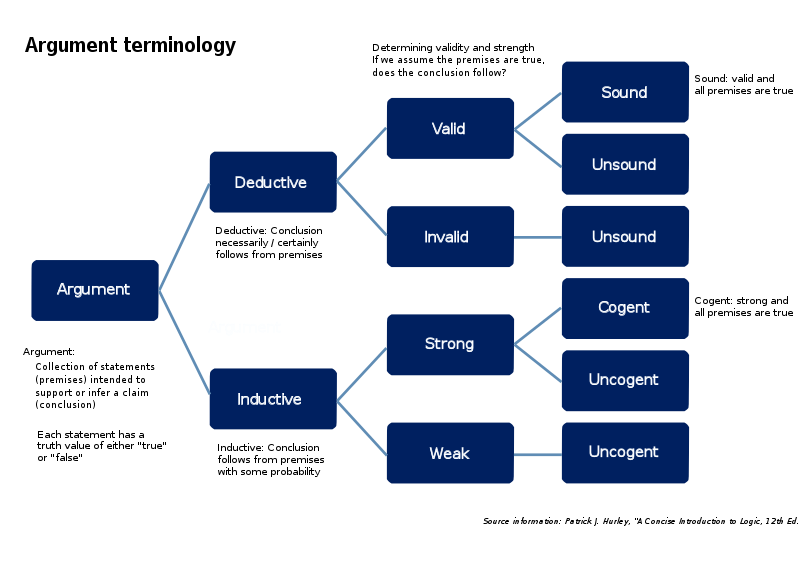
inductive reasoning
method of reasoning in which a body of observations is synthesized to hypothesize a general principle

generalization
A generalization is a form of abstraction whereby common properties of specific instances are formulated as general concepts or claims. Generalizations posit the existence of a domain or set of elements, as well as one or more common characteristics shared by those elements (thus creating a conceptual model). As such, they are the essential basis of all valid deductive inferences (particularly in logic, mathematics and science), where the process of verification is necessary to determine whether a generalization holds true for any given situation.

statistical inference
process of deducing properties of an underlying probability distribution by analysis of data
lateral thinking
manner of solving problems using an indirect and creative approach via reasoning that is not immediately obvious or attainable using only traditional step-by-step logic
problem of induction
epistemological question of whether inductive reasoning leads to definitive knowledge understood in the classic philosophical sense
case-based reasoning
approach to solve new case on solution of similar previous case
Mill's methods
methods of induction developed by philosopher John Stuart Mill
backward induction
process of reasoning backwards in time
causal inference
process of drawing a conclusion about a causal connection based on the conditions of the occurrence of an effect
argument from analogy
type of inductive argument, whereby perceived similarities are used as a basis to infer some further similarity that has yet to be observed
new riddle of induction
philosophical paradox of induction: defining “grue” to mean “green till 2030, blue afterward”, past observations seem to validate “plants are green” just as much as “plants are grue”
reflective equilibrium
when universalizable abstract principles are reflectively found to be in equilibrium with particular intuitive judgements
Inductivist turkey
metaphore
Inductionism
Inductionism is the scientific philosophy where laws are "induced" from sets of data. As an example, one might measure the strength of electrical forces at varying distances from charges and induce the inverse square law of electrostatics. This concept is considered one of the two pillars of the old view of the philosophy of science, together with verifiability. An application of inductionism can show how experimental evidence can confirm or inductively justify the belief in generalization and the laws of nature.
pessimistic induction
Argument in the philosophy of science
Laplace–Bayes estimator
in probability theory, the estimator (𝑠+1)∕(𝑛+2) for the probability of success of the next run of an experiment which one has repeated 𝑛 times with 𝑠 successes