File:Generalization_process_using_trees.svg · Wikimedia Commons · See Wikimedia Commons
generalization
Sign in to saveAlso known as generalisation, Generalize, general case, wider case
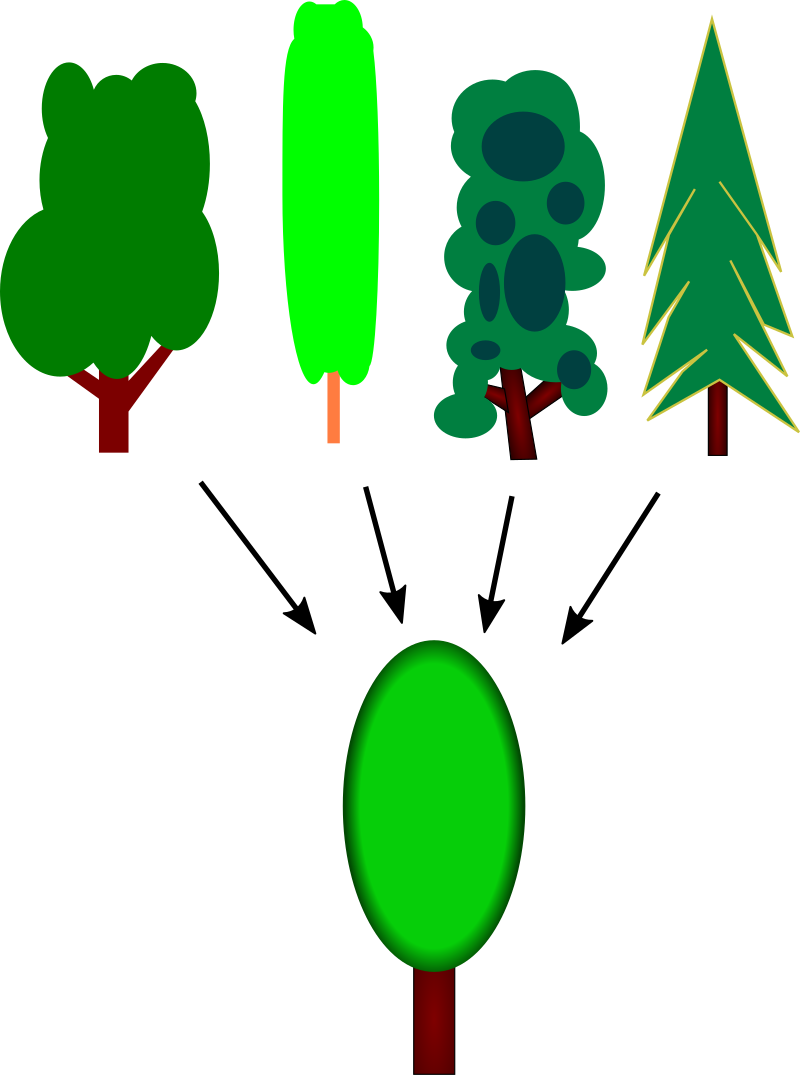
A generalization is a form of abstraction whereby common properties of specific instances are formulated as general concepts or claims. Generalizations posit the existence of a domain or set of elements, as well as one or more common characteristics shared by those elements (thus creating a conceptual model). As such, they are the essential basis of all valid deductive inferences (particularly in logic, mathematics and science), where the process of verification is necessary to determine whether a generalization holds true for any given situation.
Wikidata facts
- Instance of
- relation
- Subclass of
- concept
- Part of
- epistemology
- Image
- Generalization process using trees PNG version.png
Show 2 more facts
- opposite of
- special case
- has cause
- thought
Sources (3)
via Wikidata · CC0
~5 min read
Encyclopedic overview
7 sectionsContents
- Hypernym and hyponym
- Examples
- Biological generalization
- Cartographic generalization of geo-spatial data
- Mathematical generalizations
- See also
- References
A generalization is a form of abstraction whereby common properties of specific instances are formulated as general concepts or claims. Generalizations posit the existence of a domain or set of elements, as well as one or more common characteristics shared by those elements (thus creating a conceptual model). As such, they are the essential basis of all valid deductive inferences (particularly in logic, mathematics and science), where the process of verification is necessary to determine whether a generalization holds true for any given situation.
Generalization can also be used to refer to the process of identifying the parts of a whole, as belonging to the whole. The parts, which might be unrelated when left on their own, may be brought together as a group, hence belonging to the whole by establishing a common relation between them.
Excerpted from Wikipedia’s “generalization” article, available under the CC BY-SA 4.0 licence.