Category
page 1International law
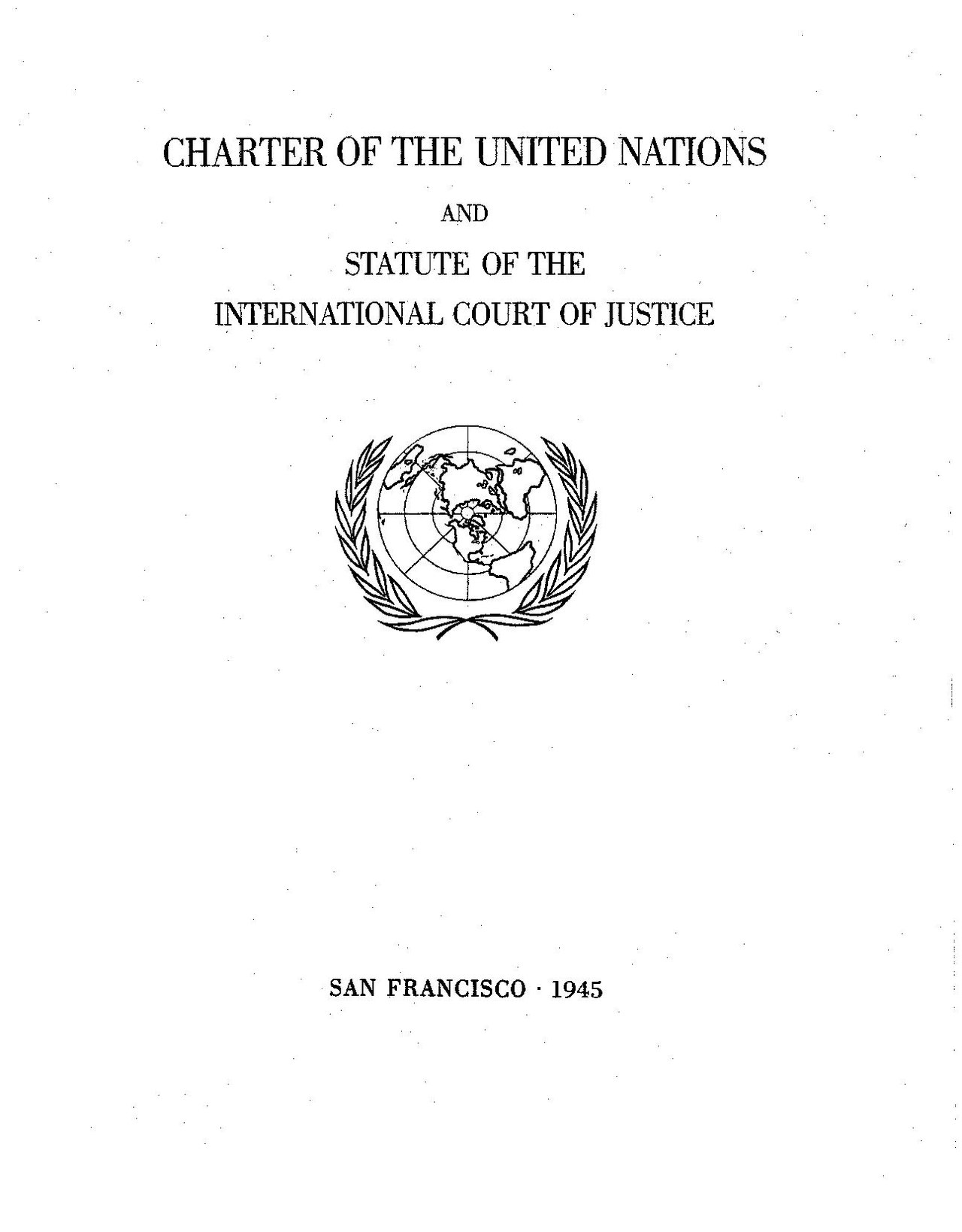
Charter of the United Nations
1945 foundational treaty of the United Nations

international law
regulations governing international relations
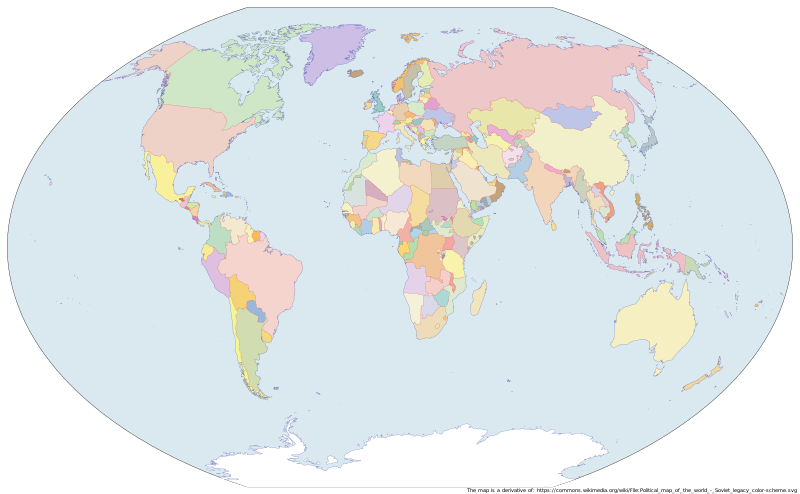
sovereign state
state that has the highest authority over a territory

customs agency
alt=A customs officer in Amsterdam Airport Schiphol checks the luggage of an incoming traveler.|thumb|260x260px|A [[customs officer in Amsterdam Airport Schiphol checks the luggage of an incoming traveler.]]
thumb|Vienna Convention on Road Signs and Signals|Vienna Convention road sign for customs
Paris Agreement
international agreement from 12 December 2015 within the United Nations Framework Convention on Climate Change (UNFCCC) dealing with greenhouse gas emissions mitigation, adaptation and finance starting in the year 2020

self-determination
Self-determination refers to a people's right to form its own political entity, and internal self-determination is the right to representative government with full suffrage.

annexation
Annexation, in international law, is the forcible acquisition and assertion of legal title over one state's territory by another state, usually following military occupation of the territory. In current international law, it is generally held to be an illegal act. It is distinct from the concepts of conquest, which describes the gaining of physical control, and cession, in which territory is given or sold through treaty.
persona non grata
foreign person whose entering or remaining in a particular country is prohibited by that country's government

customary law
type or source of law

jurisdiction
Jurisdiction (from Latin 'law' and 'speech' or 'declaration') is the legal term for the legal authority held by a legal entity to enact justice. Jurisdiction is rarely claimed to be complete: rather it is limited for example by geography, subject matter, or other factor. It is only within the scope (inside the limits) of such jurisdiction that, for example, the parties to a dispute have standing to bring the matter (a legal question) before a judge, who has power (or 'jurisdiction') to decide it authoritatively.
.jpg)
extradition
thumb|380x380px|An extradition document from the St. Louis Metropolitan Police Department|St. Louis Police Department in the [[United States, requesting the extradition of a murder suspect suspected of fleeing to Auckland in New Zealand, 1885]]

peace treaty
agreement between two or more hostile parties which formally ends a state of war
international community
broad group involving people and governments of the world that share common values and operational ties
suzerainty
A suzerain (, from Old French "above" + "supreme, chief") is a person, state or polity who has supremacy and dominant influence over the foreign policy and economic relations of another subordinate party or polity, but allows internal autonomy to that subordinate. Where the subordinate polity is called a vassal, vassal state or tributary state, the dominant party is called the suzerain. The rights and obligations of a vassal are called vassalage, and the rights and obligations of a suzerain are called suzerainty.

law of war
international laws concerning wars

secession
Secession (from ) is a term and a concept which is used in reference to the formal withdrawal of a group from a political entity.
condominium
form of subnational government in which multiple sovereign powers share sovereignty over a territory
Pacta sunt servanda
Latin legal phrase
Fourth Geneva Convention
1949 treaty

extraterritoriality
In international law, extraterritoriality or exterritoriality is the state of being exempted from the jurisdiction of local law, usually as the result of diplomatic negotiations.
terra nullius
international law term meaning territory which has never been the subject of a sovereign nation
diplomatic recognition
unilateral political act whereby a state acknowledges an act or status of another state or government
international criminal law
public international law
cabotage
Cabotage () is the transport of goods or passengers between two places in the same country by a carrier registered in a different country. The term originally applied to shipping along coastal routes, port to port, but now applies to aviation, railways, and road transport as well. Most countries do not permit cabotage, and there are strict sanctions against it, for reasons of economic protectionism, national security, or public safety. One notable exception is the European Union, whose member states all grant cabotage rights to each other.
cultural property
structures and works designated as representing cultural heritage
succession of states
process of transferring roles and responsibilities as states and their boundaries change
peremptory norm
compelling law (international) that cannot be derogated
asylum seeker
individual who seeks refuge, esp. political asylum, in a foreign country
humanitarian intervention
military intervention for humanitarian reasons
border control
measures taken to regulate the movement of goods and people across borders
customary international law
those aspects of international law that derive from custom
international human rights law
body of international law designed to promote human rights
law of the sea
international law concerning maritime environments
transitional justice
judicial and non-judicial measures implemented in order to redress legacies of human rights abuses or segments of past injustices
uti possidetis
wartime principle in international law
territorial integrity
principle under international law that prohibits states from the use of force to annex territory
.svg)
Internationality
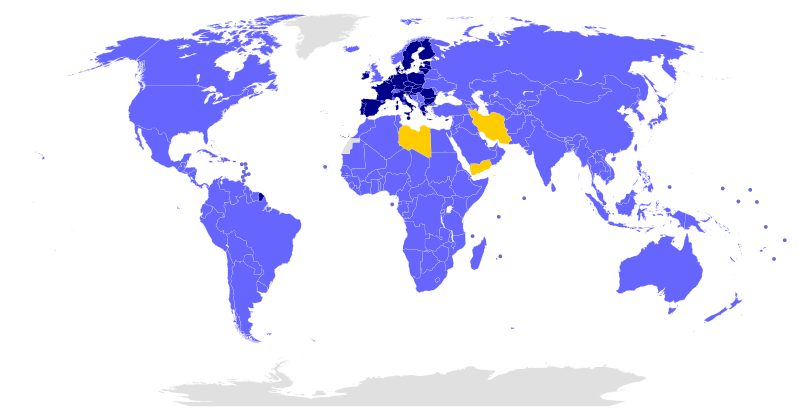
thumb|Map of members of the United Nations, an organization that has discussed and engaged in internationality.
Internationality, or the international, is the concept of something involving more than a single country and may suggest interaction between or encompassing more than one nation, or generally beyond national boundaries. For example, international law, which is applied by more than one country and usually everywhere on Earth, and international languages spoken by residents of more than one country. "International" is therefore also sometimes used as a synonym for "global".
Human rights education
education on the topic of human rights
non-interventionism
Non-interventionism or non-intervention is commonly understood as "a foreign policy of political or military non-involvement in foreign relations or in other countries' internal affairs". This is based on the grounds that a state should not interfere in the internal politics of another state as well as the principles of state sovereignty and self-determination. A similar phrase is "strategic independence".
proportionality
general principle in law about the scope of punishment for offenses
jus gentium
concept of international law within the ancient Roman legal system
targeted killing
form of assassination carried by governments against their perceived enemies
flight information region
specified region of airspace
odious debt
legal theory that says that the national debt incurred by a despotic regime should not be enforceable
.jpg)
quasi-state
A quasi-state (sometimes referred to as a state-like entity or formatively a proto-state) is a political entity, that does not represent a fully autonomous sovereign state, with its own institutions.
Convention on Psychotropic Substances
UN treaty on recreational drugs
Single Convention on Narcotic Drugs
international treaty on recreational drugs
area of freedom, security and justice
EU's home affairs and justice policies
arms control
term for restrictions and regulations upon the development, storage, proliferation and usage of conventional weapons, and weapons of mass destruction
non-refoulement
Non-refoulement () is a fundamental principle of international law anchored in the 1951 Convention Relating to the Status of Refugees that forbids a country from deporting ("refoulement") any person to any country in which their "life or freedom would be threatened" on account of "race, religion, nationality, membership of a particular social group or political opinion". The only exception to non-refoulement according to the Convention Relating to the Status of Refugees are "reasonable grounds" of "danger to the security of the country" or "danger to the community of that country". Unlike poli
res nullius
latin term from Roman law
capitulation
contracts conferring rights and privileges to foreign subjects
Paris Declaration Respecting Maritime Law
1856 treaty
Prague Declaration on European Conscience and Communism
a declaration signed on 3 June 2008
impunity
Impunity is the ability to act with exemption from punishments, losses, or other negative consequences. In the international law of human rights, impunity is failure to bring perpetrators of human rights violations to justice and, as such, itself constitutes a denial of the victims' right to justice and redress. Impunity is especially common in countries which lack the tradition of rule of law, or suffer from pervasive corruption, or contain entrenched systems of patronage, or where the judiciary is weak or members of the security forces are protected by special jurisdictions or immunities. Im
soft law
legal concept of non-bonding principles
state immunity
legal doctrine
international human rights instrument
treaty or other international document aimed at protecting universal rights
International Health Regulations
legally binding instrument of international law that aims to aid international cooperation caused by spread of diseases
intervention
use of force by one country or sovereign state in the affairs of another