Category
page 1International trade

globalization
Globalization (UK: globalisation) is the process of increasing interdependence and integration among the economies, markets, societies, and cultures of different countries worldwide. It can be attributed to a series of factors, including the reduction of barriers to international trade, the liberalization of capital movements, the development of transportation infrastructure, and the advancement of information and communication technologies. The term globalization first appeared in the early 20th century (replacing an earlier French term ). It developed its current meaning in the second half o

ISO 4217
standard which delineates currency designators and its countries

export
An export in international trade is a good produced in one country that is sold into another country or a service provided in one country for a national or resident of another country. The seller of such goods or the service provider is an exporter; the foreign buyer is an importer. Services that figure in international trade include financial, accounting and other professional services, tourism, education as well as intellectual property rights.
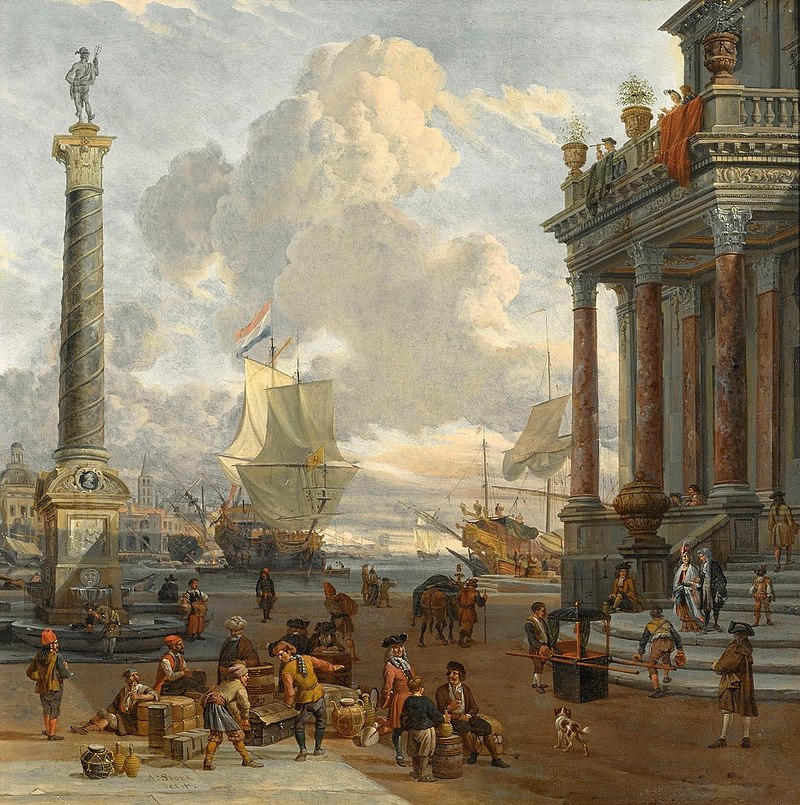
international trade
exchange of capital, goods, and services across international borders or territories

balance of trade
difference between the monetary value of exports and imports

outsourcing
autarky
Autarky is the characteristic of self-sufficiency, usually applied to societies, communities, states, and their economic systems.
economic integration
unification of economic policies between different states
internationalization and localization
process in which software is made accessible to people in different areas of the world
flag of convenience
the business practice registering a ship under a different sovereign state than that of its owners, to reduce costs or avoid regulations
cabotage
Cabotage () is the transport of goods or passengers between two places in the same country by a carrier registered in a different country. The term originally applied to shipping along coastal routes, port to port, but now applies to aviation, railways, and road transport as well. Most countries do not permit cabotage, and there are strict sanctions against it, for reasons of economic protectionism, national security, or public safety. One notable exception is the European Union, whose member states all grant cabotage rights to each other.

offshoring
Offshoring is the relocation of a business process from one country to another—typically an operational process, such as manufacturing, or supporting processes, such as accounting. Usually this refers to a company business, although state governments may also employ offshoring. More recently, technical and administrative services have been offshored.
economic nationalism
ideology favoring policies that emphasize domestic control of the economy, labor, and capital formation
trade barrier
restriction of trade by a government
grey market
trade of goods outside the original producer's authorized distribution channel
open economy
economy favoring cross-border investment and commerce
global financial system
overview about the global financial system
knock-down kit
collection of manufactured parts exported for assembly

dedollarization
right|thumb|300x300px|Worldwide use of the U.S. dollar:
Worldwide use of the euro:
capital account
concept in international economics
Russian shadow fleet
vessels illegally operated by Russia
managed services
type of service provider
National Development and Reform Commission
department of the State Council of the People's Republic of China
social dumping
practice of employers to use cheaper labour than is usually available at their site of production or sale
2021-2022 global supply chain crisis
Disruption to global trade, mostly in 2021 and 2022
international trade law
branch of law
beggar thy neighbour
economic improvement attempt that causes worse conditions for other countries

economics of coffee
economic commodities of coffee in global trading markets
nearshoring
Nearshoring is the outsourcing of business processes, especially information technology processes, to companies in a nearby country, often sharing a border with the target country. Both parties expect to benefit from one or more of the following dimensions of proximity: geographic, temporal (time zone), cultural, social, linguistic, economic, political, or historical linkages.
international economic law
field of international law that involves the regulation and conduct of states, international organizations, and private firms operating in the international economic arena
shadow fleet
sanction evasion in the maritime domain
Intrastat
Intrastat is the system for collecting information and producing statistics on the trade in goods between countries of the European Union (EU). It began operation on 1 January 1993, when it replaced customs declarations as the source of trade statistics within the EU. The requirements of Intrastat are similar in all member states of the EU, although there are important exceptions.
Combined Nomenclature
goods
Intra-industry trade
the exchange of products belonging to the same industry
Illicit financial flows
form of illegal capital flight
Standard International Trade Classification

Vogelfluglinie
thumb|300px|right|The German and part of the Danish railway line
thumb|300 px|right|Ferry at Puttgarden. Trains and cars are loaded by the lower ramp, cars only by the upper ramp.
The ' (German) or ' (Danish) is a transport corridor between Copenhagen, Denmark, and Hamburg, Germany.
Trade diversion
economic effect of customs unions
licensed production
production under license of technology developed elsewhere
Bunker adjustment factor
surcharge on sea freight charges
Business English
part of English for specific purposes

Trade facilitation
policies intended to encourage trade between nations
Invisible balance
trade in service
Sale and delivery between a producer and consumer
trade finance
strategies to facilitate international trade
global sourcing
cross-border cooperation