Category
page 1Joseph Stalin

Joseph Stalin
Joseph Vissarionovich Stalin was a Soviet revolutionary and politician who led the Soviet Union from 1924 until his death in 1953. He held office as general secretary of the Communist Party from 1922 to 1952 and as premier from 1941 until his death. Despite initially governing the country as part of a collective leadership, he eventually consolidated power to become a dictator by the 1930s. Stalin codified the Communist Party's official interpretation of Marxism as Marxism–Leninism, and his version of it is referred to as Stalinism.

Battle of Stalingrad
1942 major battle of World War II

Vyacheslav Molotov
Soviet politician, statesman and diplomat (1890–1986)

Yalta Conference
1945 WWII Allied discussion of post-war reorganization

Holodomor
The Holodomor, also known as the Ukrainian famine, was a massive man-made famine in Soviet Ukraine from 1932 to 1933 that killed millions of Ukrainians. The Holodomor was part of the wider Soviet famine of 1930–1933 which affected the major grain-producing areas of the Soviet Union.

Gulag
thumb|A punishment cell block in one of the subcamps of Vorkutlag, 1945
The Gulag was a system of forced labor camps in the Soviet Union. The word Gulag originally referred only to the division of the Soviet secret police that was in charge of running the forced labor camps from the 1930s to the early 1950s during Joseph Stalin's rule, but in English literature the term is popularly used for the system of forced labor throughout the Soviet era. The abbreviation GULAG (ГУЛАГ) stands for "Glávnoye upravléniye ispravítel'no-trudovýkh lageréy " (Гла́вное управле́ние исправи́тельно-трудовы́х лагере

Iron Curtain
term symbolizing the ideological-political conflict and physical boundary dividing Europe during the Cold War

Stalinism
thumb|Official portrait of Joseph Stalin from 1945
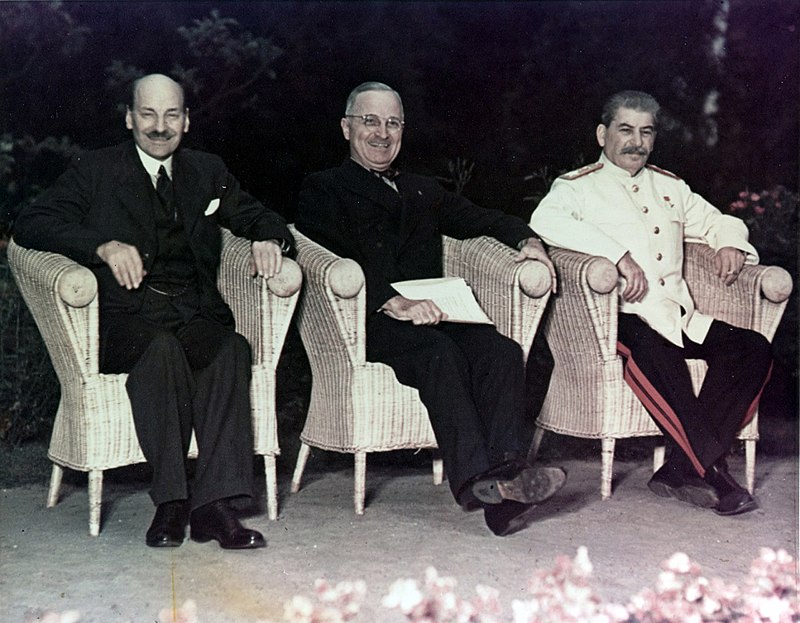
Potsdam Conference
meeting of the Allied heads of state near the end of World War II

Katyn massacre
Soviet mass murder of ca. 22,000 Poles in several parts of European Russia, including in the Katyn forest, which became a pars pro toto name for the whole massacre
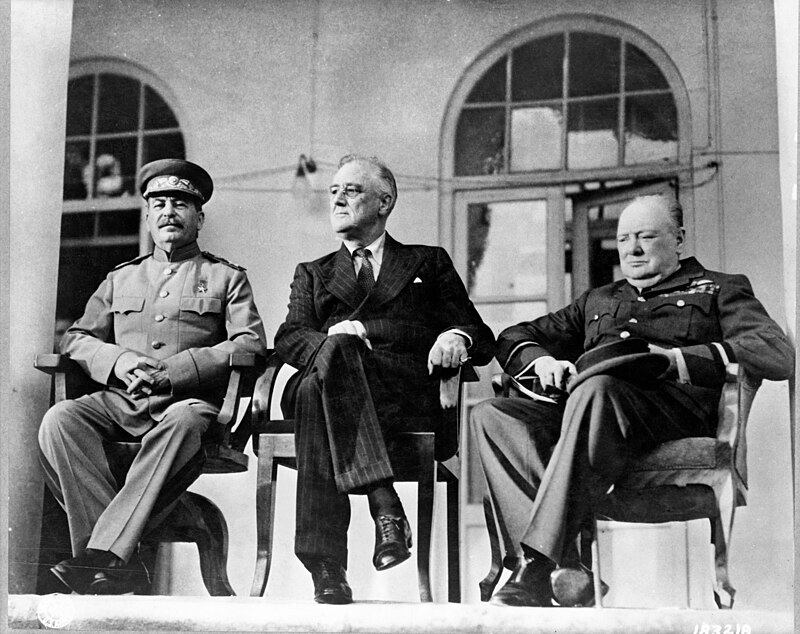
Tehran Conference
strategy meeting of the leaders of the USSR, the USA, and the UK in Tehran in 1943 during World War 2

deportation of the Crimean Tatars
ethnic cleansing carried out by the Soviet Union during World War II

population transfer in the Soviet Union
transfer and deportation of people in the Soviet Union
deportation of the Chechens and Ingush
ethnic cleansing of Chechens and Ingush in the Soviet Union under Joseph Stalin
Stalinist architecture
architectural style
American exceptionalism
ideology holding the United States as unique among nations; facet of nationalism in the United States
Order No. 227
Order issued by Joseph Stalin that coined the phrase "Not one step back!"
Tito–Stalin split
political split between Josip Broz and Joseph Stalin of year 1948

bolshevism
Bolshevism (derived from Bolshevik) is a revolutionary socialist current of Soviet Leninist and later Marxist–Leninist political thought and political regime associated with the formation of a rigidly centralized, cohesive and disciplined party of social revolution, focused on overthrowing the existing capitalist state system, seizing power and establishing the "dictatorship of the proletariat".
Kazakh famine of 1930–1933
1930–1933 man-made famine that affected Soviet Kazakhstan

RDS-1
The RDS-1 (), also known as First Lightning (), was the first nuclear weapons test that was conducted by the Soviet Union. It was detonated on 29 August 1949 at 7:00 a.m. Kazakhstan Time (decree time) (UTC+06:00), at the Semipalatinsk Test Site in the Kazakh Soviet Socialist Republic, and yielded 22 kilotons of TNT.
Soviet famine of 1932–1933
Man-made famine that mainly affected the major grain-producing areas of the Soviet Union
1907 Tiflis bank robbery
Robbery of bank stagecoach by Bolsheviks in 1907
IS tank family
series of Soviet heavy tanks, made 1943 to 1966 (in service to 1990)
percentages agreement
secret informal agreement between British Prime Minister Winston Churchill and Soviet leader Joseph Stalin during the Fourth Moscow Conference in October 1944
Soviet Union in World War II
involvement of the Soviet Union in World War II
Joseph Stalin's cult of personality
the cult of personality around Joseph Stalin
Haplogroup G
human Y-chromosome DNA haplogroup
Generalissimus of the Soviet Union
proposed military rank of the Soviet Union
Kamo
Russian revolutionary (1882-1922)
German–Soviet Axis talks
talks concerning the Soviet Union's potential entry as a fourth Axis Power in World War II
death and state funeral of Joseph Stalin
Soviet political leader's 1953 death
anti-Stalinist left
opposition to Stalinism from those on the left-wing
Moscow Conference (1944)
conference Held in Moscow
Sword of Stalingrad
King George VI's historic sword of the United Kingdom
Soviet famine of 1946–1947
lack of food distribution in the Eurasian country
Order No. 270
1941 Soviet Army command prohibiting surrender
Medvedev Forest massacre
1941 NKVD mass execution of Oryol prisoners
Georgian affair
Internal dispute between Soviet leadership involving Georgia's admittance to the USSR
People's Commissariat of Nationalities
Soviet government agency
1941 October Revolution Parade
Military parade dedicated to the anniversary of the October Revolution during the Battle of Moscow

Aleksandr Burdonsky
Soviet theatre director
Soviet offensive plans controversy
theory
Great Plan for the Transformation of Nature
Soviet agricultural and irrigation project
Greek Operation of NKVD
organised mass persecution of the Greeks of the Soviet Union
Stalin and antisemitism
extent to which Stalin was antisemitic
excess mortality in the Soviet Union under Joseph Stalin
atrocities of the Soviet Union considered genocides by historians
Stalin's alleged speech of 19 August 1939
alleged secret speech given by Stalin in 1939 to the Politburo, justifying war in Europe and collaboration with Nazi Germany
Purge of the Red Army in 1941
execution of many senior Soviet officers by Stalin
list of awards and honours bestowed upon Joseph Stalin
Wikimedia list article

1922 Moscow Trial of Socialist Revolutionaries
1922 Soviet show trial of anti-Bolshevik leftists

Valentin Berezhkov
Russian diplomat and translator (1916-1998)
Big Three
group of main Allied powers in WWII
Kremlin trial
1935 attempt to assassinate Stalin