Category
page 1Justice goddesses

Athena

Demeter
In ancient Greek religion and mythology, Demeter (; Attic: Dēmḗtēr ; Doric: Dāmā́tēr) is the Olympian goddess of the harvest and agriculture, presiding over crops, grains, food, and the fertility of the earth. Although Demeter is mostly known as a grain goddess, she also appeared as a goddess of health, birth, and marriage, and had connections to the Underworld. She is also called Deo ( Dēṓ).

Kālī
Kali (; , ), also called Kalika, is a major goddess in Hinduism, primarily associated with time, death, and destruction. Kali is also connected with transcendental knowledge and is the first of the ten Mahavidyas, a group of goddesses who provide liberating knowledge. Of the numerous Hindu goddesses, Kali is held as the most famous. She is the preeminent deity in the Hindu tantric and the Kalikula worship traditions, and is a central figure in the goddess-centric sects of Hinduism as well as in Shaivism. Kali is chiefly worshipped as the Divine Mother, Mother of the Universe, and Divine femini

Durga
Durga (; , ), also known as Mahādevī (; , , [mɐɦaːd̪eːʋiː]), and Ādiśakti(; , , [aːd̪ɪ ʃɐkt̪i]), is one of the most important deities in Hinduism. She is regarded as the principal aspect of Adi Parashakti, the Ultimate Reality in Shaktism and widely worshipped by the followers of this goddess-centric sect, and has importance in other denominations like Shaivism and Vaishnavism.

Themis
In Greek mythology and religion, Themis (; ) is the goddess and personification of justice, divine order, law, and custom. She is one of the twelve Titan children of Gaia and Uranus, and the second wife of Zeus. She is associated with oracles and prophecies, including the Oracle of Delphi.

Maat
'''Ma'at or Maat' (Egyptian: ma’at /ˈmuʀʕat/, Coptic: ⲙⲉⲓ) comprised the ancient Egyptian concepts of truth, balance, law, morality, and justice. Maat was also the goddess who personified these concepts, and regulated the stars, seasons, and the actions of mortals and the deities who had brought order from chaos at the moment of creation. Her ideological opposite was Isfet (Egyptian jzft''), meaning injustice, chaos, violence or to do evil.

Erinyes
thumb|upright=1.2|Clytemnestra tries to awaken the sleeping Erinyes. Detail from an [[Apulian red-figure bell-krater, 380–370 BC.]]

Inanna
Inanna is the ancient Mesopotamian goddess of war, love, and sex. She is also associated with political power, divine law, sensuality, and procreation. Originally worshipped in Sumer, she was known by the Akkadians, Babylonians, and Assyrians as Ishtar. Her primary title is "the Queen of Heaven".
.jpg)
Nemesis
In ancient Greek religion and myth, Nemesis (; ), also called Rhamnousia (or Rhamnusia; ), was the goddess who personified retribution for the sin of hubris: arrogance before the gods.

Horae
thumb|upright=1.3|Dionysus leads the Horae. Dionysus carries his [[thyrsus, and the middle Hora hold ears of wheat. Neo-Attic Roman relief, c. 50–25 BC.]]
In Greek mythology, the Horae (), Horai () or Hours (, ) were the goddesses of the seasons and the natural portions of time.

Ammit
Ammit (; , "Devourer of the Dead"; also rendered Ammut or Ahemait) was an ancient Egyptian goddess with the forequarters of a lion, the hindquarters of a hippopotamus, and the head of a crocodile—the three largest "man-eating" animals known to ancient Egyptians. In ancient Egyptian religion, Ammit played an important role during the funerary ritual, the Judgment of the Dead.

Lady Justice
deity

Dike
greek goddess of law and justice, the spirit of moral order and fair judgment
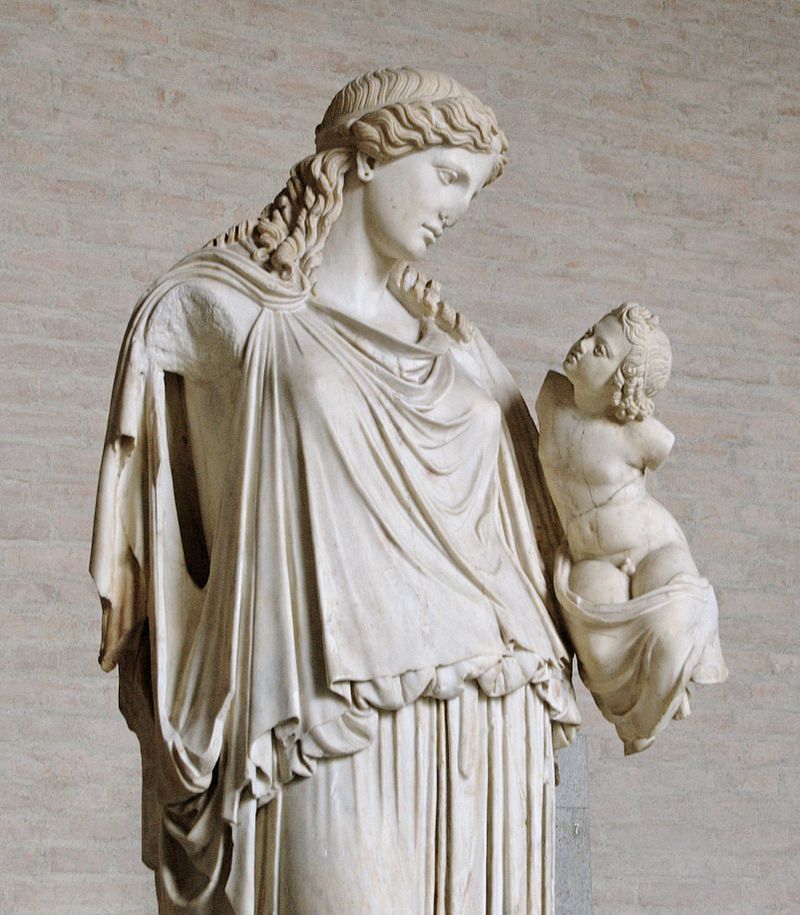
Eirene
ancient Greek goddess of peace
%20issued%20by%20Wm.%20S.%20Kimball%20%26%20Co.%20MET%20DPB871028.jpg)
Astraea
In ancient Greek religion and mythology, Astraea (; ), also spelled Astrea or Astria, is a daughter of Astraeus and Eos. She is the virgin goddess of justice, and is closely associated with another Greek justice goddess, Dike, the daughter of Zeus and Themis. Astraea is not to be confused with Asteria, the goddess of the stars and the daughter of Coeus and Phoebe.

Eunomia
right|thumb|Eunomia top right with Dike, Eirene and Themis, on a ceiling painting in Den Haag
Mafdet
Mafdet (also Mefdet, Maftet) was a goddess in the ancient Egyptian religion. She was often depicted wearing a skin of a cheetah, and protected against the bite of snakes and scorpions. She was part of the pantheon of ancient Egyptian deities that was prominent during the First Dynasty of Egypt. She was prominent during the reign of pharaoh Den whose image appears on stone vessel fragments from his tomb and is mentioned in a dedicatory entry in the Palermo Stone. Mafdet was the deification of legal justice, or possibly of capital punishment. She was associated with the protection of the king's
Vár
In Norse mythology, Vár or Vór (Old Norse, meaning either "pledge" or "beloved") is a goddess associated with oaths and agreements. Vár is attested in the Poetic Edda, compiled in the 13th century from earlier traditional sources; the Prose Edda, written in the 13th century by Snorri Sturluson; and kennings found in skaldic poetry and a runic inscription. Scholars have proposed theories about the implications of the goddess.
Syn
Norse deity

Nanshe
Nanshe ( ) was a Mesopotamian goddess in various contexts associated with the sea, marshlands, the animals inhabiting these biomes, namely bird and fish, as well as divination, dream interpretation, justice, social welfare, and certain administrative tasks. She was regarded as a daughter of Enki and sister of Ningirsu, while her husband was Nindara, who is otherwise little known. Other deities who belonged to her circle included her daughter Nin-MAR.KI, as well as Hendursaga, Dumuzi-abzu and Shul-utula. In Ur she was incorporated into the circle of Ningal, while in incantations she appears alo
Vaishno Devi
manifestation of the Hindu Mother Goddess, Devi

Clementia
thumb|Ancient statue of Clementia in the Vatican Museums#Museo Chiaramonti|Museo Chiaramonti
Poena
In Greek mythology, Poena or Poine () is the spirit of punishment and the attendant of punishment to Nemesis, the goddess of divine retribution. Some depictions are of a single being, and some depictions are of multiple beings—in the plural, the name is Poenai (); the Poenai are akin to the Erinyes.
Ala
Ordinani deity
Maman Brigitte
Vodou goddess
Praxidice
In Greek mythology, Praxidice or Praxidike (, , lit. "Applied Justice") may refer to the following characters:
Manungal
Nungal ( dNun-gal, "great princess"), also known as Manungal and possibly Bēlet-balāṭi, was the Mesopotamian goddess of prisons, sometimes also associated with the underworld. She was worshiped especially in the Ur III period in cities such as Nippur, Lagash and Ur.
Adrasteia
In ancient Greek religion and mythology, Adrasteia (; , ), also spelled Adrastia, Adrastea, Adrestia, Adrestea, Adastreia or Adrasta, originally a Phrygian mountain goddess, probably associated with Cybele, was later a Cretan nymph, and daughter of Melisseus, who was charged by Rhea with nurturing the infant Zeus in secret, to protect him from his father Cronus. By at latest the fifth century BC, she became identified with Nemesis, the goddess of divine retribution.
Homonoia
minor goddess of concord and unity of mind in Ancient Greek mythology,
Invidia
thumb|Envy (Invidia) (circa 1670) by Josse de Corte
In Latin, invidia is the sense of envy, a "looking upon" associated with the evil eye, from invidere, "to look against, to look in a hostile manner." Invidia ("Envy") is one of the Seven Deadly Sins in Christian belief.
Soteria
Greek divinity, personification of salvation