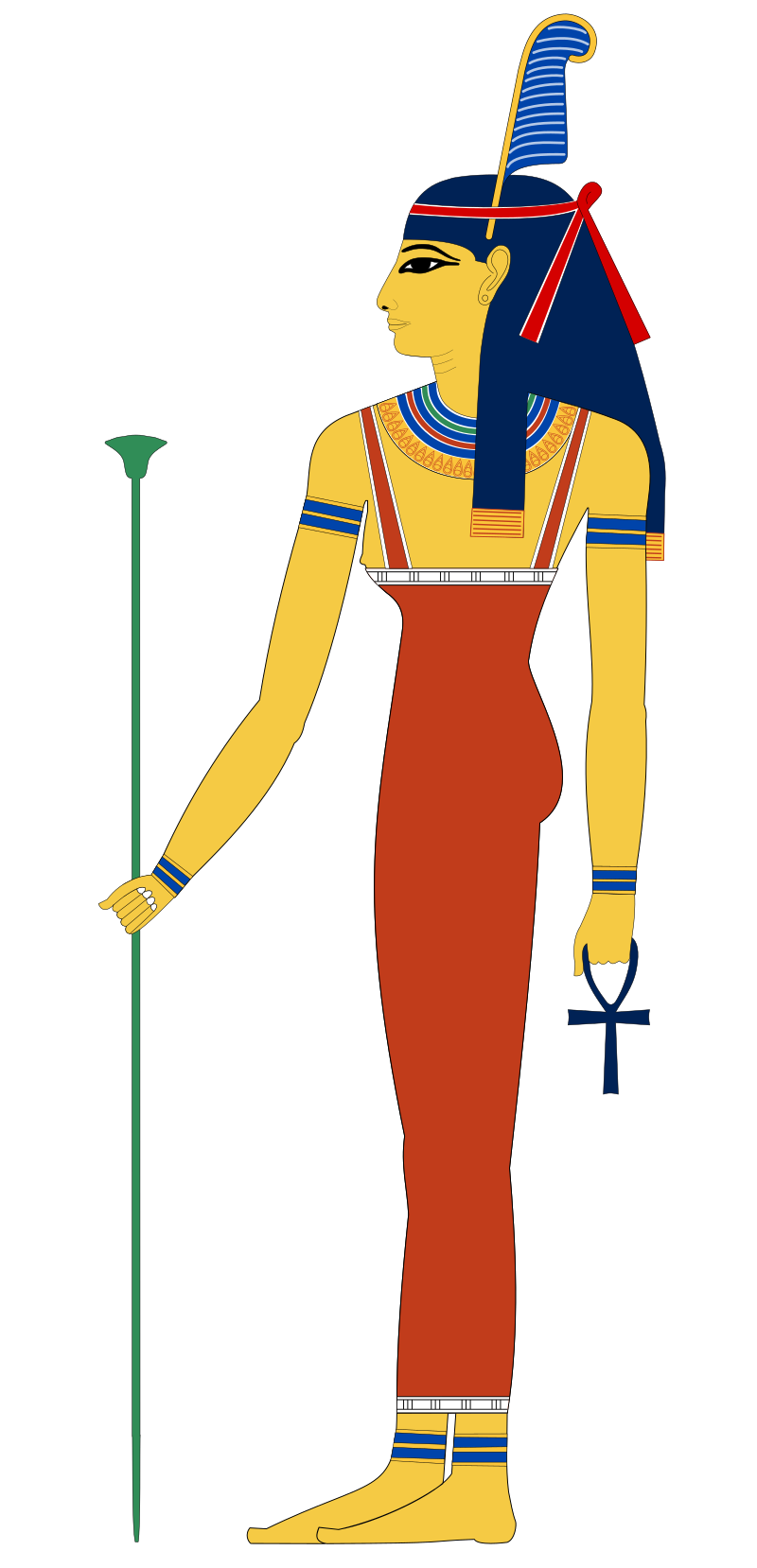
File:Maat.svg · Wikimedia Commons · See Wikimedia Commons
Maat
Sign in to save'''Ma'at or Maat' (Egyptian: ma’at /ˈmuʀʕat/, Coptic: ⲙⲉⲓ) comprised the ancient Egyptian concepts of truth, balance, law, morality, and justice. Maat was also the goddess who personified these concepts, and regulated the stars, seasons, and the actions of mortals and the deities who had brought order from chaos at the moment of creation. Her ideological opposite was Isfet (Egyptian jzft''), meaning injustice, chaos, violence or to do evil.
Maat was an ancient Egyptian concept encompassing truth, balance, law, morality, and justice, as well as a goddess who embodied these principles and maintained cosmic order among the stars, seasons, and actions of both gods and humans. Her opposing force was Isfet, representing chaos, injustice, and violence—making Maat central to how Egyptians understood a properly ordered universe.
AI-generated from the Wikipedia summary — may contain errors.
Key facts
- Deity.type
- Egyptian
- Deity.name
- Ma’at
- Deity.image
- Maat.svg
- Deity.caption
- Ma’at is both the goddess and the personification of truth, cosmic balance, and justice. Her ostrich feather represents the truth.
- Deity.god_of
- Goddess of Order
- Deity.cult_center
- All ancient Egyptian cities
- Deity.symbol
- scales, ostrich feather, Balance
- Deity.parents
- Ra and Hathor
- Deity.consort
- Thoth
- Deity.offspring
- Seshat
- Deity.hiero
- U5:a-t-C10 ! or H6 ! or U5:D36-X1-Y1:Z1*Z1*Z1*Z1 ! or U1-Aa11:X1-C10 ! or C10 ! or U5:D42-X1:Y1:Z2-I12 ! or U5:D42:X1-H6-C10-Y1-Z3 ! or H6-X1:H8-C10
via Wikipedia infobox
Wikidata facts
- Instance of
- Ancient Egyptian deity
- Part of
- Egyptian mythology
- Gender
- female
- Spouse
- Thoth
- Father
- Ra
- Image
- Maat.svg
Show 4 more facts
- domain of saint or deity
- justice
- Commons category
- Maat
- worshipped by
- religion of ancient Egypt
- iconographic symbol
- feather
Sources (1)
via Wikidata · CC0
~26 min read
Encyclopedic overview
26 sectionsContents
- Pronunciation
- History
- Goddess
- Principle
- Law
- Scribes and scribal school
- Scribes
- Scribal schools
- As rhetorical concept
- In ancient Egyptian texts
- Performance in ancient Egyptian letters
- Persuasion in ancient Egyptian letters
- Temples
- Afterlife
- Weighing of the Heart
- Assessors of Maat
- Funerary texts
- 42 Negative Confessions (''Papyrus of Ani'')<!--linked from 'Papyrus of Ani'-->
- Gallery
- See also
- References
- Notes
- Citations
- Works cited
- Further reading
- External links
'''Ma'at or Maat' (Egyptian: ma’at /ˈmuʀʕat/, Coptic: ⲙⲉⲓ) comprised the ancient Egyptian concepts of truth, balance, law, morality, and justice. Maat was also the goddess who personified these concepts, and regulated the stars, seasons, and the actions of mortals and the deities who had brought order from chaos at the moment of creation. Her ideological opposite was Isfet (Egyptian jzft), meaning injustice, chaos, violence or to do evil.
==Pronunciation== Cuneiform texts indicate that the word was pronounced /múʔʕa/ during the New Kingdom of Egypt, having lost the feminine ending t. Vowel assimilation of u to e'' later produced the Coptic word / "truth, justice".
Excerpted from Wikipedia’s “Maat” article, available under the CC BY-SA 4.0 licence.
Gallery (26)
Available in 65 languages
- Español
- Français
- Deutsch
- 中文
- 日本語
- Русский
- Português
- Italiano
- العربية
- हिन्दी
- Afrikaans
- Armenian
- Assamese
- Azerbaijani
- Bahasa Indonesia
- Bangla
- Basque
- Belarusian
Show 46 more
- Bosnian
- Breton
- Bulgarian
- Catalan
- cdo
- Croatian
- Czech
- Danish
- Egyptian Arabic
- Esperanto
- Estonian
- Finnish
- Georgian
- Greek
- Hebrew
- Hungarian
- hyw
- Icelandic
- Latin
- Lithuanian
- Macedonian
- Malay
- Manipuri
- Mingrelian
- Nederlands
- Newari
- Norwegian
- Novial
- Occitan
- Polski
- Romanian
- Serbian
- Serbian (Latin)
- Sicilian
- simple
- Slovak
- Slovenian
- Svenska
- Tiếng Việt
- Türkçe
- Ukrainian
- Urdu
- Waray
- Wu Chinese
- فارسی
- 한국어
via Wikidata sitelinks · CC0