Category
page 1Khanates

Mongol Empire
13th- and 14th-century empire originating in Mongolia

Yuan dynasty
Mongol-led imperial dynasty of China (1271–1368)
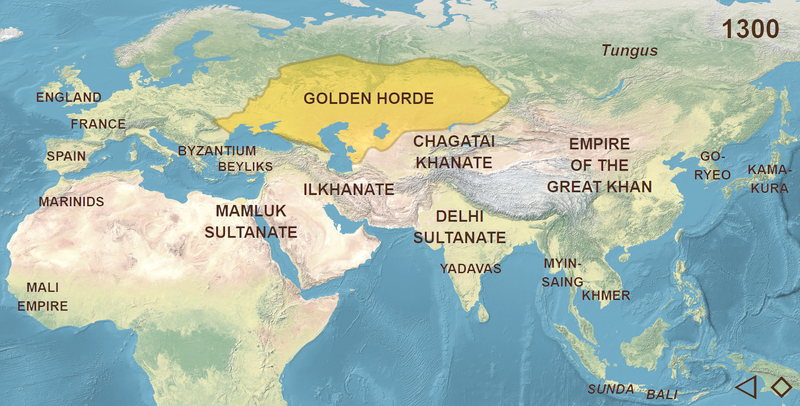
Golden Horde
medieval state in Eurasia

Khazars
The Khazars () were a semi-nomadic Turkic people who established a major commercial empire in the late 6th century CE spanning the south of modern European Russia, southern Ukraine, and western Kazakhstan. It was the most powerful polity to emerge from the break-up of the Western Turkic Khaganate. Astride a major artery of commerce between Eastern Europe and Southwestern Asia, Khazaria became one of the foremost trading empires of the early medieval world, commanding the western marches of the Silk Road and playing a key commercial role as a crossroad between China, the Middle East, and Kievan

Ilkhanate
The Ilkhanate or Il-khanate was a Mongol khanate founded in the southwestern territories of the Mongol Empire. It was ruled by the Il-Khans or Ilkhanids (), and known to the Mongols as Hülegü Ulus (). The Ilkhanid realm was officially known as the Land of Iran (Irānzamin) or simply Iran. It was established after Hülegü, the son of Tolui and grandson of Genghis Khan, inherited the West Asian and Central Asian part of the Mongol Empire after his brother Möngke Khan died in 1259.

Khanate of Qazan
former country
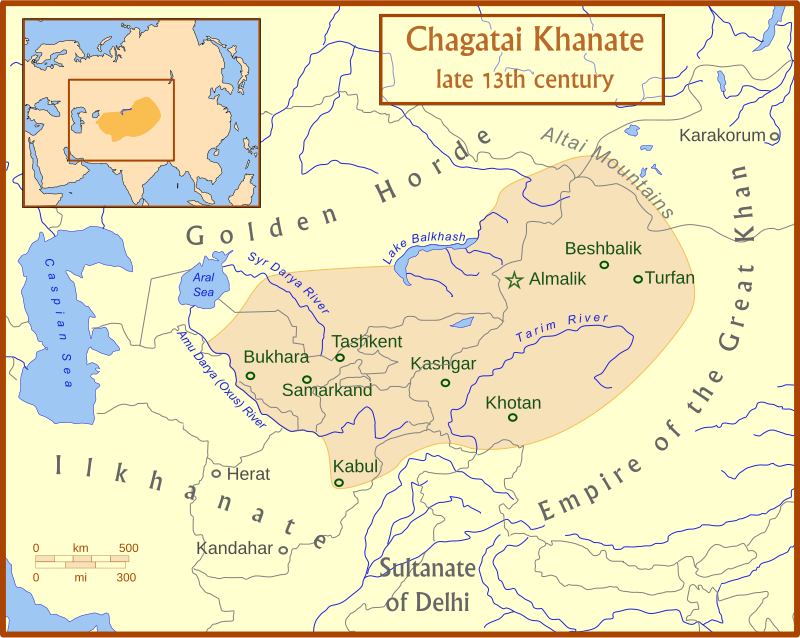
Chagatai Khanate
1226–1347 Turkicized Mongol khanate in Central Asia

Siberian Khanate
Turkic Khanate located in southwestern Siberia with a Turco-Mongol ruling class

khanate
A khanate ( ) or khaganate was a polity ruled by a khan, khagan, khatun, or khanum. Khanates were typically nomadic Mongolic and Turkic societies located on the Eurasian Steppe, and politically equivalent in status to kinship-based chiefdoms and feudal monarchies. Khanates and khaganates were organised tribally, where leaders gained power on the support and loyalty of their warrior subjects, gaining tribute from subordinates as realm funding. In comparison to a khanate, a khaganate, the realm of a khagan, was a large nomadic state maintaining subjugation over numerous smaller khanates. The tit

Liao dynasty
Khitan imperial dynasty in East Asia (916-1125), controlling northern and northeastern China, Mongolia, Russian Far East and North Korea

Uyghur Khaganate
former country

Khanate of Khiva
former country

Khanate of Kokand
former state in Central Asia

Astrakhan Khanate
medieval state

Rouran Khaganate
state established by proto-Mongols, from the late 4th century until the middle 6th century

Karakhanid Khanate
Turkic dynasty

Dzungar Khanate
Oirat Mongolian Khanate based in Dzungaria from 1634–1758, referred as the Last great Nomadic empire

Old Great Bulgaria
632–668 nomadic empire in Eastern Europe
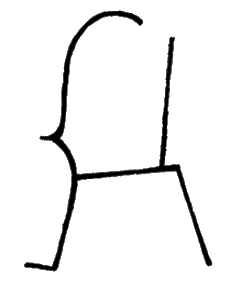
Turkic Khaganate
khaganate established by the Ashina clan of the Göktürks in medieval Inner Asia

Nogai Horde
former country

Moghulistan
Moghulistan, also called the Moghul Khanate or the Eastern Chagatai Khanate, was a Muslim, Mongol, and later Turkic breakaway khanate of the Chagatai Khanate and a historical geographic area north of the Tengri Tagh mountain range, on the border of Central Asia and East Asia. That area today includes parts of Kazakhstan, Kyrgyzstan, and northwest Xinjiang. The khanate nominally ruled over the area from the mid-14th century until the late 17th century.
Western Turkic Khaganate
former Khaganate
Bogd Khanate of Mongolia
khanate ruled by bogd khan on Outer Mongolia from 1911 to 1919 and 1921 to 1924
Northern Yuan dynasty
former empire in East Asia
Later Jin (1616-1636)
Jurchen-led dynasty in Manchuria
Eastern Turkic Khaganate
former empire in the 6th and 7th centuries
Kyrgyz Khaganate
state of the Yenisei Kyrgyz
Avar Khanate
Muslim state 13th to 19th century
Second Turkic Khaganate
Turkic state that ruled in the 7th and 8th centuries

Türgesh
The Türgesh or Türgish (; ; Old Tibetan: Du-rgyas) were a Turkic tribal confederation. Once belonging to the Duolu wing of the Western Turkic On Oq elites, Türgeshes emerged as an independent power after the demise of the Western Turks and established a khaganate in 699. The Türgesh Khaganate lasted until 766 when the Karluks defeated them. Türgesh and Göktürks were related through marriage.
Kimek Khanate
Medieval Turkic state formed by the Kimek and Kipchak people
Kalmyk Khanate
historic state
Four Oirats
Confederation of Oirat tribes of Western Mongolia
Kumul Khanate
Feudal Turkic khanate within the Qing dynasty
Kazikumukh Khanate
Feudal formation created as a result of the collapse of the Tarkov Shamkhalate (Kumyk feudal state)
Kara Del
Qamil or Kara Del was a kingdom that existed in Kumul or Hami, in present-day Xinjiang. It was founded by the Yuan prince Gunashiri, a descendant of Chagatai Khan, in the late 14th century (c. 1389), and ruled by the Chagatayids thereafter until 1463. From 1380s, it began to pay tribute to the Ming dynasty. From 1406, it was governed by Ming under the "Hami Guard" (); however, sometimes it was still under the influence of the Northern Yuan, and the ruler was called the Obedient King () under the Jimi system. It was destroyed in 1513 as a result of the wars between the Ming dynasty and the Oira
Kara-Kyrgyz Khanate
former feudal state of the Kyrgyz people

Turpan Khanate
historic state ruled by the Mongols
Khanate of Nishapur
semi-independent state ruled by the Bayat tribe
Qunduz Khanate
historical Central Asian state