File:Asia_in_1335.svg · Wikimedia Commons · See Wikimedia Commons
khanate
Sign in to saveAlso known as khanlik, khanaut, khanates, khanliks, khanauts
A khanate ( ) or khaganate was a polity ruled by a khan, khagan, khatun, or khanum. Khanates were typically nomadic Mongolic and Turkic societies located on the Eurasian Steppe, and politically equivalent in status to kinship-based chiefdoms and feudal monarchies. Khanates and khaganates were organised tribally, where leaders gained power on the support and loyalty of their warrior subjects, gaining tribute from subordinates as realm funding. In comparison to a khanate, a khaganate, the realm of a khagan, was a large nomadic state maintaining subjugation over numerous smaller khanates. The tit
A khanate was a state ruled by a khan or similar leader, typically found among nomadic Mongolic and Turkic peoples of the Eurasian Steppe, where power was based on a leader's ability to command the loyalty of warrior subjects who provided tribute. Khanates mattered historically because they were significant political entities—some even larger "khaganates" ruled over multiple smaller khanates—that organized entire regions of the Eurasian steppe through tribal leadership structures.
AI-generated from the Wikipedia summary — may contain errors.
Wikidata facts
- Subclass of
- historical country
Show 3 more facts
- topic's main category
- Category:Khanates
- Commons category
- Khanates
- described by source
- Armenian Soviet Encyclopedia
Sources (1)
via Wikidata · CC0
~8 min read
Encyclopedic overview
11 sectionsContents
- Mongol khanates
- Indefinite origin
- Turkic khanates
- Early and Late Medieval Turkic khaganates and khanates
- Central Asian Turkic khanates
- Khanates of Azerbaijan
- Khanates of the Caucasus
- Other khanates
- See also
- References
- External links
A khanate ( ) or khaganate was a polity ruled by a khan, khagan, khatun, or khanum. Khanates were typically nomadic Mongolic and Turkic societies located on the Eurasian Steppe, and politically equivalent in status to kinship-based chiefdoms and feudal monarchies. Khanates and khaganates were organised tribally, where leaders gained power on the support and loyalty of their warrior subjects, gaining tribute from subordinates as realm funding. In comparison to a khanate, a khaganate, the realm of a khagan, was a large nomadic state maintaining subjugation over numerous smaller khanates. The title of khagan, translating as "Khan of the Khans", roughly corresponds in status to that of an emperor.
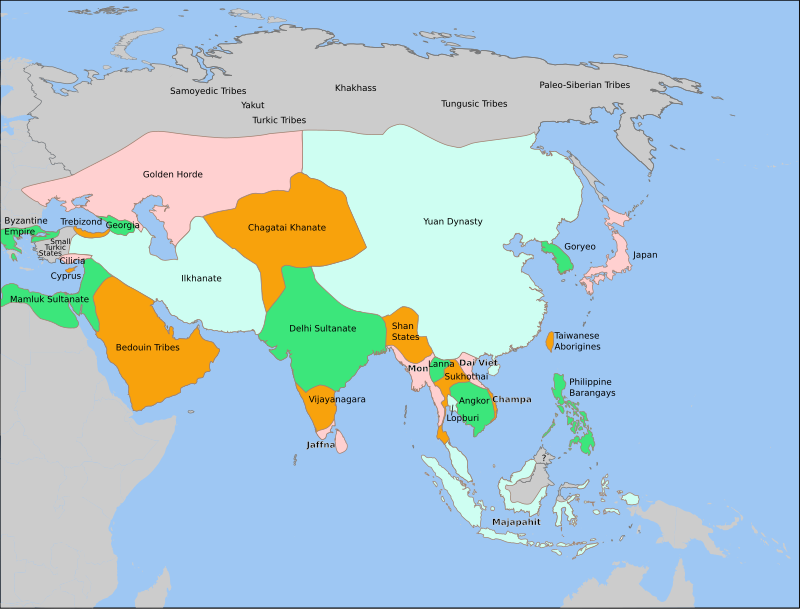
== Mongol khanates == thumb|The successor states of the Mongol Empire in 1335: the Ilkhanate, [[Golden Horde, Yuan dynasty and Chagatai Khanate]] Mongol Empire (1206–1368) was the largest steppe nomadic Khaganate as well as second largest empire and the largest contiguous empire in history. After Genghis Khan established appanages for his family in the Mongol Empire during his rule (1206–1227), his sons, daughters, and grandsons inherited separate sections of the empire. The Mongolian khanates that emerged from those appanages are listed below. Chagatai Khanate (1226–1347), In 1226, the second son of Genghis Khan, Chagatai Khan established the Chagatai Khanate. At its height in the late 13th century, the khanate extended from the Amu Darya south of the Aral Sea to the Altai Mountains in the border of modern-day Mongolia and China, roughly corresponding to the defunct Qara Khitai Empire. Initially the rulers of the Chagatai Khanate recognized the supremacy of the Great Khan, but by the reign of Kublai Khan, Ghiyas-ud-din Baraq no longer obeyed the emperor's orders. By 1347 the khanate had split into the Moghulistan and West Chagatai Khanate. Moghul Khanate Yarkent Khanate Turpan Khanate Il-Khanate (1252–1335), In 1256, Il-Khanate was established by the grandson of Genghis Khan, Hulagu Khan. Its core territory lies in what is now part of the countries of Iran, Azerbaijan, and Turkey. At its greatest extent, the Ilkhanate also included parts of modern Iraq, Syria, Armenia, Georgia, Afghanistan, Turkmenistan, Pakistan, part of modern Dagestan, and part of modern Tajikistan. Later Ilkhanate rulers, beginning with Ghazan in 1295, converted to Islam. In the 1330s, the Ilkhanate was ravaged by the Black Death. Its last khan Abu Sa'id died in 1335, after which the khanate disintegrated. The Ilkhanid rulers, although of non-Iranian origin, tried to advertise their authority by tying themselves to the Iranian past, and they recruited historians in order to present the Mongols as heirs to the Sasanians (224–651 AD) of pre-Islamic Iran.thumb|Turco-Mongol tradition|Turco-Mongol residual states and domains in the 15th century Golden Horde Blue Horde Great Horde Astrakhan Khanate Crimean Khanate Khanate of Kazan White Horde Nogai Horde Kazakh Khanate Khanate of Bukhara Khanate of Khiva Khanate of Sibir Yuan dynasty Northern Yuan dynasty thumb|Central Asia in 1636. The Dzungar Khanate was the last great [[nomadic empire in Central Asia.]] Bogd Khanate (1911–1924), under rule of the Bogd Khan, the last Mongol khagan Dzungar Khanate, formed in 1634, covering Xinjiang region of China, Kyrgyzstan, eastern Kazakhstan and western Mongolia; 2 December 1717 – 1720, also styled Protector of Tibet; 1755 tributary to the Qing dynasty, 1758 annexed by Qing dynasty Kalmyk Khanate, established c.1630 by the Torghut branch of the Mongol Oirats, settled along the lower Volga River (in modern Russia and Kazakhstan), 1630-1771 Kara Del Keraite Khanate Khamag Mongol Khanate Khoshut Khanate Khotgoid Khanate Mergid Khanate Naiman Khanate Tatar Khanate Kumul Khanate – a vassal state to Qing dynasty and Republic of China, abolished in 1930
Excerpted from Wikipedia’s “khanate” article, available under the CC BY-SA 4.0 licence.