Category
page 1Landmarks in Germany

Bremen
Bremen (), officially the City Municipality of Bremen, is the capital of the German state of the Free Hanseatic City of Bremen () a two-city-state consisting of the cities of Bremen and Bremerhaven. It is an important port city with about 586,000 inhabitants, the Hanseatic city is the 11th-largest city of Germany and the second-largest city in Northern Germany after Hamburg.
.jpg)
Lübeck
Lübeck (; or ; Latin: ), officially the Hanseatic City of Lübeck (), is a city in Northern Germany. With around 220,000 inhabitants, it is the second-largest city on the German Baltic coast and the second-largest city in the state of Schleswig-Holstein, after its capital of Kiel. It is the 36th-largest city in Germany.

Trier
Trier ( , ; ), formerly and traditionally known in English as Trèves ( , ) and Triers (see also names in other languages), is a city on the banks of the Moselle in Germany. It lies in a valley between low vine-covered hills of red sandstone in the west of the state of Rhineland-Palatinate, near the border with Luxembourg and within the important Moselle wine region.

Weimar
Weimar is a city in the German state of Thuringia, in Central Germany between Erfurt to the west and Jena to the east, southwest of Leipzig, north of Nuremberg and west of Dresden. Together with the neighbouring cities of Erfurt and Jena, it forms the central metropolitan area of Thuringia, with approximately 500,000 inhabitants. The city itself has a population of 65,000. Weimar is well known because of its cultural heritage and importance in German history.
.jpg)
Wismar

Neuschwanstein Castle
castle in Bavaria, Germany, Europe
%204.JPG)
Stralsund
Stralsund (; Swedish: Strålsund), officially the Hanseatic City of Stralsund (German: Hansestadt Stralsund), is the fifth-largest city in the northeastern German state of Mecklenburg-Western Pomerania after Rostock, Schwerin, Neubrandenburg and Greifswald, and the second-largest city in the Pomeranian part of the state. It is located on the southern coast of the Strelasund, a sound of the Baltic Sea separating the island of Rügen from the Pomeranian mainland.

Lutherstadt Wittenberg
Wittenberg, officially Lutherstadt Wittenberg, is the fourth-largest town in the state of Saxony-Anhalt, in the Federal Republic of Germany. It is situated on the River Elbe, north of Leipzig and south-west of the reunified German federal capital city of Berlin, and has a population of 46,008 (2018).

Brandenburg Gate
triumphal arch in Berlin, Germany

Quedlinburg
Quedlinburg () is a town situated just north of the Harz mountains, in the district of Harz in the west of Saxony-Anhalt, Germany. As an influential and prosperous trading centre during the early Middle Ages, Quedlinburg became a center of influence under the Ottonian dynasty in the 10th and 11th centuries. The castle, church and old town with around 2,100 timber houses, dating from this time of influence, were added to the UNESCO World Heritage List in 1994 because of their exceptional preservation and outstanding Romanesque architecture.

Goslar
Goslar (; Eastphalian: Goslär) is a historic town in Lower Saxony, Germany. It is the administrative centre of the district of Goslar and is located on the northwestern slopes of the Harz mountain range. The Old Town of Goslar with over 1.500 timber houses and the Mines of Rammelsberg are UNESCO World Heritage Sites for their millennium-long testimony to the history of ore mining and their political importance for the Holy Roman Empire and Hanseatic League. Each year Goslar awards the Kaiserring to an international artist, called the "Nobel Prize" of the art world.

Cologne Cathedral
Roman-Catholic cathedral in Cologne, Germany
%2C%20houses%20for%20the%20nuns.jpg)
Eisleben
Eisleben () is a town in Saxony-Anhalt, Germany. It is famous as both the hometown of the influential theologian Martin Luther and the place where he died; hence, its official name is Lutherstadt Eisleben.

Reichstag
seat of the German Bundestag and, before 1945, the eponymous parliament of the Weimar Republic
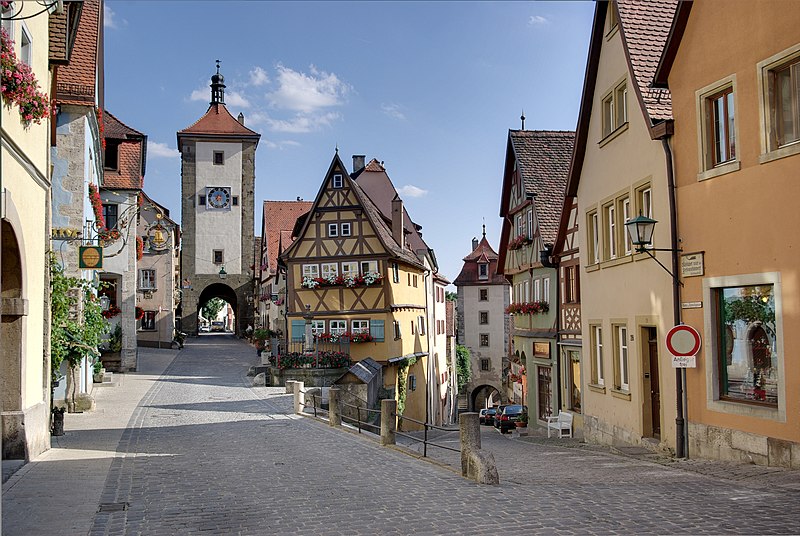
Rothenburg ob der Tauber
town in Germany
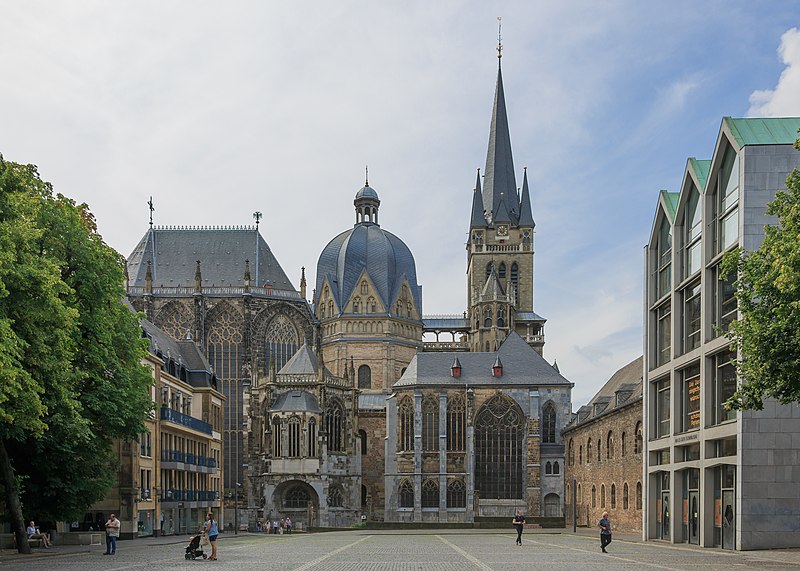
Aachen Cathedral
Roman-Catholic cathedral in Aachen, Germany

Stade
Stade (; ), officially the Hanseatic City of Stade (, ) is a city in Lower Saxony in northern Germany. First mentioned in records in 934, it is the seat of the district () which bears its name. It is located roughly to the west of Hamburg and belongs to that city's wider metropolitan region. Within the area of the city are the urban districts of Bützfleth, Hagen, Haddorf and Wiepenkathen, each of which have a council () of their own with some autonomous decision-making rights.

Fernsehturm Berlin
television tower in Berlin

Wartburg
The Wartburg () is a castle originally built in the Middle Ages. It is situated on a precipice of to the southwest of and overlooking the town of Eisenach, in the state of Thuringia, Germany. It was the home of St. Elisabeth of Hungary, the place where Martin Luther translated the New Testament of the Bible into German, the site of the Wartburg festival of 1817 and the supposed setting for the possibly legendary Sängerkrieg. It was an important inspiration for Ludwig II when he decided to build Neuschwanstein Castle.

Museum Island
northern part of Spree Island in the Spree river in central Berlin

Sanssouci Palace
Sanssouci () is a historical building in Potsdam, near Berlin. Built by Prussian King Frederick the Great as his summer palace, it is often counted among the German rivals of Versailles. While Sanssouci is in the more intimate Rococo style and is far smaller than its French Baroque counterpart, it is similarly notable for the numerous temples and follies in the surrounding park. The palace was designed and built by Georg Wenzeslaus von Knobelsdorff between 1745 and 1747 to meet Frederick's need for a private residence where he could escape the pomp and ceremony of the royal court. The palace's

Ulm Minster
Gothic church in Germany
Hohenzollern Castle
ancestral seat of the imperial House of Hohenzollern in the Swabian Alps of central Baden-Württemberg, Germany
Muskau Park
landscape park in the Upper Lusatia region of Germany and Poland
Maulbronn Monastery
monastery in Germany

Wieskirche
The Pilgrimage Church of Wies (officially: Wallfahrtskirche zum Gegeißelten Heiland auf der Wies ("Pilgrimage Church of the Scourged Savior on the Meadow"); abbr. Wieskirche ("Meadow Church")) is a Roman Catholic oval Rococo church, designed in the late 1740s and completed in 1754. It is the major work of the brothers Johann Baptist and Dominikus Zimmermann, the latter of whom lived nearby for the last eleven years of his life. It is located in the foothills of the Alps, in the municipality of Steingaden, Germany. It belongs to the diocese of Augsburg (deanery of Weilheim-Schongau), and is ded

Lichtenstein Castle
château in Württemberg

Eltz Castle
Castle in Germany

Walhalla memorial
Memorial in Donaustauf, Bavaria
Dessau-Wörlitz Garden Realm
cultural landscape
Bergpark Wilhelmshöhe
landscape park with castle in Kassel, Germany
Palaces and Parks of Potsdam and Berlin
World Heritage site in Germany
Zollverein Coal Mine Industrial Complex
large former industrial site in the city of Essen, North Rhine-Westphalia, Germany
St. Nicholas Church, Hamburg
church building in Altstadt (Hamburg), Germany
Holstentor
two-towered city gate in Lübeck, Germany, used as a museum
.jpg)
Hermannsdenkmal
thumb|Aerial view of the Hermannsdenkmal
St. Michaelis Church, Hamburg
Lutheran church in Hamburg, Germany
Dresden Elbe Valley
cultural landscape in Saxony in Germany
Limes Germanicus
fortifications of ancient Roman provinces
Ehrenbreitstein Fortress
German fortress
Bavaria
Statue of Bavaria in Munich, Germany
King's House on Schachen
alpine chalet of Ludwig II of Bavaria, Germany
Marienberg Fortress
cultural heritage monument D-6-63-000-317 (0) in Würzburg, Bavaria
Abbey of Reichenau
monastery
Old Castle
Renaissance castle in Stuttgart, Germany, seat of the Landesmuseum Württemberg
Palace of Aachen
Carolingian palace in Aachen, Germany
World Clock
large clock in Berlin, Germany
Funkturm Berlin
radio tower in Berlin

Kunstareal
The Kunstareal (, "art district") is a museum quarter in the city centre of Munich, Germany.
Bürresheim Castle
castle in Germany
Hambach Castle
castle near the urban district Hambach of Neustadt an der Weinstraße in Rhineland-Palatinate, Germany
Niederwalddenkmal
monument commemorating the founding of Germany

Befreiungshalle
The Befreiungshalle ("Hall of Liberation", ) is a neoclassical monument on the Michelsberg hill above the town of Kelheim in Bavaria, Germany. It stands upstream of Regensburg on the river Danube at the confluence of the Danube and the Altmühl, i.e. the Rhine–Main–Danube Canal. It is just downstream of the Danube Gorge, towering above its lower end. It was commissioned by King Ludwig I of Bavaria to commemorate the victory over Napoleon in the Befreiungskriege of 1813–1815.
Rheinfels Castle
castle in Germany
Pfalzgrafenstein Castle
castle in Germany
imperial cathedral
cathedral linked to the German emperors
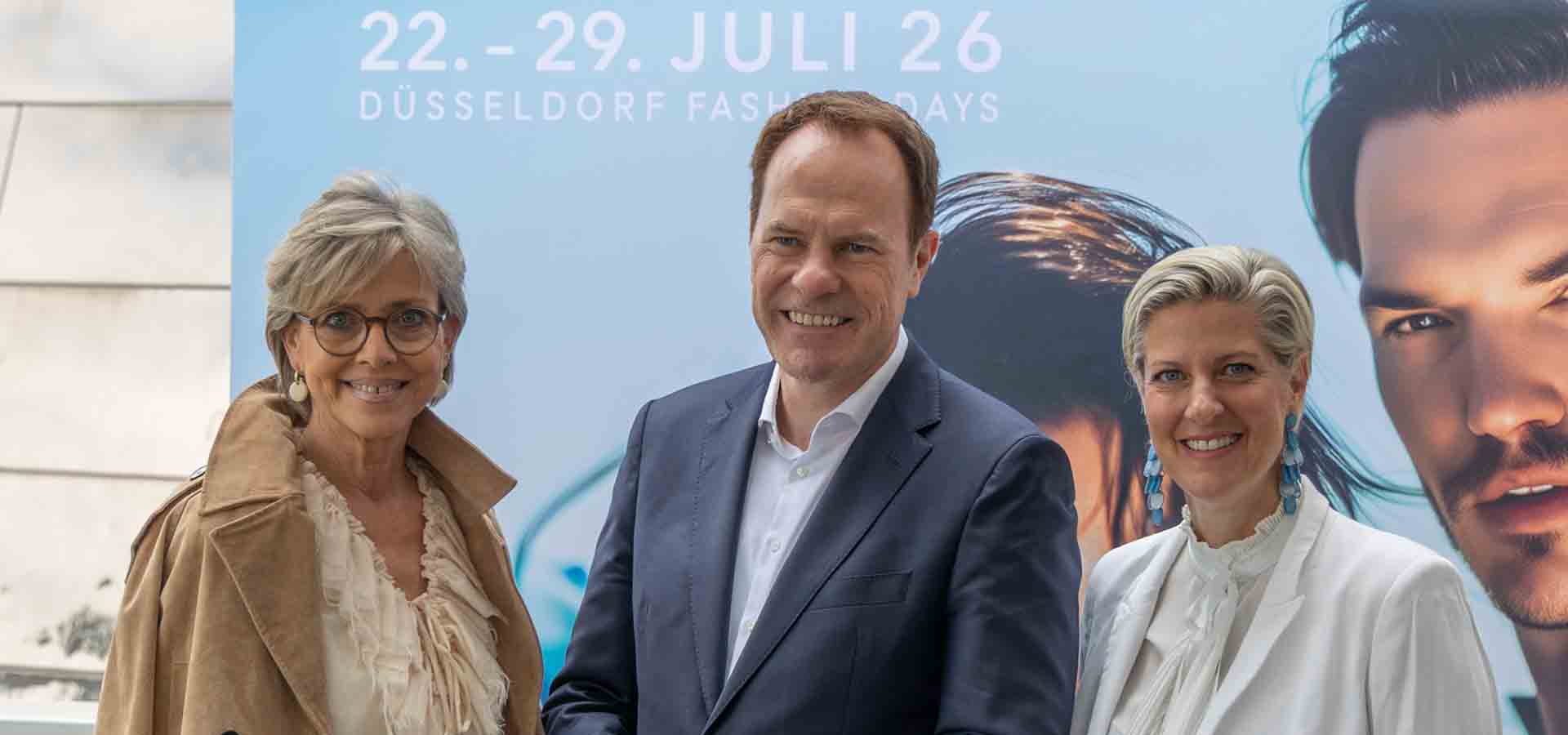
Königsallee
thoroughfare and shopping street in Düsseldorf, Germany
Aachen Town Hall
historic town hall in Aachen, Germany
St. Severi (Erfurt)
church in Thuringia, Germany
Schloss Mespelbrunn
cultural heritage monument D-6-71-141-7 (0) in Mespelbrunn, Bavaria