
File:Brandenburger_Tor_abends.jpg · Wikimedia Commons · See Wikimedia Commons
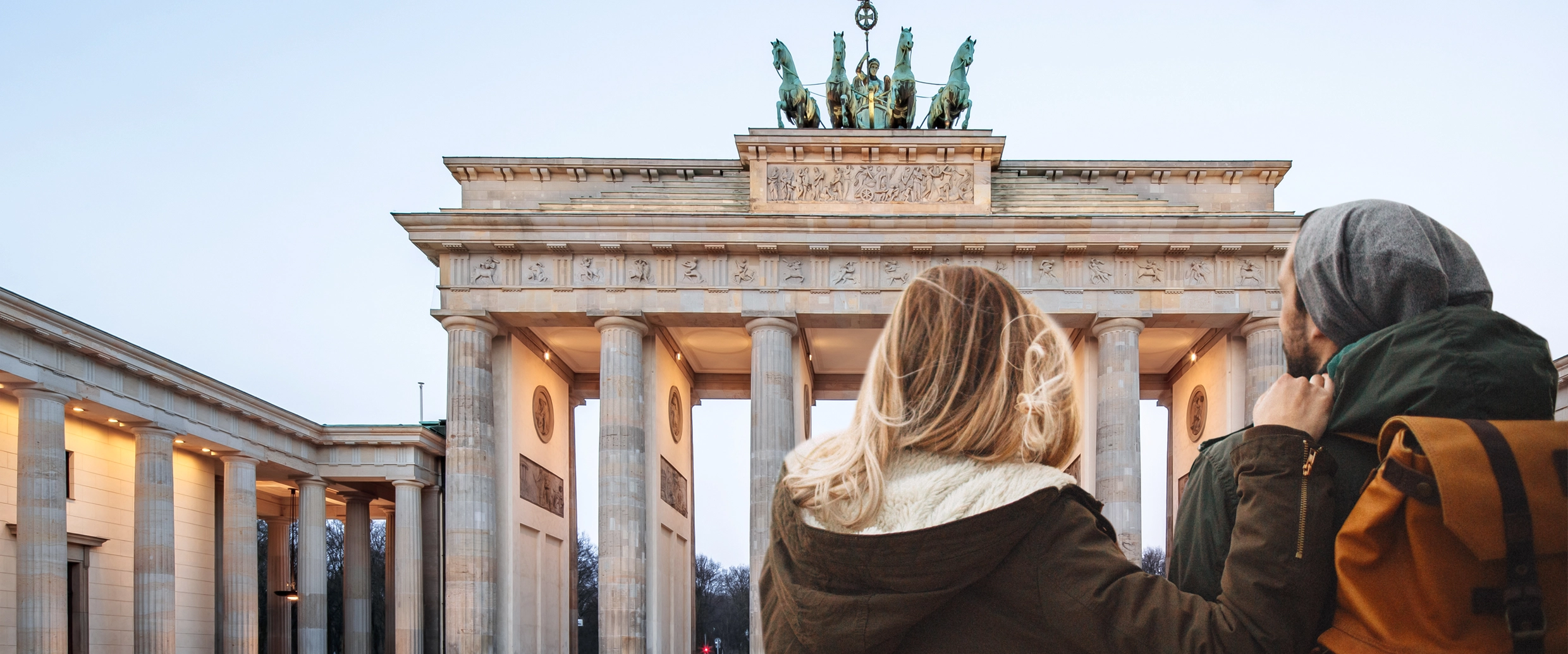
The Brandenburg Gate is a triumphal arch located in Berlin, Germany, that stands as one of the city's most iconic landmarks. It has served as a powerful symbol of Berlin's history, from Prussian military power through the division and reunification of Germany.
AI-generated from the Wikipedia summary — may contain errors.
Official website
Brandenburger Tor in Berlin: Infos, Events & mehr | visitBerlin.de
Das Brandenburger Tor - Eine der wichtigsten Berliner Sehenswürdigkeiten: ✓ Events ✓ Geschichte & Architektur ► Besuchen Sie das Wahrzeichen Berlins!
visitberlin.de →Link to the official site · 10,294 chars · not written by Vinony
Wikidata facts
- Instance of
- tourist attraction
- Part of
- Berlin Customs Wall
- Named after
- Brandenburg an der Havel
- Country
- Kingdom of Prussia
- Located in
- Berlin
- Owned by
- Berlin
- Material used
- sandstone
- Location
- Dorotheenstadt
- Official website
- www.brandenburg-gate.de
- Image
- Berlin-Brandenburg Gate overview.jpg
- Height
- 26
Show 17 more facts
- architectural style
- Greek Revival architecture
- hashtag
- BrandenburgerTor
- applies to jurisdiction
- Germany
- architect
- Heinrich Strack
- Commons category
- Brandenburg Gate
- Commons gallery
- Brandenburger Tor
- commissioned by
- Friedrich Wilhelm II of Prussia
- native label
- Brandenburger Tor
- date of official opening
- 1791-08-06
- located on street
- Pariser Platz
- inception
- 1791-00-00
- different from
- Brandenburg Gate
- webcam page URL
- www.youtube.com/watch?v=OY6inDeSC-Y
- P12749
- Heterotardigrada
- P8168
- Chöpfenberg
- inspired by
- Propylaea of Athens
- time period
- Kingdom of Prussia
Sources (13)
via Wikidata · CC0
~23 min read
Encyclopedic overview
The Brandenburg Gate (German: Brandenburger Tor [ˈbʁandn̩ˌbʊʁɡɐ ˈtoːɐ̯] ) is an 18th-century neoclassical monument in Berlin, Germany. One of the best-known landmarks of the country, it was erected on the site of a former city gate that marked the start of the road from Berlin to Brandenburg an der Havel, the former capital of the Margraviate of Brandenburg. The current structure was built from 1788 to 1791 by orders of King Frederick William II of Prussia, based on designs by the royal architect Carl Gotthard Langhans. The bronze sculpture of the quadriga crowning the gate is a work by the sculptor Johann Gottfried Schadow.
The Brandenburg Gate is located in the western part of the city centre within Mitte, at the junction of Unter den Linden and Ebertstraße. The gate dominates the Pariser Platz to the east, while to the immediate west it opens onto the Platz des 18. März beyond which the Straße des 17. Juni begins. One block to the north stands the Reichstag building, home to the German parliament (Bundestag), and further to the west is the Tiergarten inner-city park. The gate also forms the monumental entry to Unter den Linden, which leads directly to the former City Palace of the Prussian monarchs (now housing the Humboldt Forum museum), and Berlin Cathedral.
Excerpted from Wikipedia’s “Brandenburg Gate” article, available under the CC BY-SA 4.0 licence.
Gallery (13)
On the map
Available in 83 languages
- Español
- Français
- Deutsch
- 中文
- 日本語
- Русский
- Português
- Italiano
- العربية
- हिन्दी
- Afrikaans
- Albanian
- Aragonese
- Armenian
- Asturian
- Azerbaijani
- Bahasa Indonesia
- Balinese
Show 64 more
- Bangla
- Bashkir
- Basque
- be_x_old
- Belarusian
- Bosnian
- Breton
- Bulgarian
- Catalan
- Croatian
- Czech
- Danish
- Erzya
- Esperanto
- Estonian
- Filipino
- Finnish
- Galician
- Georgian
- Greek
- Hebrew
- Hungarian
- Icelandic
- Irish
- Javanese
- Kannada
- Latin
- Latvian
- Lithuanian
- Luxembourgish
- Macedonian
- Malay
- Marathi
- Mongolian
- Nederlands
- Norwegian
- Occitan
- Polski
- Punjabi
- Romanian
- Serbian
- Serbian (Latin)
- simple
- Slovak
- Slovenian
- Svenska
- Tamil
- Tiếng Việt
- Türkçe
- Ukrainian
- Urdu
- Uzbek
- Venetian
- Waray
- Welsh
- Western Frisian
- Western Panjabi
- Wu Chinese
- Zaza
- zh_min_nan
- zh_yue
- فارسی
- ไทย
- 한국어
via Wikidata sitelinks · CC0