Category
page 1Languages of Germany

German
West Germanic language native to Central Europe
Turkish
Oghuz Turkic language of the Turkish people

Danish
North Germanic language spoken in Northern Europe

Yiddish
thumb|The opening page of the 1828 Yiddish-written Jewish holiday of Purim play Esther, oder die belohnte Tugend from [[Fürth (by Nürnberg), Bavaria]]

Silesian
West Slavic ethnolect

Frisian
group of Germanic languages

Romani
language of the Romani people belonging to the Indo-Aryan branch of the Indo-European language family

Low German
West Germanic language spoken mainly in northern Germany and the eastern part of the Netherlands

Upper Sorbian
language spoken by Sorbs in Germany in the historical province of Upper Lusatia

Limburgish language
Limburgish ( or ; ; also Limburgian, Limburgic or Limburgan) is the collective designation for a group of closely related language varieties spoken in most of Belgian and Dutch Limburg and in the adjacent areas of North Rhine-Westphalia.
Lower Sorbian
Western Slavic language spoken in eastern Germany in the historical province of Lower Lusatia

Bavarian
major group of Upper German varieties spoken in the southeast of the German language area Bavaria

Sorbian
Lechitic language spoken by the Sorbs
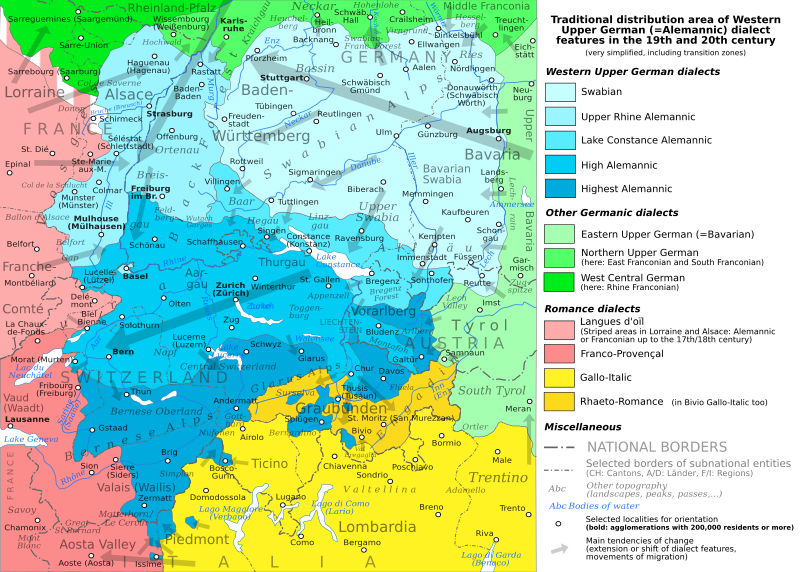
Alemannic
group of dialects of the Upper German branch of the Germanic language family

Polabian
extinct West Slavic language

North Frisian
minority languages of Germany, spoken mostly by people in North Frisia

Ripuarian
German dialect group

Old High German
earliest stage of the German language, spoken from 500/750 to 1050 AD
Old Saxon
Germanic language spoken 8C – 12C

Low Saxon
group of Low German dialects spoken in parts of the Netherlands, northwestern Germany and southern Denmark
Swabian
Upper German dialect
.svg)
Plautdietsch
Plautdietsch () or Mennonite Low German is a Low Prussian dialect of East Low German with Dutch influence that developed in the 16th and 17th centuries in the Vistula delta area of Royal Prussia. The word Plautdietsch translates to "flat (or low) German" (referring to the plains of northern Germany). In other Low German dialects, the word for Low German is usually realised as Plattdütsch/Plattdüütsch or Plattdüütsk , – very often also as Plattdeutsch – but the spelling Plautdietsch is used to refer specifically to the Vistula variant of the language.
German Sign Language
sign language in which the deaf community and hearing people communicate with each other in Germany
Silesian German
German dialect or language spoken in Silesia
Standard High German
written and formal spoken German
Slovincian
extinct West Slavic language
Franconian
West Germanic language family
Old Frisian
West Germanic language spoken between the 13th and 16th centuries
Lingua Ignota
mystical language created by St. Hildegard of Bingen
Old Dutch
set of Franconian dialects spoke in the Low Countries during the Early Middle Ages
Westphalian
major dialect group of West Low German
Yenish
language
Pomeranian
language
East Frisian Low Saxon
language
Upper Saxon
East Middle German dialect
Low Alemannic German
dialect
East Central German
dialect group
East Frisian
Germanic language
South Jutlandic
dialect of Danish
West Central German
language
South Franconian German
dialect
East Franconian German
High German dialect
Berlin German
dialect
Moselle Romance
extinct Gallo-Romance dialect spoken around the Moselle River in Germany
Central Bavarian
dialect
languages of Germany
languages of a geographic region
Northern Bavarian
dialect
High Franconian German
dialect
Southern Bavarian
cluster of Upper German dialects
Kursenieki
dialect of the Latvian language spoken by the Kursenieki of the Curonian Spit
Low Prussian
dialect of East Low German
Communicationssprache
'''''' is one of the earliest international auxiliary languages.
Eastphalian
Low German dialect
Thuringian dialect
dialect
Petuh
Petuh (Petu) is a mixed language of Flensburg, a mixture of German, Low German, Danish, and Southern Jutish spoken in Flensburg on the German–Danish border. It is High German in vocabulary (with some Danish concepts and loan translations), but it has Danish and Low Saxon grammar and syntax. It originated in the 19th century and was still vibrant in the 1950s, but it is now on the verge of extinction.
Cleves dialects
Kleverlandish (; ) is a group of Low Franconian dialects spoken on both sides of the Dutch-German border along the Meuse and Rhine rivers.
Ponaschemu
Ponaschemu [] is a mixed language that was formed by mixing German and Lower Sorbian. Sometimes it is taken as a dialect of German.
Rotwelsch
Rotwelsch (, "beggar's foreign (language)") or Gaunersprache ( "crook's language") also Khokhmer Loshn (from Yiddish "", "tongue of the wise") is a secret language, a cant or thieves' argot, spoken by groups (primarily marginalized groups) in Germany, Switzerland, Austria, and Bohemia. The language is based on a mix of Low German, Yiddish, Hebrew, Romani, Latin, and Czech with a High German substrate.
Masurian
dialect of Polish spoken in northeastern Poland
Northern Low Saxon
West Low German dialect