Category
page 1Late Ordovician first appearances
starfish
Starfish or sea stars are a class of marine invertebrates generally shaped like a star polygon. (In common usage, these names are also often applied to ophiuroids, which are correctly referred to as brittle stars or basket stars.) Starfish are also known as asteroids because they form the taxonomic class Asteroidea (). About 1,900 species of starfish live on the seabed, and are found in all the world's oceans, from warm, tropical zones to frigid, polar regions. They can occur from the intertidal zone down to abyssal depths, at below the surface.

Echinoidea
class of marine invertebrates

Platyhelminthes
Platyhelminthes () is a phylum of relatively simple bilaterian, unsegmented, soft-bodied invertebrates commonly called flatworms or flat worms. Being acoelomates (having no body cavity), and having no specialised circulatory and respiratory organs, they are restricted to having flattened shapes that allow oxygen and nutrients to pass through their bodies by diffusion. The digestive cavity has only one opening for both ingestion (intake of nutrients) and egestion (removal of undigested wastes); as a result, the food can not be processed continuously.

Chelicerata
The subphylum Chelicerata (from Neo-Latin, , ) constitutes one of the major subdivisions of the phylum Arthropoda. Chelicerates include the sea spiders, horseshoe crabs, and arachnids (including harvestmen, scorpions, spiders, solifuges, ticks, and mites, among many others), as well as a number of extinct lineages, such as the eurypterids (sea scorpions) and chasmataspidids.

Turbellaria
The Turbellaria are one of the traditional sub-divisions of the phylum Platyhelminthes (flatworms), and include all the sub-groups that are not exclusively parasitic. There are about 4,500 species, which range from to large freshwater forms more than long or terrestrial species like Bipalium kewense which can reach in length. All the larger forms are flat with ribbon-like or leaf-like shapes, since their lack of respiratory and circulatory systems means that they have to rely on diffusion for internal transport of metabolites. However, many of the smaller forms are round in cross section. Most
Ostracoda
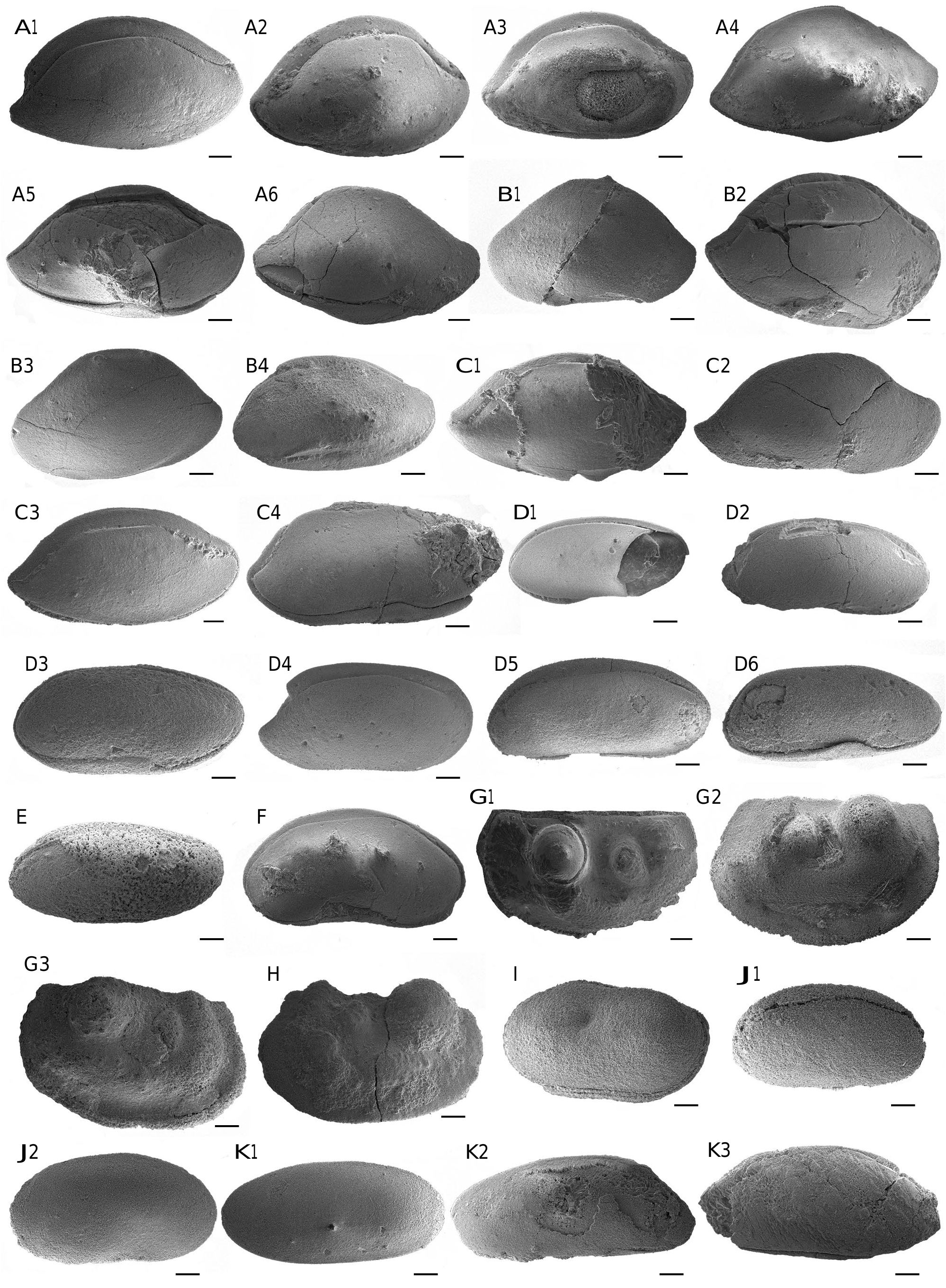
Ostracods, or ostracodes, are a class of the Crustacea (class Ostracoda), sometimes known as seed shrimp. Some 33,000 species (only 13,000 of which are extant) have been identified, grouped into 7 valid orders. They are small crustaceans, typically around in size, but varying from , the latter in the case of the marine Gigantocypris. The largest known freshwater species is Megalocypris princeps, which reach 8 mm in length. In most cases, their bodies are flattened from side to side and protected by a bivalve-like valve or "shell" made of chitin, and often calcium carbonate. The family Ent
Merostomata
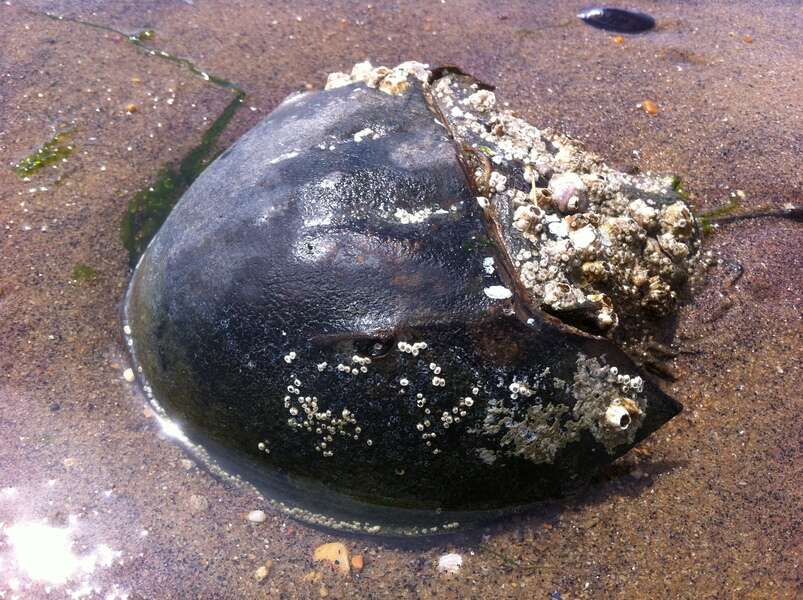
Merostomata is a class of chelicerate arthropods that contains the extinct Eurypterida (sea scorpions) and the extant Xiphosura (horseshoe crabs). The term was originally used by James Dwight Dana to refer to Xiphosura only, but was emended by Henry Woodward to cover both groups.
Teleostomi
Teleostomi (from Greek τελεος, complete + Greek στόμα, mouth) is an obsolete taxon of jawed vertebrates that supposedly includes the tetrapods, bony fish, and the wholly extinct acanthodian fish. Key characters of this group include an operculum and a single pair of respiratory openings, features which were lost or modified in some later representatives. The teleostomes include all jawed vertebrates except the chondrichthyans and the extinct class Placodermi.
Favosites
Favosites is an extinct genus of tabulate coral characterized by polygonal closely packed corallites (giving it the common name "honeycomb coral"). The walls between corallites are pierced by pores known as mural pores which allowed transfer of nutrients between polyps. Favosites, like many corals, thrived in warm sunlit seas, feeding by filtering microscopic plankton with their stinging tentacles and often forming part of reef complexes. The genus had a worldwide distribution from the Late Ordovician to Late Permian.
==Distribution==
Favosites had a vast distribution, and its fossils can be

Halysites
thumb|right|Thin-section view of Halysites corallum
Leonaspis
Leonaspis is a widespread genus of odontopleurid trilobite that lived from the Late Ordovician to the late Middle Devonian. Fossils of various species have been found on all continents except Antarctica.
Dalmanites
Dalmanites is a genus of trilobite in the order Phacopida. They lived from the Late Ordovician to Middle Devonian. It was named for the Swedish naturalist Johan Wilhelm Dalman.
Productida
Productida is an extinct order of brachiopods in the extinct class Strophomenata. Members of Productida first appeared during the Silurian. They represented the most abundant group of brachiopods during the Permian period, accounting for 45-70% of all species. The vast majority of species went extinct during the Permian-Triassic extinction event, though a handful survived into the Early Triassic. Many productids are covered in hollow tubular spines, which are characteristic of the group. A number of functions for the spines have been proposed, including as a defensive mechanism against predato
Chonetes
Chonetes is an extinct genus of brachiopods. It ranged from the Late Ordovician to the Middle Jurassic.
Homalonotus
Homalonotus is an extinct genus of trilobites in the order Phacopida. It contains several species, including H. armatus and H. roemeri. It is closely related to other trilobites such as Arduennella and Dipleura..
Proetidae
Proetidae is a family of proetid trilobites. The first species appeared in the Upper Ordovician, and the last genera survived until the Middle Permian. However, if the closely related family Phillipsiidae is actually a subfamily of Proetidae, then the proetids of Proetidae survive until the end of the Permian, where the last perish during the Permian–Triassic extinction event.
Pleurocystites
Pleurocystites (meaning rib bag or side bladder) is a genus of rhombiferan echinoderm (a cystoid) that lived in the Late Ordovician. Its fossils are known from Europe and North America. Pleurocystites grew to a height of 2 centimeters (3/4 of an inch) and fed on plankton.
Onychopterella
Onychopterella ( , from Ancient Greek: ὄνῠξ (ónyx), "claw", and πτερόν (pteron), "wing") is a genus of predatory eurypterid ("sea scorpion"), an extinct group of aquatic arthropods. Fossils of Onychopterella have been discovered in deposits from the Late Ordovician to the Late Silurian. The genus contains three species: O. kokomoensis, the type species, from the Early Pridoli epoch of Indiana; O. pumilus, from the Early Llandovery epoch of Illinois, both from the United States; and O. augusti, from the Late Hirnantian to Early Rhuddanian stages of South Africa.