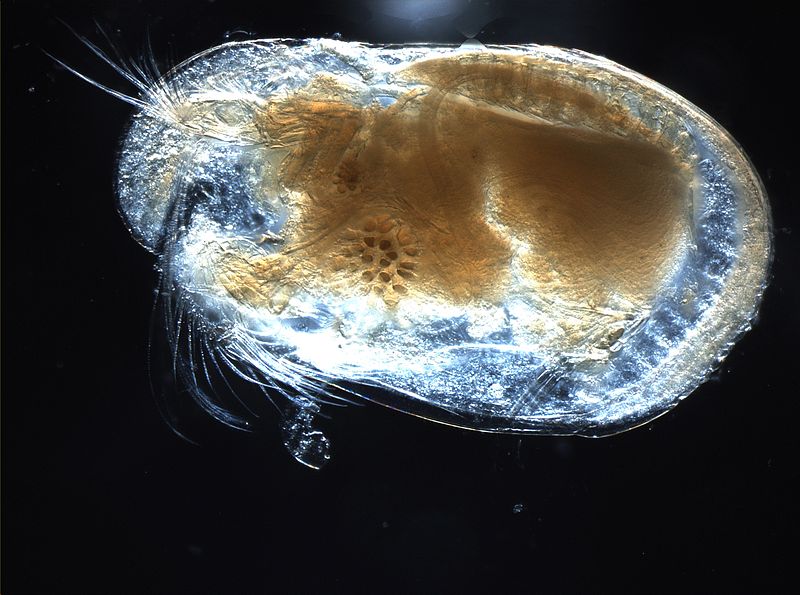
File:Ostracod.JPG · Wikimedia Commons · See Wikimedia Commons
Ostracoda
Sign in to saveOstracods, or ostracodes, are a class of the Crustacea (class Ostracoda), sometimes known as seed shrimp. Some 33,000 species (only 13,000 of which are extant) have been identified, grouped into 7 valid orders. They are small crustaceans, typically around in size, but varying from , the latter in the case of the marine Gigantocypris. The largest known freshwater species is Megalocypris princeps, which reach 8 mm in length. In most cases, their bodies are flattened from side to side and protected by a bivalve-like valve or "shell" made of chitin, and often calcium carbonate. The family Ent
OverviewAI-generated
Ostracoda is a class within the phylum Arthropoda and kingdom Animalia. It is a taxon under the parent taxa Crustacea and Oligostraca. The class was described by Latreille in 1806 and has an accepted status. Common names for the group include mussel shrimp, Mosselkreeftjes, muslingkreps, and черупкари. The organisms are found in marine, brackish, and freshwater habitats.
The class has existed for about 450 million years. Records of Ostracoda are held by institutions including USNM, NHMUK, and LACM, with specimens located in the United States, United Kingdom, and Israel. The subject is described in sources such as the Brockhaus and Efron Encyclopedic Dictionary and the Encyclopaedia Hebraica.
Synthesized by Vinony from 29 facts across 6 sources: Wikidata, GBIF, Gbif Occ, WoRMS, iDigBio, Vinony graph. Generated from structured data (not the Wikipedia text) and checked against those facts — may still contain errors.
Species
mussel shrimp
Ostracoda
CLASS
- KingdomAnimalia
- PhylumArthropoda
- ClassOstracoda
介形綱(學名:Ostracoda),在日語或參考自日語的文獻亦作貝虫綱或貝形虫綱,是甲殼亞門之下的一個綱級分類單元,其生物泛稱作介形蟲或种子虾。目前已辨識的介形蟲有約7萬個物種,當中只有約1.3萬個現生種,其餘5萬多個皆為化石種[1],可分類為多個目。介形蟲是一種小型的甲殻動物,一般約1 mm(0.039英寸)大小,但也有比較極端的巨海螢屬(英语:Gigantocypris)(Gigantocypris(英语:Gigantocypris))物種的尺寸變化從0.2至30 mm(0.008至1.181英寸)。 現今介形綱生物分佈廣泛,大部分為淡水與海水中的水生動物,也有部分品種為潮濕地帶的陸生動物[2]。 介形綱生物均為細小甲殼亞門生物,一般約1毫米(0.04英寸)大,但其大小的差異可以由0.2毫米(0.008英寸)到30毫米(1.2英寸)不等,當中以巨海螢(英语:Gigantocypris)的體型最大。 參考資料 ^ Richard C. Brusca & Gary J. Brusca. Invertebrates 2nd. Sinauer Associates(英语:Sinauer Associates). 2003. ISBN 978-0-87893-097-5. ^ J. D. Stout. The Terrestrial Plankton. Tuatara. 1963, 11 (2): 57–65. 取自“https://zh.wikipedia.org/w/index.php?title=介形綱&oldid=53159118” 分类: 甲殼亞門 介形綱 发光生物 隐藏分类: 物种微格式条目 含有拉丁語的條目 有蓝链却未移除内部链接助手模板的页面
via GBIF
Museum specimens
- Specimen records
- 24,947
- With media
- 3,120
- Collections
- USNM, NHMUK, LACM
- Recorded in
- United States, United Kingdom, Israel
Wikidata facts
- Instance of
- taxon
- Parent taxon
- Oligostraca
- Image
- Ostracoda.jpg
Show 6 more facts
- taxon rank
- class
- Commons category
- Ostracoda
- topic's main category
- Category:Ostracods
- taxon name
- Ostracoda
- taxon common name
- черупкари
- start time
- 450000000-
via Wikidata · CC0
~16 min read
Encyclopedic overview
14 sectionsContents
- Etymology
- Fossils
- Description
- Body parts
- Palaeoclimatic reconstruction
- Distribution
- Ecology
- Lifecycle
- Predators
- Bioluminescence
- Classification
- See also
- References
- External links
Ostracods, or ostracodes, are a class of the Crustacea (class Ostracoda), sometimes known as seed shrimp. Some 33,000 species (only 13,000 of which are extant) have been identified, grouped into 7 valid orders. They are small crustaceans, typically around in size, but varying from , the latter in the case of the marine Gigantocypris. The largest known freshwater species is Megalocypris princeps, which reach 8 mm in length. In most cases, their bodies are flattened from side to side and protected by a bivalve-like valve or "shell" made of chitin, and often calcium carbonate. The family Entocytheridae and many planktonic forms do not have calcium carbonate. The hinge of the two valves is in the upper (dorsal) region of the body. Ostracods are grouped together based on shell and soft part morphology, and molecular studies have not unequivocally supported the group's monophyly. They have a wide range of diets, and the class includes carnivores, herbivores, scavengers and filter feeders, but most ostracods are deposit feeders.
==Etymology== Ostracod comes from the Greek óstrakon meaning shell or tile.
Excerpted from Wikipedia’s “Ostracoda” article, available under the CC BY-SA 4.0 licence.